Sex After Menopause: Comfort, Desire, and Options
Dryness and pain have targeted treatments, while changes in desire may call for a broader look at what feels good to you.
After menopause, lower estrogen can reduce vaginal lubrication and tissue elasticity, which may make friction or penetration painful. Start by separating a comfort concern from a change in desire or a change in what intimacy means to you. Lubricants or moisturizers may help vaginal symptoms; persistent genitourinary symptoms have targeted treatment options, including low-dose vaginal estrogen, but that is not a universal treatment for desire. 2 3 4 5
Sex after menopause doesn’t have to follow one pattern, and there’s no requirement to be sexually active or to return to how things felt before. You might want less pain, more pleasure, a different kind of intimacy, or no change at all. It can help to name the concern first: is sex uncomfortable, has desire changed, or are your preferences different?
When comfort is the main concern
As estrogen declines, vaginal tissue can become less lubricated and less elastic. Those changes can make friction or penetration uncomfortable. Menopause-related vaginal symptoms are one possible contributor to sexual discomfort, not an explanation for every kind of pain. 5
Vaginal lubricants and moisturizers are nonprescription options that may ease vaginal symptoms. If those aren’t enough, menopause guidance recommends discussing low-dose vaginal estrogen or other targeted treatments for bothersome genitourinary symptoms. Vaginal estrogen works locally to help symptoms such as dryness and irritation; it isn’t a general treatment for every menopause symptom or every sexual concern. 1 2 3
It may take time to see the full effect of vaginal estrogen. One clinical reference says it can take up to three months; if symptoms remain bothersome, that’s a reason to revisit the plan rather than assume you have to live with them. 2
A systematic review of hormone therapy trials found that estrogen alone probably slightly improves overall sexual-function scores, particularly in lubrication, pain, and satisfaction. But the studies varied considerably, and sexual function was not the primary outcome in most of them. That finding supports treating a symptom such as painful dryness, not expecting estrogen to reliably restore desire or produce the same result for everyone. 4
When desire has changed
Desire doesn’t have a single cause. A review of sexual concerns around menopause describes possible contributions from physical changes, medication side effects, aging-related health changes, and psychosocial factors. That means it may be useful to consider what else has changed, rather than treating lower desire as proof that a hormone is missing. Don’t stop a prescribed medicine on your own; if you suspect a side effect, bring it up with the prescriber. 5
If dryness or pain is making intimacy something you anticipate with discomfort, addressing that symptom may help. If comfort is already okay but desire still feels different, vaginal estrogen may not answer your main question. There isn’t one treatment approach that fits every woman, so the useful next step depends on what you want to change. 4 5
Match the next step to your goal
- Dryness or friction: Try a vaginal lubricant or moisturizer, or ask about other options if symptoms persist. 2
- Ongoing menopause-related vaginal symptoms: Ask whether local vaginal estrogen or another targeted treatment is appropriate. Guidance also names vaginal dehydroepiandrosterone and oral ospemifene as options for some people with bothersome symptoms not relieved by over-the-counter treatments. 3
- Desire feels different: Consider physical, medication-related, and psychosocial factors alongside vaginal symptoms. 5
- Your definition of intimacy has changed: You can set goals around comfort and pleasure that suit you now; penetration or a return to a previous pattern doesn’t have to be the measure of success.
The most useful question may not be “How do I get back to normal?” but “What, if anything, would I like to feel different?” That answer can guide whether you focus on vaginal comfort, desire, another health factor, or simply making room for a different kind of intimacy.
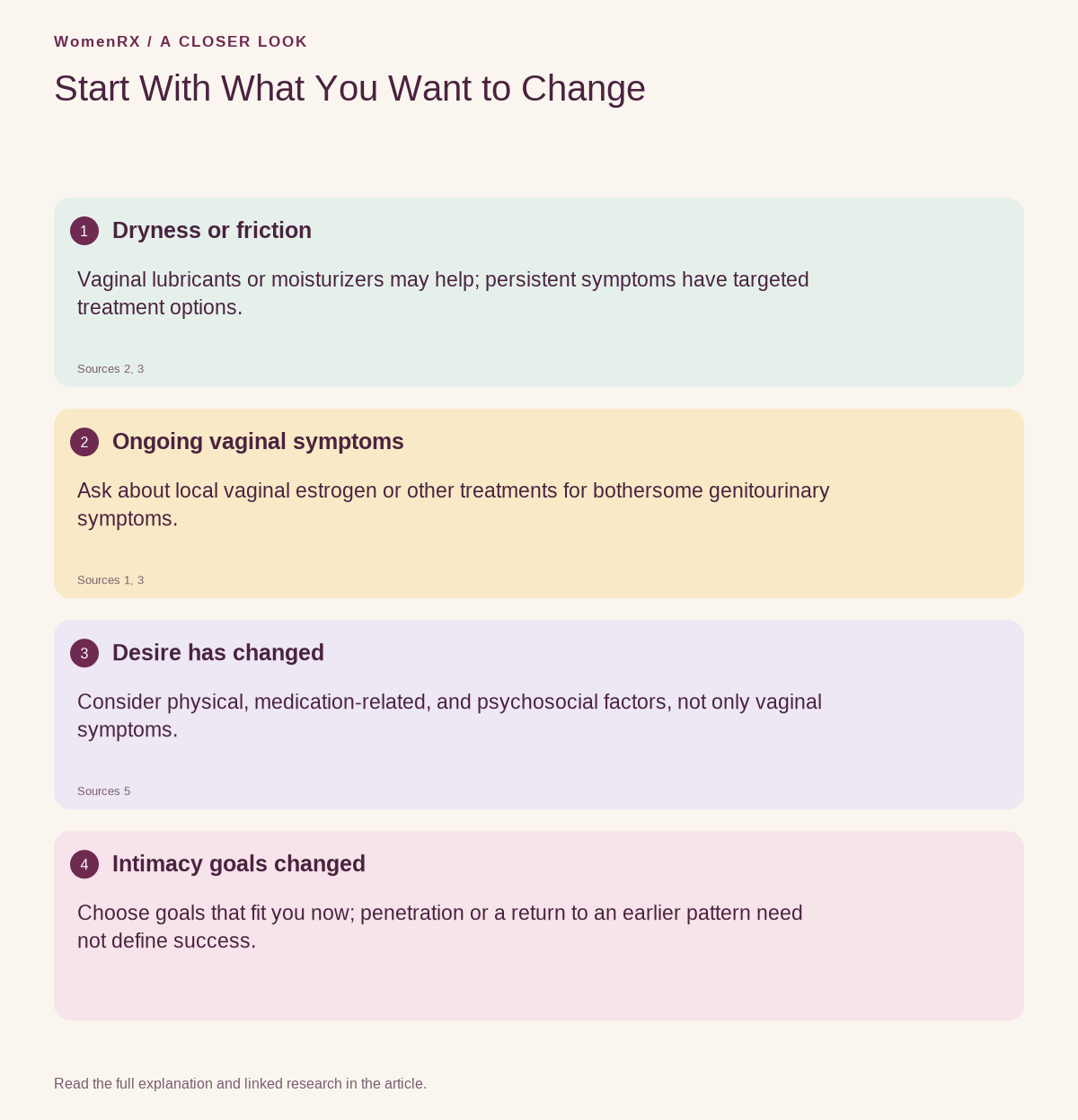
Start With What You Want to Change
Dryness or friction: Vaginal lubricants or moisturizers may help; persistent symptoms have targeted treatment options.23
Ongoing vaginal symptoms: Ask about local vaginal estrogen or other treatments for bothersome genitourinary symptoms.13
Desire has changed: Consider physical, medication-related, and psychosocial factors, not only vaginal symptoms.5
Intimacy goals changed: Choose goals that fit you now; penetration or a return to an earlier pattern need not define success.
Read the figure as text
A concern-based guide to distinguish vaginal comfort from desire and personal intimacy goals.- Dryness or friction: Vaginal lubricants or moisturizers may help; persistent symptoms have targeted treatment options.23
- Ongoing vaginal symptoms: Ask about local vaginal estrogen or other treatments for bothersome genitourinary symptoms.13
- Desire has changed: Consider physical, medication-related, and psychosocial factors, not only vaginal symptoms.5
- Intimacy goals changed: Choose goals that fit you now; penetration or a return to an earlier pattern need not define success.
Sources you can check
- About vaginal oestrogen - NHSAccessed 2026-09-25Return to first citation
- Common questions about vaginal oestrogen - NHSAccessed 2026-09-25Return to first citation
- The 2022 hormone therapy position statement of The North American Menopause Society.“The 2022 Hormone Therapy Position Statement of The North American Menopause Society” Advisory Panel. · Menopause (New York, N.Y.) · 2022Return to first citation
- Hormone therapy for sexual function in perimenopausal and postmenopausal women.Lara LA, Cartagena-Ramos D, Figueiredo JB, Rosa-E-Silva ACJ, Ferriani RA, Martins WP, Fuentealba-Torres M. · The Cochrane database of systematic reviews · 2023Return to first citation
- Practical aspects in the management of vaginal atrophy and sexual dysfunction in perimenopausal and postmenopausal women.Goldstein I, Alexander JL. · The journal of sexual medicine · 2005Return to first citation