If Flibanserin Isn’t Right, What Can You Discuss?
The next step depends on whether low desire is part of a broader health, medication, pain, mood, or relationship concern.
There isn’t one substitute for flibanserin that fits every situation. A useful discussion starts with what changed and what else is going on, including health conditions, medicines, distress, relationship context, or pain. Depending on the cause, the next step may be a medication review, care for mood or another health concern, or assessment of pain. For some premenopausal women with acquired, generalized HSDD, bremelanotide is another prescription option, not a like-for-like replacement. 12347
Low desire can be distressing, but it doesn’t automatically mean you have HSDD or need a desire medication. Flibanserin is indicated for women under 65 with acquired, generalized HSDD that causes marked distress or interpersonal difficulty and isn’t due to a co-existing medical or psychiatric condition, relationship problems, or a medication or other drug. That definition points toward the first useful question: what might be contributing to the change? 1
Start with what changed
Consider when the change began, whether it happens in all situations or only some, and whether it’s bothering you. A clinician may also ask about health conditions, medicines, mood, relationship concerns, and fear of an unplanned pregnancy. These are relevant parts of sexual health, not evidence that any one factor is the cause. 13
Life stage can help frame that conversation without deciding the answer in advance. For example, mention if the change began after childbirth or around menopause, and whether it has shifted over time. Timing is context to discuss, not a diagnosis or a reason to assume one treatment fits.
If a medicine or health condition may be involved
Some medicines can affect sexual desire or performance, and chronic conditions can affect sexual health. If the change coincided with starting or changing a medicine, bring that timing up. A medication review can focus on whether an effect is plausible and whether a change in your overall treatment is worth considering. If another health condition seems relevant, the discussion can focus on caring for that condition rather than adding a desire medication. 13
Mood deserves its own consideration. Antidepressants can help with diagnosed depression or anxiety, while some, including SSRIs and SNRIs, can reduce sex drive. If either mood symptoms or treatment seem relevant, discuss both the benefits and possible sexual side effects rather than treating low desire in isolation. That tradeoff may also matter if mood symptoms arose around menopause; a treatment for mood isn’t automatically a treatment for desire. 4
If pain or relationship context matters
Pain and desire aren’t interchangeable concerns. In analyses of flibanserin trials, changes in the sexual-function pain domain were smaller and largely not different from placebo. If sex hurts, make pain a separate focus of the visit so the discussion doesn’t rest on the expectation that a desire medication will resolve it. 7
Relationship problems were excluded as a cause in the population for which flibanserin is indicated. If desire differs by partner, situation, or type of stimulation, explain that pattern; it may point toward a discussion of what’s happening in those settings rather than low desire across settings. 1
When another prescription might be discussed
Bremelanotide is an option for some premenopausal women with acquired, generalized HSDD that causes distress and isn’t due to a medication or drug effect. It is a different medicine with different use and potential side effects, not an automatic substitute for flibanserin. In phase 3 studies, nausea was more common with bremelanotide than placebo and was the most common reason for stopping treatment. 25
That option has a narrower fit than “low desire” alone: the pattern, life stage, distress, and possible contributing factors all matter. If flibanserin didn’t help or wasn’t suitable, a useful next conversation is not just “what drug is next?” It’s whether another medicine fits, or whether a medication effect, mood concern, pain, or other health issue needs attention first. 12347
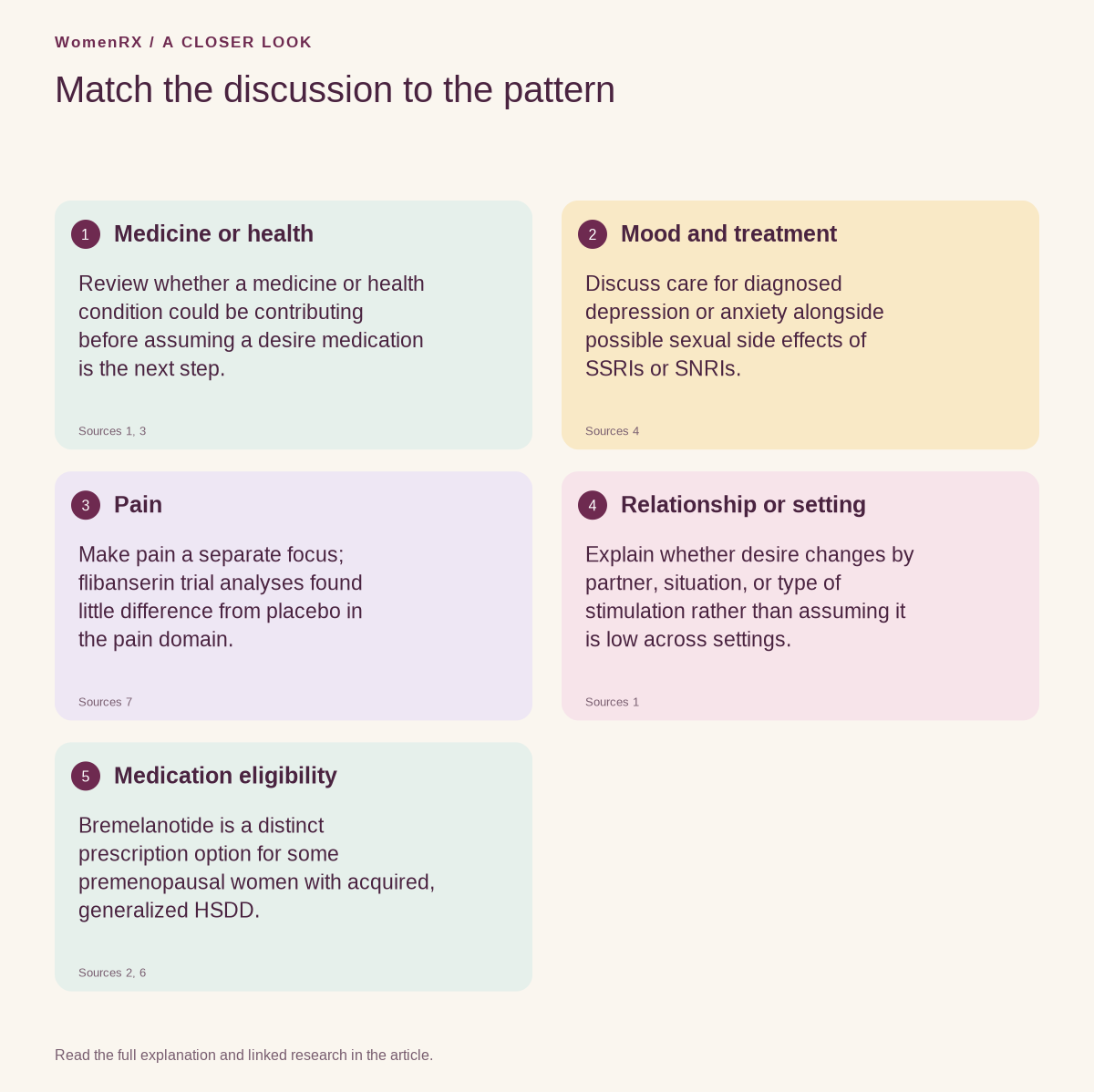
Match the discussion to the pattern
Medicine or health: Review whether a medicine or health condition could be contributing before assuming a desire medication is the next step.13
Mood and treatment: Discuss care for diagnosed depression or anxiety alongside possible sexual side effects of SSRIs or SNRIs.4
Pain: Make pain a separate focus; flibanserin trial analyses found little difference from placebo in the pain domain.7
Relationship or setting: Explain whether desire changes by partner, situation, or type of stimulation rather than assuming it is low across settings.1
Medication eligibility: Bremelanotide is a distinct prescription option for some premenopausal women with acquired, generalized HSDD.26
Read the figure as text
These paths organize possible next conversations; they don’t diagnose the cause or rank treatments.- Medicine or health: Review whether a medicine or health condition could be contributing before assuming a desire medication is the next step.13
- Mood and treatment: Discuss care for diagnosed depression or anxiety alongside possible sexual side effects of SSRIs or SNRIs.4
- Pain: Make pain a separate focus; flibanserin trial analyses found little difference from placebo in the pain domain.7
- Relationship or setting: Explain whether desire changes by partner, situation, or type of stimulation rather than assuming it is low across settings.1
- Medication eligibility: Bremelanotide is a distinct prescription option for some premenopausal women with acquired, generalized HSDD.26
More questions, answered
Is bremelanotide interchangeable with flibanserin?
No. They are distinct prescription medicines, and bremelanotide is indicated for some premenopausal women with acquired, generalized HSDD. Whether it fits depends on the individual situation; the medicines shouldn’t be assumed equivalent. 26
Can antidepressants affect desire?
Some can. SSRIs and SNRIs may reduce sex drive, although antidepressants can help when depression or anxiety is present. If both mood symptoms and medication effects may matter, discuss that tradeoff together. 4
Sources you can check
- ADDYI (FLIBANSERIN) TABLET, FILM COATED [SPROUT PHARMACEUTICALS, INC.] | US prescribing information and patient instructionsAccessed 2026-09-25Return to first citation
- VYLEESI (BREMELANOTIDE) INJECTION [COSETTE PHARMACEUTICALS, INC.] | US prescribing information and patient instructionsAccessed 2026-09-25Return to first citation
- Sexual Health | MedlinePlusAccessed 2026-09-25Return to first citation
- Other medicines for menopause symptoms - NHSAccessed 2026-09-25Return to first citation
- Safety Profile of Bremelanotide Across the Clinical Development Program.Clayton AH, Kingsberg SA, Portman D, Sadiq A, Krop J, Jordan R, Lucas J, Simon JA. · Journal of women's health (2002) · 2022Return to first citation
- Bremelanotide: First Approval.Dhillon S, Keam SJ. · Drugs · 2019Return to first citation
- Effects of Flibanserin on Subdomain Scores of the Female Sexual Function Index in Women With Hypoactive Sexual Desire Disorder.Simon JA, Clayton AH, Goldstein I, Kingsberg SA, Shapiro M, Patel S, Kim NN. · Sexual medicine · 2022Return to first citation