Bremelanotide for Low Desire: Who It’s For
Bremelanotide is intended for a specific kind of distressing low desire in premenopausal women, not as a general libido booster.
In the U.S., bremelanotide (Vyleesi) is indicated for premenopausal women with acquired, generalized hypoactive sexual desire disorder (HSDD) that causes marked distress or interpersonal difficulty and isn’t explained by a medical or psychiatric condition or a medication or drug. It’s an as-needed injection studied in this defined group. Uncontrolled high blood pressure and known cardiovascular disease rule it out under the labeling. 1
Low desire alone doesn’t define the condition
Bremelanotide, sold as Vyleesi, is intended for premenopausal women with acquired, generalized HSDD. The label describes “acquired” as desire problems that developed after a period without them, and “generalized” as a pattern that occurs regardless of the type of stimulation, situation, or partner. The low desire must cause marked distress or interpersonal difficulty, and not be due to a co-existing medical or psychiatric condition or the effects of a medication or drug. 1
That distinction matters: a change in desire isn’t automatically a disorder or a reason to take medication. For example, part of the assessment is whether a medication or co-existing medical condition explains the change in desire. 1 The label’s indication doesn’t cover every cause or experience of low libido.
What was studied, and what the results mean
The evidence behind the U.S. indication comes from two 24-week randomized, placebo-controlled trials involving 1,247 premenopausal women with acquired, generalized HSDD. Participants had experienced the condition for at least six months. Their average age was 39, and the age range was 19 to 56. The trials included a later 52-week extension without a control group, so that extension can’t make the same placebo comparison as the first 24 weeks. 1
On a desire questionnaire scored from 1.2 to 6, average desire scores rose by 0.5 versus 0.2 points in one trial, and by 0.6 versus 0.2 in the other, for Vyleesi and placebo respectively. The difference favored Vyleesi, but the averages also show that improvement was not unique to the medication. The trials also found a statistically significant improvement in a measure of desire-related distress compared with placebo. 1
These findings apply to the premenopausal women studied, not automatically to postmenopausal women. Vyleesi’s U.S. indication is for premenopausal women, and these trials don’t establish its benefit for postmenopausal use. 1
How it’s used
In the trials, women self-administered a 1.75 mg dose under the skin with an autoinjector, as needed, approximately 45 minutes before anticipated sexual activity. They were instructed not to use more than one dose in 24 hours or more than 12 doses in a month. Most trial participants used it two or three times a month, and no more than once a week. Those study instructions aren’t a reason to start it or adjust its use without a prescription and directions from the prescriber. 1
A practical discussion is whether an as-needed injection fits your circumstances and what you would count as a meaningful change. The trials measured both desire and distress, so it can be useful to consider whether either has improved, rather than treating “more desire” as the only possible measure of benefit. 1
Safety questions that affect candidacy
The label contraindicates Vyleesi for people with uncontrolled high blood pressure or known cardiovascular disease. It also says the medicine isn’t recommended for people at high risk for cardiovascular disease. Before treatment, and periodically during it, the label advises considering cardiovascular risk and ensuring blood pressure is well controlled. It warns that taking more than one dose within 24 hours can make blood pressure effects more pronounced. 1
In the two 24-week trials, serious adverse reactions were reported in 1.1% of participants receiving Vyleesi and 0.5% receiving placebo. Those figures describe the trial groups, not your individual risk. 1
Ask how your blood pressure and cardiovascular history affect whether this medicine is appropriate for you. Also bring up prescription medicines, nonprescription drugs, and health conditions that might help explain the change in desire; the indication excludes low desire due to a medication or drug or a co-existing medical or psychiatric condition. 12 Before choosing an as-needed injection, ask which adverse effects to watch for and what to do if they occur.
A focused conversation
You might ask:
- Does my experience fit the labeled pattern of acquired, generalized HSDD, including the distress or relationship difficulty it requires?
- Could a health condition or medicine be contributing to my change in desire?
- Do my blood pressure or cardiovascular risks make bremelanotide unsuitable?
- If we try it, when will we review whether desire or distress has changed, and what should I do if it hasn’t?
The point isn’t to qualify for a specific drug at all costs. It’s to identify what may be affecting desire, then decide whether the studied use, expected benefit, safety considerations, and as-needed injection approach fit your situation.
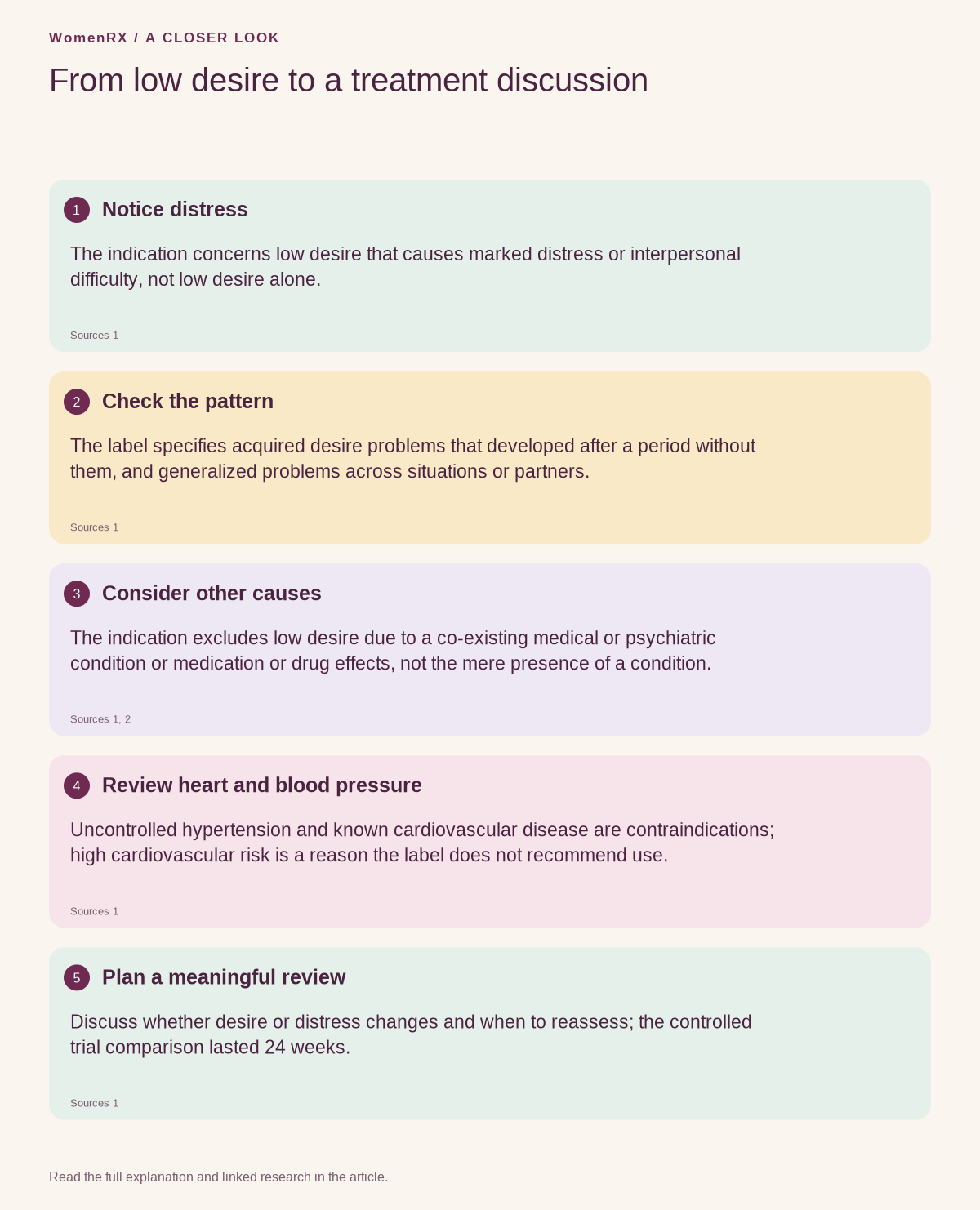
From low desire to a treatment discussion
Notice distress: The indication concerns low desire that causes marked distress or interpersonal difficulty, not low desire alone.1
Check the pattern: The label specifies acquired desire problems that developed after a period without them, and generalized problems across situations or partners.1
Consider other causes: The indication excludes low desire due to a co-existing medical or psychiatric condition or medication or drug effects, not the mere presence of a condition.12
Review heart and blood pressure: Uncontrolled hypertension and known cardiovascular disease are contraindications; high cardiovascular risk is a reason the label does not recommend use.1
Plan a meaningful review: Discuss whether desire or distress changes and when to reassess; the controlled trial comparison lasted 24 weeks.1
Read the figure as text
A path from the experience of low desire to the questions that shape whether bremelanotide fits the labeled use.- Notice distress: The indication concerns low desire that causes marked distress or interpersonal difficulty, not low desire alone.1
- Check the pattern: The label specifies acquired desire problems that developed after a period without them, and generalized problems across situations or partners.1
- Consider other causes: The indication excludes low desire due to a co-existing medical or psychiatric condition or medication or drug effects, not the mere presence of a condition.12
- Review heart and blood pressure: Uncontrolled hypertension and known cardiovascular disease are contraindications; high cardiovascular risk is a reason the label does not recommend use.1
- Plan a meaningful review: Discuss whether desire or distress changes and when to reassess; the controlled trial comparison lasted 24 weeks.1
More questions, answered
Is bremelanotide intended for postmenopausal women?
The U.S. indication and the cited efficacy trials are for premenopausal women. This evidence doesn’t establish benefit for postmenopausal use. 1
Is it meant to increase desire in anyone who wants more libido?
No. The indication is for a defined pattern of low desire that causes marked distress or interpersonal difficulty and isn’t explained by a co-existing medical or psychiatric condition or by a medication or drug. 1