Bremelanotide vs Flibanserin: Different Fits for Low Desire
Vyleesi is an as-needed injection and Addyi is a daily bedtime tablet, with different eligibility and safety tradeoffs.
Bremelanotide (Vyleesi) is an as-needed injection for premenopausal women with acquired, generalized hypoactive sexual desire disorder (HSDD). Flibanserin (Addyi) is a daily bedtime tablet indicated for women younger than 65 with the same condition, including women after menopause. Vyleesi’s main cautions include nausea and blood-pressure increases; Addyi’s include sleepiness, fainting risk, and interactions with alcohol and certain medicines. Separate trials don’t establish which works better.123
If low desire is bothering you, these medicines can sound like two ways to solve the same problem. They aren’t interchangeable. Bremelanotide and flibanserin have different use patterns, adverse effects, and prescribing considerations. Both are intended for acquired, generalized HSDD: desire that became low after previously being satisfactory, remains low across situations or partners, and causes distress or interpersonal difficulty. Their labels exclude low desire attributed to a medical or psychiatric condition, relationship problems, or a medicine or other drug substance.12
An occasional injection or a nightly tablet
Vyleesi is a self-administered injection used as needed before anticipated sexual activity. Its label says to use it at least 45 minutes beforehand, no more than once in 24 hours; more than eight doses a month is not recommended. The duration of effect after a dose is unknown, so that 45-minute timing isn’t a promise of when or how long you’ll feel a change. Addyi is a tablet taken every night at bedtime, not just on nights when you anticipate sex. Bedtime use matters because taking it during waking hours increases the risks of low blood pressure, fainting, injury, and sedation. Both labels say to stop treatment after eight weeks if symptoms haven’t improved.12
That’s a practical difference. An as-needed injection requires anticipating sex and being comfortable with an autoinjector. A nightly tablet avoids injections but makes treatment, and its interaction precautions, part of your everyday routine. Neither pattern tells you which medicine will help you more.123
What the trials measured, and what they didn’t settle
In two 24-week placebo-controlled trials in premenopausal women with acquired, generalized HSDD, Vyleesi improved reported desire and bother about low desire more than placebo. It did not significantly improve the number of satisfying sexual events compared with placebo in those trials. That distinction matters if you’re hoping for a particular change in your sex life rather than simply a higher desire score.1
Addyi also showed benefits against placebo, but its trial results need a closer look. In three 24-week trials of premenopausal women with acquired, generalized HSDD, women taking Addyi reported greater increases in satisfying sexual events than women taking placebo. For example, in one trial the mean change from baseline at week 24 was 1.6 versus 0.8 satisfying events per 28 days. The desire findings depended on how desire was measured: two trials found no statistically significant difference on a daily-diary desire measure, while a third found an improvement on a questionnaire about desire over the past four weeks. The label also reports improvement on a question about feeling bothered by low desire.2
For naturally postmenopausal women younger than 65, one 24-week placebo-controlled Addyi trial found improvements in satisfying sexual events, reported desire, and bother about low desire. That extends the evidence beyond the premenopausal population, but the trial excluded women with several significant medical conditions and those taking other medicines. Its results may not describe what happens for every woman after menopause.2
Trials of these medicines have generally compared each with placebo, not directly with the other medicine. A systematic review of completed registered trials found differences in outcome measures and reporting that limit comparisons across studies. Vyleesi’s lack of a significant effect on satisfying-event counts in its trials, alongside Addyi’s positive results on that measure, does not establish that Addyi works better: they weren’t tested against each other under the same conditions.123
Bremelanotide: nausea and blood pressure deserve attention
Nausea, flushing, injection-site reactions, and headache were among the most commonly reported adverse reactions with Vyleesi. In its placebo-controlled trials, nausea was reported by 40% of Vyleesi-treated participants and about 1% of placebo-treated participants. Adverse reactions led 18% taking Vyleesi to stop study treatment, compared with 2% taking placebo; nausea accounted for discontinuation in 8% taking Vyleesi. That 8% counts those who stopped because of nausea, not everyone who experienced it.1
Vyleesi can also temporarily raise blood pressure and lower heart rate after a dose. It is contraindicated for people with uncontrolled high blood pressure or known cardiovascular disease, and its label does not recommend it for people at high cardiovascular risk. If blood pressure or heart health is part of your medical history, that may matter more than whether you prefer an injection or tablet.1
Focal skin darkening, including on the face, gums, or breasts, is another consideration. It was reported in 1% of Vyleesi-treated participants using up to eight doses a month in the placebo-controlled trials. The label says it is more likely in people with darker skin and may not fully resolve after stopping. It also advises effective contraception during treatment and stopping Vyleesi if pregnancy is suspected because human pregnancy data are too limited to establish its safety.1
Vyleesi can slow stomach emptying and affect how some oral medicines are absorbed. Its label specifically says to avoid combining it with oral naltrexone products used to treat alcohol or opioid addiction because naltrexone exposure may fall enough to jeopardize treatment.1
Flibanserin: bedtime use doesn’t remove interaction risks
Addyi’s nightly pattern comes with a different set of cautions. In five 24-week placebo-controlled trials of premenopausal women with HSDD, sleepiness, sedation, or fatigue occurred in 21% taking Addyi and 8% taking placebo. Its label says sedation risk increases with alcohol, other sedating drugs, or medicines that raise flibanserin levels.2
Low blood pressure and fainting are also concerns. Addyi is contraindicated for people with any degree of liver impairment and with medicines that moderately or strongly inhibit an enzyme called CYP3A4. Fluconazole is one example: in an interaction study, low blood pressure or fainting that required participants to lie down occurred in 3 of 15 people taking it with Addyi, and the study was stopped. An occasional prescription can therefore be relevant to the decision, not just a medicine you take every day.2
Alcohol matters with Addyi, too. Because of the risk of low blood pressure and fainting, its label calls for at least two hours between one or two standard drinks and the bedtime tablet, and for skipping the tablet after three or more drinks that evening. It also advises avoiding alcohol until the following day after taking Addyi. If drinking is sometimes part of your evening, those restrictions can affect whether a daily tablet fits your routine.2
Menopause changes which option is labeled for you
Vyleesi is indicated for premenopausal women with acquired, generalized HSDD; it is not indicated after menopause. Addyi is indicated for women younger than 65 with that condition, and its label describes placebo-controlled trials in both premenopausal and naturally postmenopausal women. Neither label presents these medicines as treatments to enhance sexual performance.12
Low desire can have more than one contributing factor. Stress, relationship concerns, and psychological factors can be relevant, and clinical reviews discuss approaches such as sex therapy and couples therapy alongside medication. That doesn’t make distressing low desire less real. It means the choice isn’t necessarily limited to one prescription versus the other.45
The most useful comparison is personal but concrete: Does an anticipated-sex injection or a nightly tablet fit better? Do cardiovascular health, pregnancy plans, or oral naltrexone complicate Vyleesi? Do liver health, alcohol, sedating drugs, or an interacting prescription complicate Addyi? And what change in desire or distress would make treatment worthwhile to you? Those questions help separate a workable option from one that only sounds convenient on paper.12
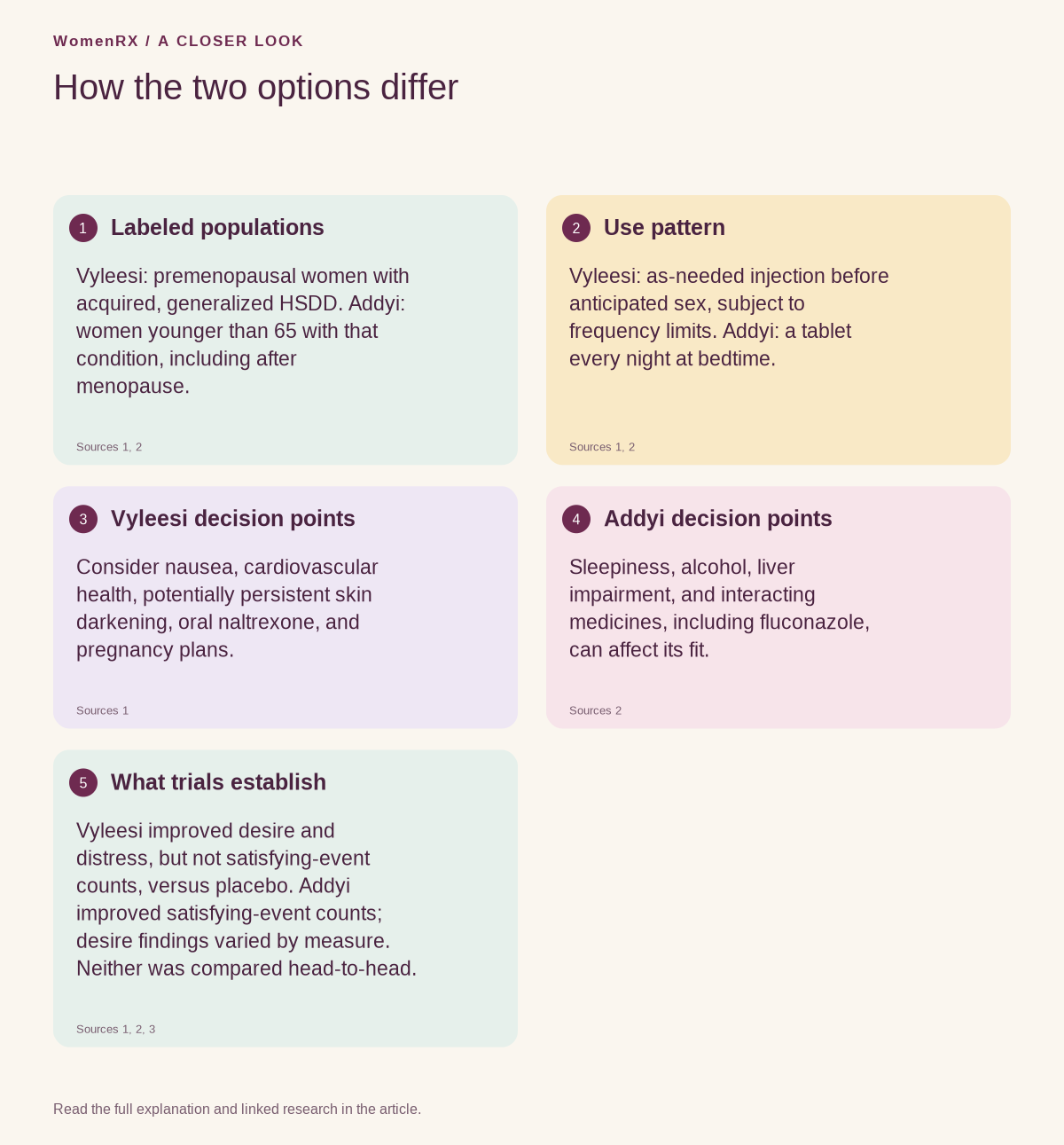
How the two options differ
Labeled populations: Vyleesi: premenopausal women with acquired, generalized HSDD. Addyi: women younger than 65 with that condition, including after menopause.12
Use pattern: Vyleesi: as-needed injection before anticipated sex, subject to frequency limits. Addyi: a tablet every night at bedtime.12
Vyleesi decision points: Consider nausea, cardiovascular health, potentially persistent skin darkening, oral naltrexone, and pregnancy plans.1
Addyi decision points: Sleepiness, alcohol, liver impairment, and interacting medicines, including fluconazole, can affect its fit.2
What trials establish: Vyleesi improved desire and distress, but not satisfying-event counts, versus placebo. Addyi improved satisfying-event counts; desire findings varied by measure. Neither was compared head-to-head.123
Read the figure as text
Compare the features most likely to affect eligibility and day-to-day fit, without treating separate trials as a contest.- Labeled populations: Vyleesi: premenopausal women with acquired, generalized HSDD. Addyi: women younger than 65 with that condition, including after menopause.12
- Use pattern: Vyleesi: as-needed injection before anticipated sex, subject to frequency limits. Addyi: a tablet every night at bedtime.12
- Vyleesi decision points: Consider nausea, cardiovascular health, potentially persistent skin darkening, oral naltrexone, and pregnancy plans.1
- Addyi decision points: Sleepiness, alcohol, liver impairment, and interacting medicines, including fluconazole, can affect its fit.2
- What trials establish: Vyleesi improved desire and distress, but not satisfying-event counts, versus placebo. Addyi improved satisfying-event counts; desire findings varied by measure. Neither was compared head-to-head.123
More questions, answered
Does either medicine have proof it works better than the other?
No head-to-head result is established by the trials summarized in a 2026 systematic review. Each medicine showed benefits against placebo on some measures, but differences in trial populations, outcomes, and reporting mean those results cannot rank the two medicines.123
Sources you can check
- VYLEESI (BREMELANOTIDE) INJECTION [COSETTE PHARMACEUTICALS, INC.] | US prescribing information and patient instructionsAccessed 2026-09-25Return to first citation
- ADDYI (FLIBANSERIN) TABLET, FILM COATED [SPROUT PHARMACEUTICALS, INC.] | US prescribing information and patient instructionsAccessed 2026-09-25Return to first citation
- Clinical trial evidence on emerging pharmacological therapies for hypoactive sexual desire disorder in women: a systematic review and analysis of completed studies registered on ClinicalTrials.gov.Ashour AM. · Frontiers in medicine · 2026Return to first citation
- Understanding Hypoactive Sexual Desire Disorder (HSDD) in Women: Etiology, Diagnosis, and Treatment.Ronghe V, Pannase K, Gomase KP, Mahakalkar MG. · Cureus · 2023Return to first citation
- What Women Want? The State of the Art regarding the Treatment of Young Women with Hypoactive Sexual Desire Disorder.de Oliveira L, Vignozzi L, Giraldi A, Varod S, Corona G, Reisman Y. · Pharmacology · 2024Return to first citation