PT-141 for Low Desire: What the Evidence Actually Covers
Bremelanotide has trial evidence and a US-approved product for a specific group of premenopausal women, but a product’s PT-141 label alone doesn’t show that it is the same medicine.
Vyleesi is a US-approved injection containing bremelanotide for premenopausal women with acquired, generalized hypoactive sexual desire disorder (HSDD) that causes marked distress or interpersonal difficulty. Its indication excludes low desire due to a co-existing medical or psychiatric condition, among other limits. The trials don’t establish that a product labeled PT-141 has the same contents or safety. 1 5
A product name doesn’t identify its contents
The product-specific evidence here concerns Vyleesi, an injection containing bremelanotide. A product advertised online as “PT-141” isn’t shown to be Vyleesi, to contain the same substance or amount, or to meet the same product standards just because it uses that name. A marketing name alone can’t settle what a particular product is. 1
That distinction matters when judging claims. Evidence that a particular medicine was tested does not automatically support claims about every product marketed with a related name. The trials also don’t establish that an online product has been reviewed or approved for use.
Who the treatment was studied and approved for
Vyleesi’s US indication is narrow: it covers premenopausal women with acquired, generalized HSDD that causes marked distress or interpersonal difficulty. It excludes low desire due to a co-existing medical or psychiatric condition, but that isn’t a complete list of the indication’s limits. Low desire by itself isn’t the full description of the condition addressed by the indication. 1
The two main phase 3 trials enrolled premenopausal women with HSDD and compared bremelanotide with placebo for 24 weeks. Of 1,267 women randomized, 1,247 were included in the safety population and 1,202 in the efficacy population. The participants’ mean age was 39, and most were White and enrolled at US sites. 5
Those results should not be treated as evidence for every woman with low desire. In particular, the approved indication and the pivotal trials described here concern premenopausal women. They don’t establish effectiveness for postmenopausal women, or for low desire arising from a different cause. Age-subgroup findings within the trials don’t erase that population limit. 1 4 5
What the trials found, and what that means
In the phase 3 trials, bremelanotide produced statistically significant improvements compared with placebo in measures of sexual desire and distress related to low desire. In the combined analysis, the between-group difference in change from baseline was 0.35 points on the Female Sexual Function Index desire domain and -0.33 points on the distress measure. These are changes on questionnaire scales, not a promise that every person will notice a meaningful improvement. 5
That distinction helps put “effective” in context: the trials found an average difference on specific measures in a selected group of premenopausal women with diagnosed HSDD. They don’t show that the medicine will restore desire for everyone, or that it addresses relationship, health, mood, or other factors that may affect desire. The trial results support the studied indication, not a general claim that bremelanotide is a remedy for low libido. 1 5
Safety questions are product- and person-specific
Nausea was the most common adverse effect in the phase 3 trials: it occurred in 40.0% of participants receiving bremelanotide and 1.3% receiving placebo. Flushing occurred in 20.3% versus 1.3%, and headache in 11.3% versus 1.9%. These figures come from the integrated double-blind phase 3 study population, not from every possible product sold as PT-141. 2
A safety review also reported small, temporary increases in blood pressure during monitoring. The authors advised caution for people at risk of cardiovascular disease and said blood pressure should be well controlled during treatment. Those findings matter when considering whether the studied medicine is suitable; they aren’t a reason to assume the same risk profile for a product whose contents or source are unknown. 2
A small phase 1 study tested a single intranasal dose with or without alcohol in 24 healthy adults, 12 women and 12 men. That study cannot establish general alcohol safety for the approved injection or settle risks for other products: it used a different route and dose, included a small, mixed-sex group, and assessed a limited exposure. 3
Questions that separate evidence from marketing
If you’re evaluating a claim or discussing treatment, ask:
- Does the claim concern the specific approved Vyleesi injection, or a product described as PT-141?
- Is the claimed use for a premenopausal woman with acquired, generalized HSDD and associated distress, the population addressed by the indication?
- What evidence supports the exact product, route, and claimed use, rather than bremelanotide as a compound in a different study?
- What safety effects, including nausea and blood-pressure changes, matter for your circumstances?
The central point is simple: research on bremelanotide is real, but its boundaries matter. A study of one formulation and population doesn’t certify a differently marketed product or answer whether the treatment fits an individual’s situation.
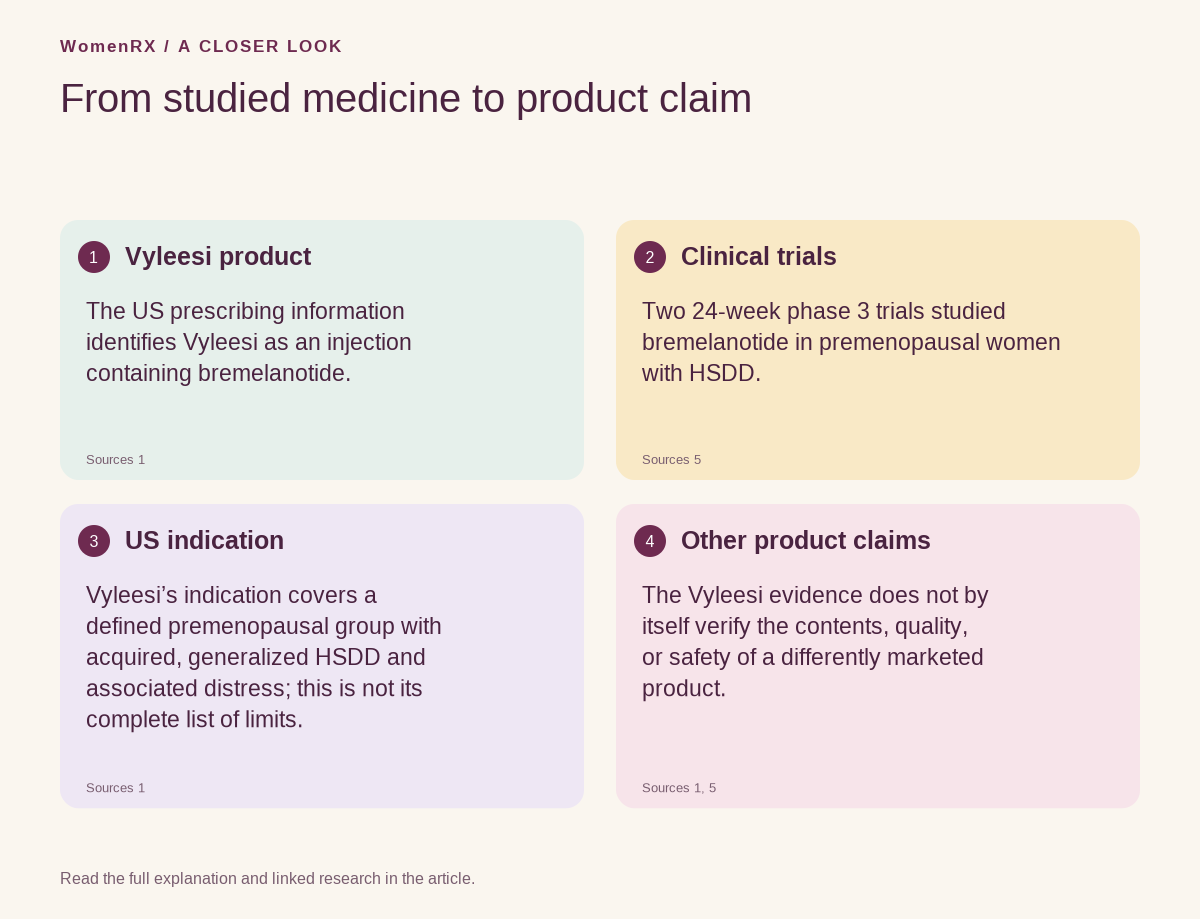
From studied medicine to product claim
Vyleesi product: The US prescribing information identifies Vyleesi as an injection containing bremelanotide.1
Clinical trials: Two 24-week phase 3 trials studied bremelanotide in premenopausal women with HSDD.5
US indication: Vyleesi’s indication covers a defined premenopausal group with acquired, generalized HSDD and associated distress; this is not its complete list of limits.1
Other product claims: The Vyleesi evidence does not by itself verify the contents, quality, or safety of a differently marketed product.15
Read the figure as text
These are different evidence steps. Evidence for the approved injection does not automatically verify another product marketed using the PT-141 name.- Vyleesi product: The US prescribing information identifies Vyleesi as an injection containing bremelanotide.1
- Clinical trials: Two 24-week phase 3 trials studied bremelanotide in premenopausal women with HSDD.5
- US indication: Vyleesi’s indication covers a defined premenopausal group with acquired, generalized HSDD and associated distress; this is not its complete list of limits.1
- Other product claims: The Vyleesi evidence does not by itself verify the contents, quality, or safety of a differently marketed product.15
More questions, answered
Does a PT-141 label establish that a product is Vyleesi?
No. Vyleesi is a specific injection containing bremelanotide, and its clinical evidence concerns that product and the populations studied. A PT-141 label alone doesn’t establish a product’s contents or show that it has the same evidence. 1 5
Does the evidence apply after menopause?
The US indication and pivotal trials described here concern premenopausal women. They don’t establish that bremelanotide is effective for postmenopausal women. 1 5
Sources you can check
- VYLEESI (BREMELANOTIDE) INJECTION [COSETTE PHARMACEUTICALS, INC.] | US prescribing information and patient instructionsAccessed 2026-09-25Return to first citation
- Safety Profile of Bremelanotide Across the Clinical Development Program.Clayton AH, Kingsberg SA, Portman D, Sadiq A, Krop J, Jordan R, Lucas J, Simon JA. · Journal of women's health (2002) · 2022Return to first citation
- Phase I Randomized Placebo-controlled, Double-blind Study of the Safety and Tolerability of Bremelanotide Coadministered With Ethanol in Healthy Male and Female Participants.Clayton AH, Lucas J, DeRogatis LR, Jordan R. · Clinical therapeutics · 2017Return to first citation
- Prespecified and Integrated Subgroup Analyses from the RECONNECT Phase 3 Studies of Bremelanotide.Simon JA, Kingsberg SA, Portman D, Jordan R, Lucas J, Sadiq A, Krop J, Clayton AH. · Journal of women's health (2002) · 2022Return to first citation
- Bremelanotide for the Treatment of Hypoactive Sexual Desire Disorder: Two Randomized Phase 3 Trials.Kingsberg SA, Clayton AH, Portman D, Williams LA, Krop J, Jordan R, Lucas J, Simon JA. · Obstetrics and gynecology · 2019Return to first citation