Low Desire: Options Beyond Bremelanotide
The best next step depends on what’s behind the change: structured therapy, a review of possible contributors, and prescription treatment address different needs.
Bremelanotide is one option for a specific group: premenopausal women with acquired, generalized low desire that causes distress and isn’t due to a medical or psychiatric condition or medication. Other approaches aren’t interchangeable with it. Mindfulness-based programs have encouraging but variable findings, especially in menopausal women; testosterone has evidence for some postmenopausal women with distressing low desire. 1 3 4
First, what kind of help are you looking for?
Low desire can be upsetting, but a treatment aimed at desire itself may not address the whole reason it’s happening. Medicines and chronic conditions can affect sexual health, and Vyleesi’s prescribing information specifically excludes low desire caused by a co-existing condition or medication from its indicated use. That makes the distinction useful: is the concern persistent low desire that causes distress, or might another health factor be part of the picture? 1 2
Pain with sex or menopausal symptoms are also worth mentioning if they’re part of your experience. Neither should be assumed to explain a change in desire, but separating these concerns can help clarify what kind of help you need. Research on mindfulness-based approaches in menopausal women has measured desire, distress, and other aspects of sexual function separately. 4 6
A review of those possible contributors is not a promise that one cause will be found. It can help determine whether a treatment for low desire fits the situation, or whether another concern deserves attention first.
What the different options can offer
Mindfulness-based therapy: a structured behavioral approach
Mindfulness-based programs aim to help people relate differently to sexual thoughts, sensations, and distress. A systematic review of seven randomized trials involving 609 menopausal women reported improvements in desire, arousal, and sexual distress, but results for overall sexual function varied. The programs and measures differed across studies, so this is encouraging evidence, not a guarantee that a particular class, app, or practice will help you. 4
A broader systematic review also found some evidence for mindfulness-based treatments in female desire or arousal difficulties, while noting that evidence varies across sexual concerns. 6 This makes structured therapy a reasonable option to explore when distress or patterns of attention and response feel central, without treating it as a substitute for evaluating other contributors. The reported benefits don’t establish that every program is suitable for you or free of downsides; you can ask what a program involves before committing to it.
Online CBT: promising, but early evidence
Cognitive behavioral therapy (CBT) works with patterns of thought and behavior. In one feasibility study, 11 women with Sexual Interest/Arousal Disorder completed a self-guided online CBT program. Participants reported improvements before and after the program, but the small study was designed to assess feasibility, not establish how well online CBT works compared with other care. 5
If you’re considering an online program, the useful distinction is between a tested intervention and general wellness content that happens to use words like “therapy” or “mindfulness.” The findings from one small program don’t establish that all self-guided options have the same effects. Nor can that feasibility study settle which women are best served by a self-guided program rather than care that also addresses pain, symptoms, or a possible medication effect. 5
Medical review and prescription treatments
A clinician can help sort out whether a medical condition or medication may be contributing, both of which are relevant to the Vyleesi indication. MedlinePlus lists medicines and chronic diseases among factors that can affect sexual health. 1 2 If you suspect a medication is involved, bring up the concern with the person who prescribes it rather than changing it on your own. Mention pain with sex or menopausal symptoms too, if either applies; they deserve attention in their own right, not an automatic label of low-desire disorder. 4 6
Vyleesi is indicated for premenopausal women with acquired, generalized HSDD that causes marked distress or interpersonal difficulty, when the low desire is not due to a co-existing medical or psychiatric condition or a medication. It is not a general-purpose treatment for every change in desire. 1 Its prescribing information also describes nausea and blood-pressure effects as safety considerations. Those tradeoffs belong in a treatment discussion, not in a comparison that treats a prescription injection and a behavioral program as equivalent choices. 1
For postmenopausal women with low desire causing substantial personal concern, a review reports that clinical trials have consistently found benefits of testosterone therapy on several aspects of sexual function. That evidence applies to this specific population and concern; it doesn’t establish benefits for every woman or every kind of sexual difficulty. 3 This is a medical-treatment discussion, not a reason to self-treat with a product marketed as testosterone. The review’s summary of benefit does not, by itself, settle an individual woman’s safety tradeoffs. 3
Where nonprescription approaches fit
A nonprescription approach may feel more accessible, but “natural” does not tell you whether an option is effective for your concern or safe for you. Research on structured behavioral programs cannot establish that a supplement works as an alternative to bremelanotide. Treat supplement claims as a separate question requiring evidence about the specific ingredient and product, not as equivalent to evidence for a studied treatment.
A practical comparison is to ask what the option is meant to address, who it was studied in, and whether the outcome was desire, distress, or overall sexual function. Those are related, but they aren’t the same result. If low desire is distressing, or you think a condition or medication may be involved, a clinical review can help you choose among these different paths rather than relying on a product label alone. 1 2
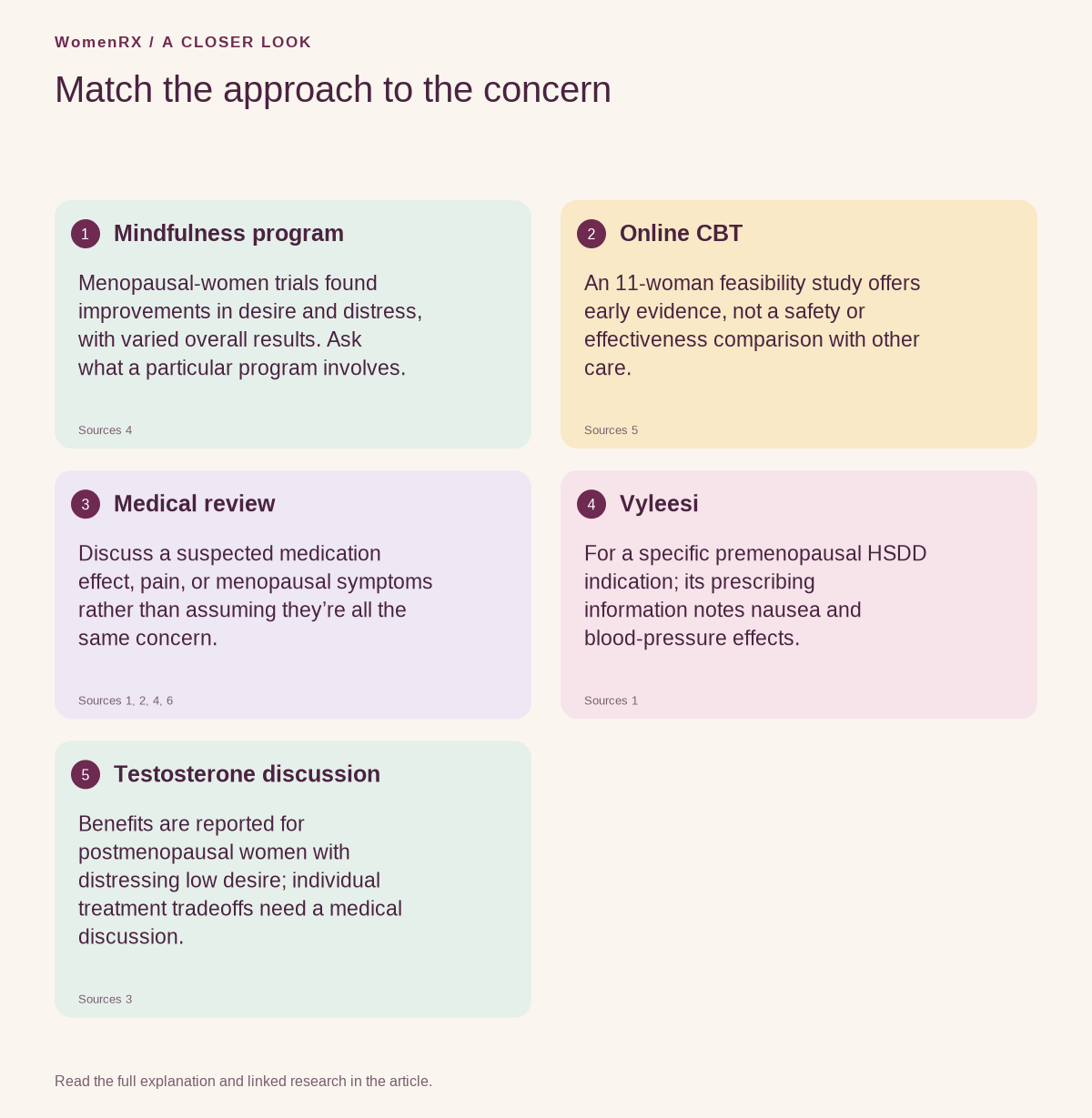
Match the approach to the concern
Mindfulness program: Menopausal-women trials found improvements in desire and distress, with varied overall results. Ask what a particular program involves.4
Online CBT: An 11-woman feasibility study offers early evidence, not a safety or effectiveness comparison with other care.5
Medical review: Discuss a suspected medication effect, pain, or menopausal symptoms rather than assuming they’re all the same concern.1246
Vyleesi: For a specific premenopausal HSDD indication; its prescribing information notes nausea and blood-pressure effects.1
Testosterone discussion: Benefits are reported for postmenopausal women with distressing low desire; individual treatment tradeoffs need a medical discussion.3
Read the figure as text
These options differ in what they address, how directly they’ve been studied, and where an individual care discussion matters.- Mindfulness program: Menopausal-women trials found improvements in desire and distress, with varied overall results. Ask what a particular program involves.4
- Online CBT: An 11-woman feasibility study offers early evidence, not a safety or effectiveness comparison with other care.5
- Medical review: Discuss a suspected medication effect, pain, or menopausal symptoms rather than assuming they’re all the same concern.1246
- Vyleesi: For a specific premenopausal HSDD indication; its prescribing information notes nausea and blood-pressure effects.1
- Testosterone discussion: Benefits are reported for postmenopausal women with distressing low desire; individual treatment tradeoffs need a medical discussion.3
More questions, answered
Does mindfulness work for low desire after menopause?
A systematic review of seven randomized trials involving 609 menopausal women found improvements in desire, arousal, and sexual distress, but overall sexual-function results varied. That supports considering a structured program, not expecting a uniform result from every mindfulness practice. 4
Is testosterone an option for every woman with low desire?
Clinical trials reporting benefits of testosterone therapy concern postmenopausal women whose low desire causes substantial personal concern. Those findings should not be generalized to every woman or every cause of low desire. 3
Sources you can check
- VYLEESI (BREMELANOTIDE) INJECTION [COSETTE PHARMACEUTICALS, INC.] | US prescribing information and patient instructionsAccessed 2026-09-25Return to first citation
- Sexual Health | MedlinePlusAccessed 2026-09-25Return to first citation
- Not just sex: other roles for testosterone in women.Davis SR. · Climacteric : the journal of the International Menopause Society · 2025Return to first citation
- Effects of Mindfulness-Based Intervention on Sexual Health in Menopause: A Systematic Review.Altıntaş E, Ünlü Suvari G, Oskay Ü. · International journal of sexual health : official journal of the World Association for Sexual Health · 2025Return to first citation
- Feasibility of a cognitive behavioral online intervention for women with Sexual Interest/Arousal Disorder.Stephenson KR, Zippan N, Brotto LA. · Journal of clinical psychology · 2021Return to first citation
- Mindfulness-based intervention and sexuality: a systematic review.Ciaurriz Larraz AM, Villena Moya A, Chiclana Actis C. · Trends in psychiatry and psychotherapy · 2024Return to first citation