PT-141 and Bremelanotide: What’s Actually Approved?
The FDA-approved treatment is a specific bremelanotide medicine for a specific diagnosis, not every product or use labeled PT-141.
In the United States, bremelanotide is FDA-approved as Vyleesi, a prescription injection for premenopausal women with acquired, generalized hypoactive sexual desire disorder (HSDD). That approval doesn’t automatically cover every product called PT-141, every formulation of bremelanotide, or treatment of low desire in general. A name on a website or package isn’t proof that the exact product is FDA-approved. 1 3
The name and the approval aren’t interchangeable
Bremelanotide is the active drug in Vyleesi, the FDA-approved prescription injection. The clinical trials and product labeling concern that medicine, not every item that might be advertised using the name PT-141 or similar wording. 1 3
That distinction matters when you’re checking a product: approval applies to a specific medicine and its labeled use. A PT-141 label by itself doesn’t establish that the product is Vyleesi, that it has the same formulation, or that the FDA has approved it. Don’t treat a shared or similar name as proof of approval.
Who Vyleesi is approved for
Vyleesi is indicated for premenopausal women with acquired, generalized HSDD. The supporting phase 3 trials enrolled premenopausal women with HSDD and compared bremelanotide with placebo over 24 weeks. The FDA product information describes two trials involving 1,247 premenopausal women with acquired, generalized HSDD. 1 4
This is narrower than “low libido.” Low desire can have many contexts, and not everyone who reports it meets criteria for HSDD; distress is part of the distinction described in research on the condition. The approval therefore shouldn’t be read as evidence that bremelanotide is approved for every woman with reduced desire, for postmenopausal women, or for other sexual concerns. 2 3
What the trials can, and can’t, tell you
In the two phase 3 trials, participants taking bremelanotide had statistically significant improvements compared with placebo in measures of sexual desire and distress related to low desire. Those findings support the particular indication studied; they don’t establish that a differently formulated or marketed product has the same evidence. 4
The treatment also had side effects. In the combined double-blind phase 3 data, nausea occurred in 40.0% of people taking bremelanotide and 1.3% taking placebo; flushing occurred in 20.3% and 1.3%, respectively. Those figures describe trial participants using bremelanotide, not every product sold under a related name. 3
A practical way to check a product claim
Look for the exact product name, active ingredient, dosage form, and labeled indication, rather than relying on “PT-141” alone. Vyleesi is the named prescription injection in the FDA product information. If a seller claims that another product is FDA-approved, the claim needs to match that exact product, not merely refer to bremelanotide or a similar name. 1
The key takeaway: bremelanotide has FDA approval as Vyleesi for a defined group and diagnosis. That approval is not a blanket endorsement of all products described as PT-141 or of all uses for low sexual desire.
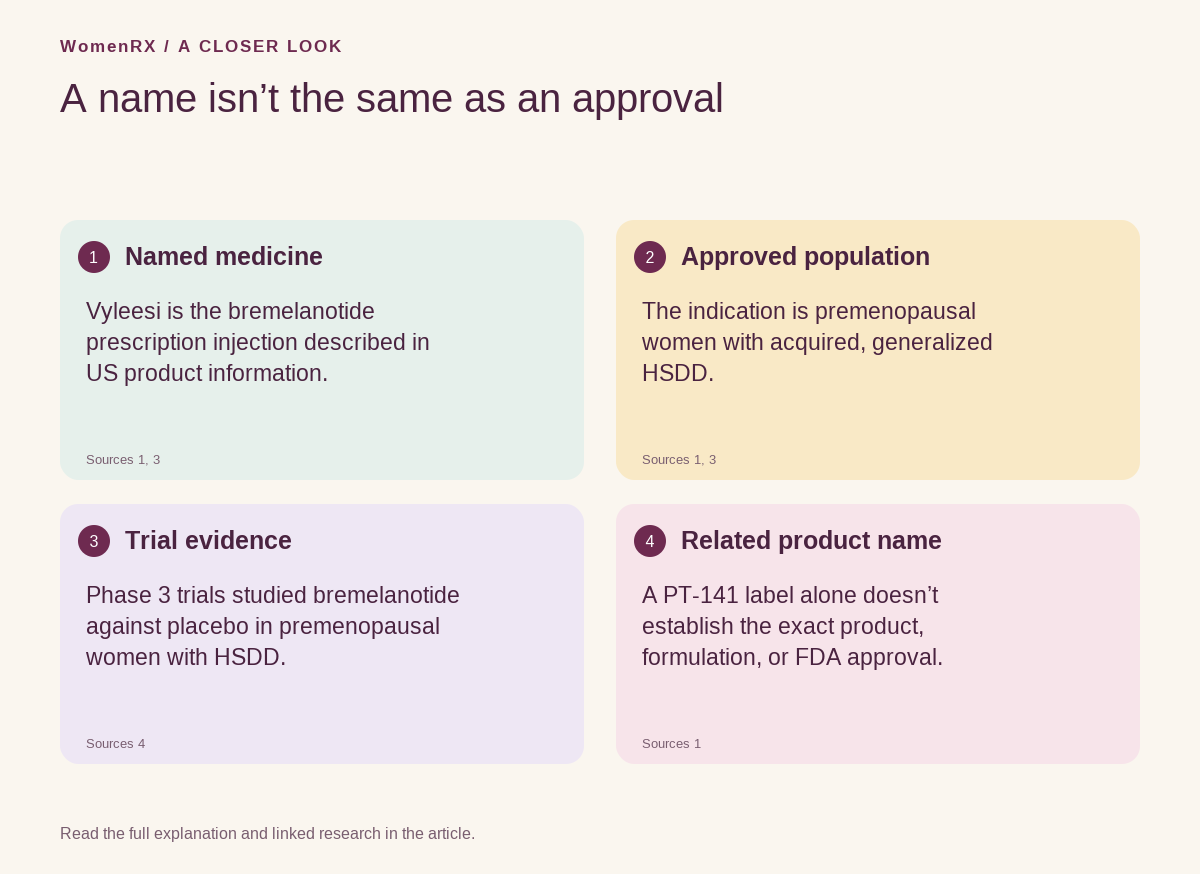
A name isn’t the same as an approval
Named medicine: Vyleesi is the bremelanotide prescription injection described in US product information.13
Approved population: The indication is premenopausal women with acquired, generalized HSDD.13
Trial evidence: Phase 3 trials studied bremelanotide against placebo in premenopausal women with HSDD.4
Related product name: A PT-141 label alone doesn’t establish the exact product, formulation, or FDA approval.1
Read the figure as text
Compare what the Vyleesi approval covers with what a PT-141 label alone does, and doesn’t, tell you.- Named medicine: Vyleesi is the bremelanotide prescription injection described in US product information.13
- Approved population: The indication is premenopausal women with acquired, generalized HSDD.13
- Trial evidence: Phase 3 trials studied bremelanotide against placebo in premenopausal women with HSDD.4
- Related product name: A PT-141 label alone doesn’t establish the exact product, formulation, or FDA approval.1
More questions, answered
Does an FDA-approved treatment for HSDD mean every kind of low desire is HSDD?
No. Low desire alone doesn’t establish HSDD; distress is part of the distinction described in research on the condition. Vyleesi’s indication is for premenopausal women with acquired, generalized HSDD, not low desire in every circumstance. 2 3
Sources you can check
- VYLEESI (BREMELANOTIDE) INJECTION [COSETTE PHARMACEUTICALS, INC.] | US prescribing information and patient instructionsAccessed 2026-09-25Return to first citation
- Clinical trial evidence on emerging pharmacological therapies for hypoactive sexual desire disorder in women: a systematic review and analysis of completed studies registered on ClinicalTrials.gov.Ashour AM. · Frontiers in medicine · 2026Return to first citation
- Safety Profile of Bremelanotide Across the Clinical Development Program.Clayton AH, Kingsberg SA, Portman D, Sadiq A, Krop J, Jordan R, Lucas J, Simon JA. · Journal of women's health (2002) · 2022Return to first citation
- Bremelanotide for the Treatment of Hypoactive Sexual Desire Disorder: Two Randomized Phase 3 Trials.Kingsberg SA, Clayton AH, Portman D, Williams LA, Krop J, Jordan R, Lucas J, Simon JA. · Obstetrics and gynecology · 2019Return to first citation