How Bremelanotide Works and What It Treats
Bremelanotide activates melanocortin receptors, but its exact effect on sexual desire in women isn’t known.
Bremelanotide is indicated for premenopausal women with acquired, generalized hypoactive sexual desire disorder (HSDD) that causes marked distress or interpersonal difficulty and isn’t due to certain other conditions or medication effects. It activates melanocortin receptors, but the exact way it may improve HSDD in women is unknown. That mechanism is different from flibanserin’s serotonin-receptor action. 13
A specific use, not a treatment for every kind of low desire
Bremelanotide’s US prescribing information describes a narrow clinical role: treatment of premenopausal women with acquired, generalized hypoactive sexual desire disorder (HSDD). “Acquired” means the low desire developed after a period without that problem. “Generalized” means it occurs across situations, partners, and types of stimulation. The label also requires marked distress or interpersonal difficulty, and excludes cases due to a co-existing medical or psychiatric condition or the effects of a medication or drug. 1
That’s more specific than simply wanting to feel more desire. Low desire can have different contributors, so a medicine aimed at one signaling system shouldn’t be treated as a fit for every situation. The label’s clinical trials measured changes in reported desire and distress about low desire; receptor activity itself isn’t evidence that a particular person will benefit. 1
What the medicine does in the body
Bremelanotide is a melanocortin receptor agonist, which means it activates melanocortin receptors. It activates several receptor subtypes; at therapeutic doses, the prescribing information identifies MC1R and MC4R as the most relevant. MC4R-expressing neurons are found in many areas of the central nervous system. 1
Researchers have proposed that melanocortin signaling may influence brain pathways involved in sexual desire. One hypothesis involves MC4R activity in the hypothalamus and changes in dopamine signaling. That idea draws partly on animal research. It isn’t a demonstrated explanation of how bremelanotide improves HSDD in women: the prescribing information says that mechanism is unknown. 13
An animal study offers a further reason to keep the distinction clear. In female Syrian hamsters, bremelanotide did not enhance sexual reward in the test used. That finding cannot determine whether the medicine helps women, but it does show why a proposed brain pathway shouldn’t be presented as settled proof of how the drug works. 2
Different receptor target, not a proven better choice
Flibanserin is another medication discussed for HSDD. It acts on serotonin receptors, while bremelanotide acts on melanocortin receptors. These are different signaling targets; the distinction alone doesn’t show that one treatment works better for a particular person. 3
The useful takeaway is that bremelanotide is intended for a defined HSDD population, not low desire from any cause. Its receptor activity gives researchers a possible biological explanation to investigate, but it can’t predict an individual response or replace the criteria in its labeled use. The indication is for premenopausal women. For breastfeeding, the label says there’s no information on the medicine in human milk or its effects on a breastfed infant or milk production. 1
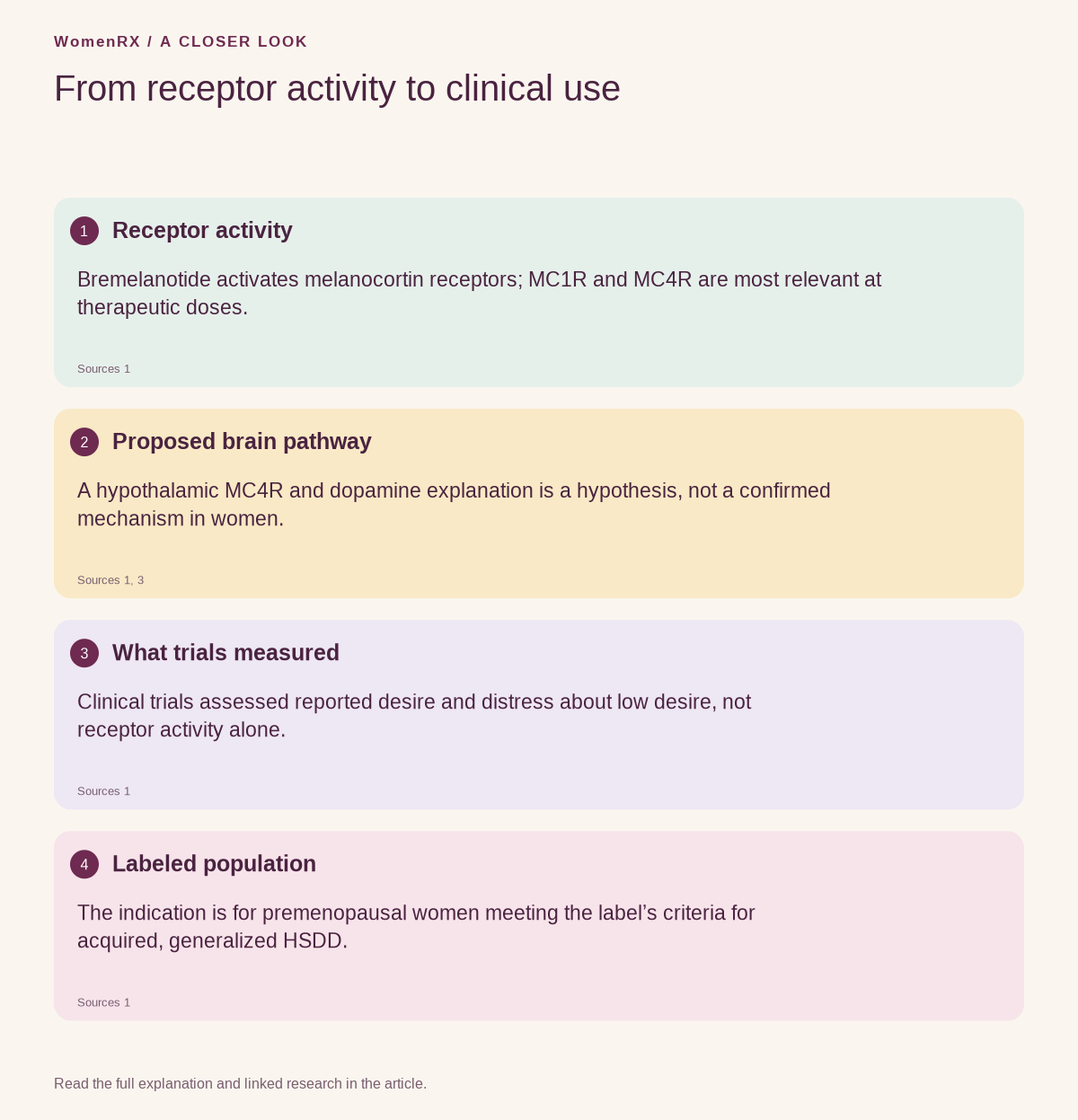
From receptor activity to clinical use
Receptor activity: Bremelanotide activates melanocortin receptors; MC1R and MC4R are most relevant at therapeutic doses.1
Proposed brain pathway: A hypothalamic MC4R and dopamine explanation is a hypothesis, not a confirmed mechanism in women.13
What trials measured: Clinical trials assessed reported desire and distress about low desire, not receptor activity alone.1
Labeled population: The indication is for premenopausal women meeting the label’s criteria for acquired, generalized HSDD.1
Read the figure as text
This pathway separates what the medicine is known to target from a proposed brain explanation and the population named in its indication.- Receptor activity: Bremelanotide activates melanocortin receptors; MC1R and MC4R are most relevant at therapeutic doses.1
- Proposed brain pathway: A hypothalamic MC4R and dopamine explanation is a hypothesis, not a confirmed mechanism in women.13
- What trials measured: Clinical trials assessed reported desire and distress about low desire, not receptor activity alone.1
- Labeled population: The indication is for premenopausal women meeting the label’s criteria for acquired, generalized HSDD.1
More questions, answered
Does bremelanotide work by increasing dopamine?
A proposed explanation involves melanocortin receptors and dopamine signaling, but this is a hypothesis, not an established account of how bremelanotide improves HSDD in women. The prescribing information says the mechanism is unknown. 13
Is bremelanotide meant for any woman with low desire?
No. Its labeled use is for premenopausal women with acquired, generalized HSDD that causes marked distress or interpersonal difficulty and isn’t due to specified other conditions or medication effects. 1
Sources you can check
- VYLEESI (BREMELANOTIDE) INJECTION [COSETTE PHARMACEUTICALS, INC.] | US prescribing information and patient instructionsAccessed 2026-09-25Return to first citation
- Female Syrian hamster analyses of bremelanotide, a US FDA approved drug for the treatment of female hypoactive sexual desire disorder.Borland JM, Kohut-Jackson AL, Peyla AC, Hall MA, Mermelstein PG, Meisel RL. · Neuropharmacology · 2025Return to first citation
- The neurobiology of bremelanotide for the treatment of hypoactive sexual desire disorder in premenopausal women.Pfaus JG, Sadiq A, Spana C, Clayton AH. · CNS spectrums · 2022Return to first citation