Flibanserin: How It Works and What It Treats
Flibanserin is intended for a specific diagnosis of persistently low, distressing sexual desire, while its proposed brain mechanism remains unsettled.
Flibanserin (Addyi) is indicated in the United States for women under 65 with acquired, generalized hypoactive sexual desire disorder (HSDD): distressing low desire that isn’t explained by certain other causes. 1 It acts on serotonin receptors, but how it treats HSDD is unknown. 1 2 The trials described in its label assessed changes in desire and satisfying sexual events over 24 weeks, not effects on demand. 1
A diagnosis, not just a lower libido
Flibanserin is the generic name for Addyi. The US prescribing information indicates it for women younger than 65 with acquired, generalized HSDD. “Acquired” means the low desire developed after a period without that problem. “Generalized” means it isn’t limited to one kind of sexual activity, situation, or partner. The low desire must also cause marked distress or interpersonal difficulty. 1
That distinction matters: a change in desire, by itself, isn’t the same as HSDD. The indication excludes low desire attributed to a co-existing medical or psychiatric condition, relationship problems, or the effects of a medication or other drug. That makes flibanserin a treatment for a particular diagnosis, not a general remedy for sexual dissatisfaction or every change in libido. 1
The label covers women under 65, but the trials described in it enrolled premenopausal women whose acquired, generalized HSDD had lasted at least six months. Those trial details don’t establish that evidence is equally strong across reproductive stages, including perimenopause and postmenopause. 1
What researchers think it does in the brain
Flibanserin acts on serotonin receptors, especially as an agonist at 5-HT1A receptors and an antagonist at 5-HT2A receptors. A review describes preclinical findings involving changes in serotonin, dopamine, and norepinephrine in certain brain regions. Researchers have proposed that these changes could shift the balance between inhibitory and excitatory signals related to desire. Those downstream chemical changes have not been established as the explanation for clinical effects in women taking flibanserin. 2 1
That’s a hypothesis about how the drug might work, not a settled explanation of its effect in a particular woman. The US prescribing information says the mechanism of action for treating HSDD is not known. So it’s more accurate to say that flibanserin is thought to affect brain signaling than to say it directly switches desire on or reliably raises libido. 1 2
The trials described in the label assessed changes over 24 weeks, not whether taking flibanserin produces an immediate effect. 1
What the clinical evidence does and doesn’t show
The label describes three randomized, double-blind, placebo-controlled trials lasting 24 weeks in premenopausal women with acquired, generalized HSDD. The trials assessed sexual desire and satisfying sexual events. 1
The practical takeaway is to keep the mechanism and the diagnosis separate: a proposed brain-signaling explanation doesn’t mean flibanserin applies to every reason desire changes. Its US indication is specific, and the clinical trials described in the label were conducted in premenopausal women. Those trials don’t establish equal effects in other reproductive stages. 1 2
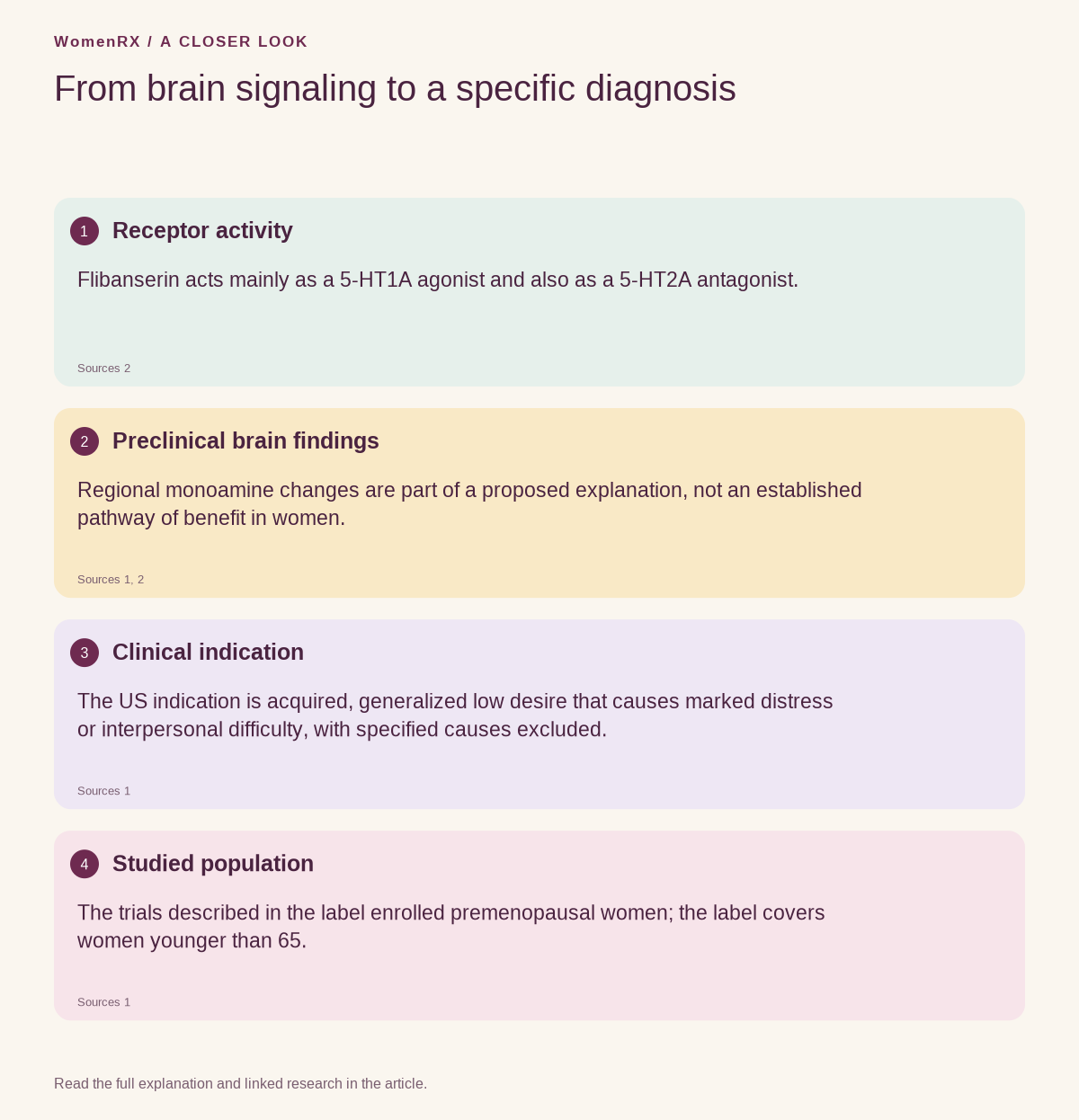
From brain signaling to a specific diagnosis
Receptor activity: Flibanserin acts mainly as a 5-HT1A agonist and also as a 5-HT2A antagonist.2
Preclinical brain findings: Regional monoamine changes are part of a proposed explanation, not an established pathway of benefit in women.12
Clinical indication: The US indication is acquired, generalized low desire that causes marked distress or interpersonal difficulty, with specified causes excluded.1
Studied population: The trials described in the label enrolled premenopausal women; the label covers women younger than 65.1
Read the figure as text
Receptor activity and preclinical findings inform a possible explanation; the clinical indication is defined separately by a particular pattern of low desire and distress.- Receptor activity: Flibanserin acts mainly as a 5-HT1A agonist and also as a 5-HT2A antagonist.2
- Preclinical brain findings: Regional monoamine changes are part of a proposed explanation, not an established pathway of benefit in women.12
- Clinical indication: The US indication is acquired, generalized low desire that causes marked distress or interpersonal difficulty, with specified causes excluded.1
- Studied population: The trials described in the label enrolled premenopausal women; the label covers women younger than 65.1
More questions, answered
What do “acquired” and “generalized” mean in HSDD?
“Acquired” means low desire developed after a period without that problem. “Generalized” means it occurs across types of stimulation, situations, or partners, rather than only in one setting. 1
Does the age limit mean flibanserin was studied equally before and after menopause?
No. The US indication is for women under 65, while the trials described in the prescribing information enrolled premenopausal women. The label’s age range and the trial population are different pieces of information. 1
Sources you can check
- ADDYI (FLIBANSERIN) TABLET, FILM COATED [SPROUT PHARMACEUTICALS, INC.] | US prescribing information and patient instructionsAccessed 2026-09-25Return to first citation
- Multifunctional pharmacology of flibanserin: possible mechanism of therapeutic action in hypoactive sexual desire disorder.Stahl SM, Sommer B, Allers KA. · The journal of sexual medicine · 2011Return to first citation