Bupropion: What It Treats, How It Works, and What to Ask
Bupropion has established uses, but its effect on brain signaling alone can’t tell you whether it fits your treatment goal.
Bupropion is approved for depression, seasonal affective disorder, and as an aid to smoking cessation. It affects norepinephrine and dopamine reuptake, but that broad mechanism doesn’t mean it treats every mood or attention concern, or predict your response. The specific product, the reason for treatment, health history, and pregnancy or breastfeeding context can all shape the prescribing discussion. 2 1
Start with the treatment goal
Bupropion is used for depression, seasonal affective disorder, and as an aid to smoking cessation. These are established uses, but the approved use depends on the specific product. For example, CONTRAVE, a combination of bupropion and naltrexone, is not approved to treat major depressive disorder. Having the same active ingredient doesn’t make every bupropion-containing product interchangeable for every purpose. 2 1
Bupropion is also used off-label for other reasons. A clinical reference lists examples including antidepressant-related sexual dysfunction, bipolar-associated depression, obesity, and ADHD in children and adolescents. Off-label describes a use that isn’t an approved indication for that product; the label alone doesn’t tell you how strong the evidence is or whether the use fits a particular person. 2
A useful first question is: “What specific condition or symptom are we trying to treat?” The answer helps distinguish an established use from an off-label choice and makes it easier to discuss what benefit is expected.
What the mechanism can tell you
Bupropion is described as affecting the reuptake of norepinephrine and dopamine, chemical messengers involved in signaling between nerve cells. That’s a broad description of how the medicine acts. It isn’t a complete explanation of why it helps with an approved condition, and it can’t predict how one person will respond. 1
So, for example, hearing that a medicine affects dopamine doesn’t establish that it will help with every concern involving motivation, attention, or mood. A proposed mechanism and a demonstrated clinical use are different things. Focus the discussion on the treatment goal and the evidence for using that particular product for it. 2
Health history can change the conversation
Mention a history of seizures or bipolar disorder when discussing bupropion. The CONTRAVE prescribing information warns that bupropion can cause seizures and that antidepressant treatment can precipitate mania or hypomania. Those are product-label cautions, not a way to predict what will happen to you, but they make relevant history worth raising before a treatment choice is made. 1
If an off-label use is being considered, ask what benefit is expected, what evidence supports that use, and what would prompt a change in the plan. Those questions are more useful than trying to infer a likely effect from a simplified brain-chemistry explanation.
Pregnancy and breastfeeding are separate questions
If you’re pregnant, planning a pregnancy, or breastfeeding, bring that context into the discussion about the reason for treatment and the exact product. The label information described here addresses breastfeeding, not pregnancy, so it doesn’t establish pregnancy safety.
For breastfeeding, the CONTRAVE label reports that bupropion and its metabolites can be present in human milk. It describes limited postmarketing reports without a clear association of adverse effects in breastfed infants, as well as reports of infant seizures for which the relationship to bupropion is unclear. Because CONTRAVE also contains naltrexone, these details shouldn’t be treated as a complete answer for bupropion-only products or every breastfeeding situation. 1
A practical discussion can stay focused: What is the intended use? Is it approved for this product, or is it off-label? What health history matters? If pregnancy or breastfeeding applies, what does the information for this exact product say, and what remains uncertain?
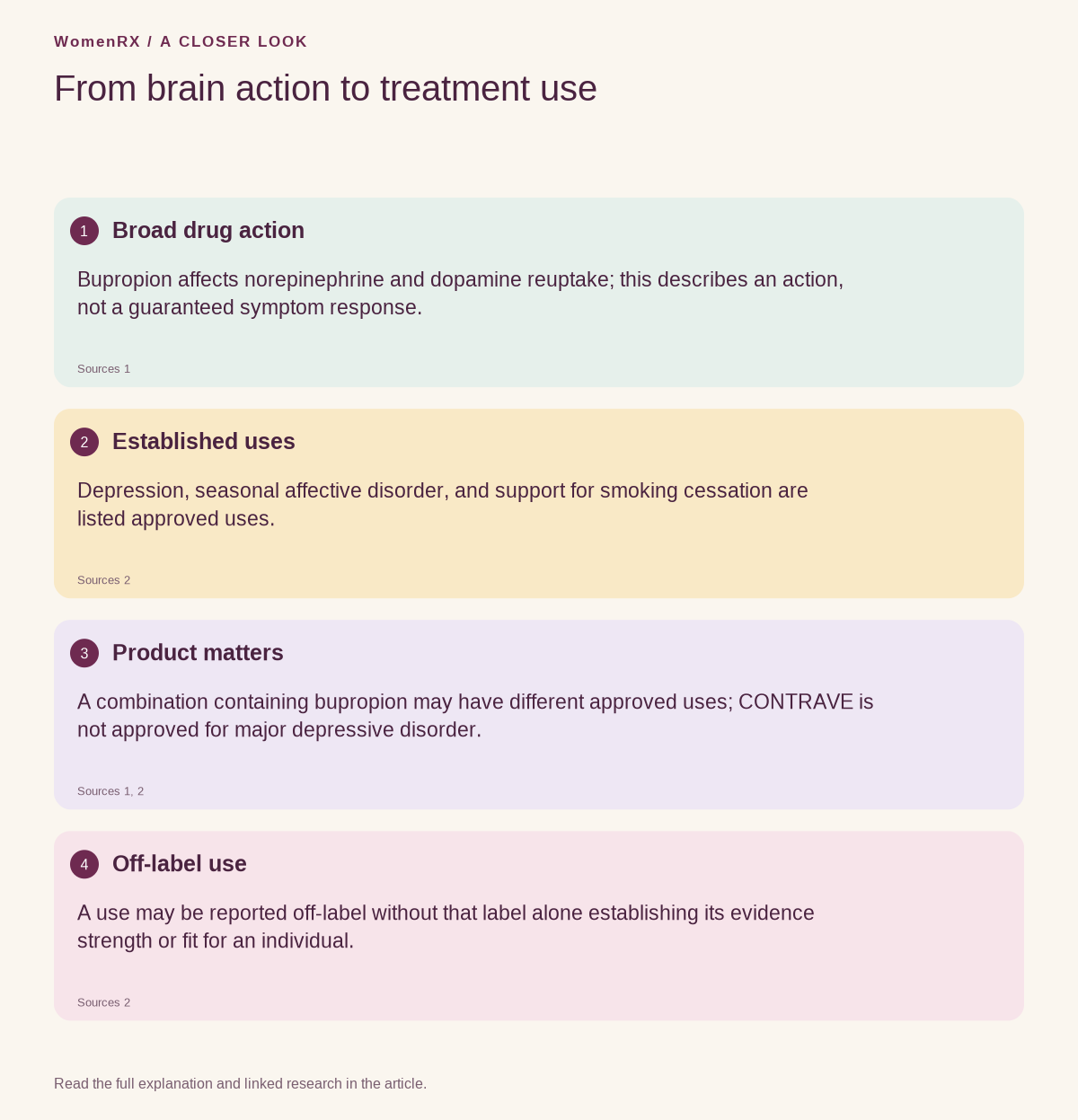
From brain action to treatment use
Broad drug action: Bupropion affects norepinephrine and dopamine reuptake; this describes an action, not a guaranteed symptom response.1
Established uses: Depression, seasonal affective disorder, and support for smoking cessation are listed approved uses.2
Product matters: A combination containing bupropion may have different approved uses; CONTRAVE is not approved for major depressive disorder.12
Off-label use: A use may be reported off-label without that label alone establishing its evidence strength or fit for an individual.2
Read the figure as text
This figure separates a broad mechanism description from established uses and the limits of using one to predict the other.- Broad drug action: Bupropion affects norepinephrine and dopamine reuptake; this describes an action, not a guaranteed symptom response.1
- Established uses: Depression, seasonal affective disorder, and support for smoking cessation are listed approved uses.2
- Product matters: A combination containing bupropion may have different approved uses; CONTRAVE is not approved for major depressive disorder.12
- Off-label use: A use may be reported off-label without that label alone establishing its evidence strength or fit for an individual.2
More questions, answered
Does bupropion’s mechanism mean it will improve focus or motivation?
No. Affecting dopamine and norepinephrine reuptake describes a broad drug action; it doesn’t establish that bupropion will help a particular symptom. ADHD is among the off-label uses listed in a clinical reference, but that listing alone doesn’t show that it’s an appropriate choice for a specific person. 1 2
Sources you can check
- CONTRAVE EXTENDED-RELEASE (NALTREXONE HYDROCHLORIDE AND BUPROPION HYDROCHLORIDE) TABLET, EXTENDED RELEASE [NALPROPION PHARMACEUTICALS LLC] | US prescribing information and patient instructionsAccessed 2026-09-25Return to first citation
- BupropionHuecker MR, Smiley A, Saadabadi A. · 2024Return to first citation