How Testosterone Therapy Works in Women, and What It Treats
Its evidence-backed role is narrow: selected women with distressing low sexual desire may benefit, but a hormone level alone cannot identify who needs treatment.
Testosterone may influence sexual desire, but the exact pathway in women isn’t fully understood. It can act through androgen receptors, directly or after conversion to DHT, though that mechanism is supported mainly by preclinical research. Clinically, guidelines support systemic testosterone for selected postmenopausal women with hypoactive sexual desire disorder (HSDD), not as a general menopause treatment. A testosterone blood test doesn’t diagnose HSDD. 2 4 5
A hormone pathway is not the same as a proven treatment
Testosterone can bind to androgen receptors. It can also be converted to dihydrotestosterone (DHT), which acts through those receptors. This gives researchers a plausible way to think about how testosterone might affect sexual desire. But the pathway is not fully understood in women. A review describes testosterone as having a possible excitatory role in desire, while noting that its mechanism remains unclear. 4 5
Part of the proposed androgen-receptor explanation comes from experiments in rats. Those findings can help generate hypotheses, but they do not show how testosterone works in women or prove that a particular mechanism causes a clinical benefit. 5
That distinction matters: a biologically plausible effect isn’t proof that testosterone treats every symptom associated with menopause. The clinical evidence is focused on a specific sexual-health concern. 2 3
The treatment target is HSDD, not a lab result
Hypoactive sexual desire disorder, or HSDD, means low sexual desire that causes marked personal or interpersonal distress. Desire can be affected by hormonal, neurobiological, and psychosocial factors, so the assessment considers the wider picture rather than treating a blood test as the answer. 4
For postmenopausal women, professional guidance supports considering systemic testosterone when HSDD is confirmed through a biopsychosocial assessment. The guideline describes a moderate therapeutic benefit for women whose HSDD isn’t primarily related to modifiable factors or other concerns, such as relationship or mental-health problems. That is a narrower claim than saying testosterone reliably increases desire for all women. 2 3
A total testosterone level doesn’t diagnose HSDD. Guidance describes measuring a baseline level and using follow-up testing to help monitor treatment, not to decide whether low desire is real or whether a woman qualifies for care. In practice, improvement should be judged by whether the concern that brought her to treatment improves, alongside monitoring for signs of excess androgen exposure and keeping levels in the premenopausal physiological range. 1 2
What the evidence does not establish
The evidence-backed indication is not menopause in general. The cited clinical guidance identifies HSDD in postmenopausal women as the established indication; it does not establish testosterone as a treatment for a broad collection of menopause-related concerns. 2 3
Guidance also notes limited data for women in the late reproductive years, but the evidence base is less established there than it is for postmenopausal women. Results from men, animal experiments, or women without a confirmed HSDD diagnosis shouldn’t be treated as direct proof of benefit for every woman. 2 5
The prescribing guidance discusses systemic transdermal testosterone and recommends shared decision-making about off-label use. It does not recommend compounded products because adequate efficacy and safety data are lacking. Even when treatment is used at physiological levels, long-term safety has not been established, so the potential benefit and uncertainty both belong in the decision. 2
The useful question isn’t simply whether a testosterone result is low. It’s whether low desire is causing distress, what might be contributing to it, and whether the expected benefit of treatment fits the concern being treated.
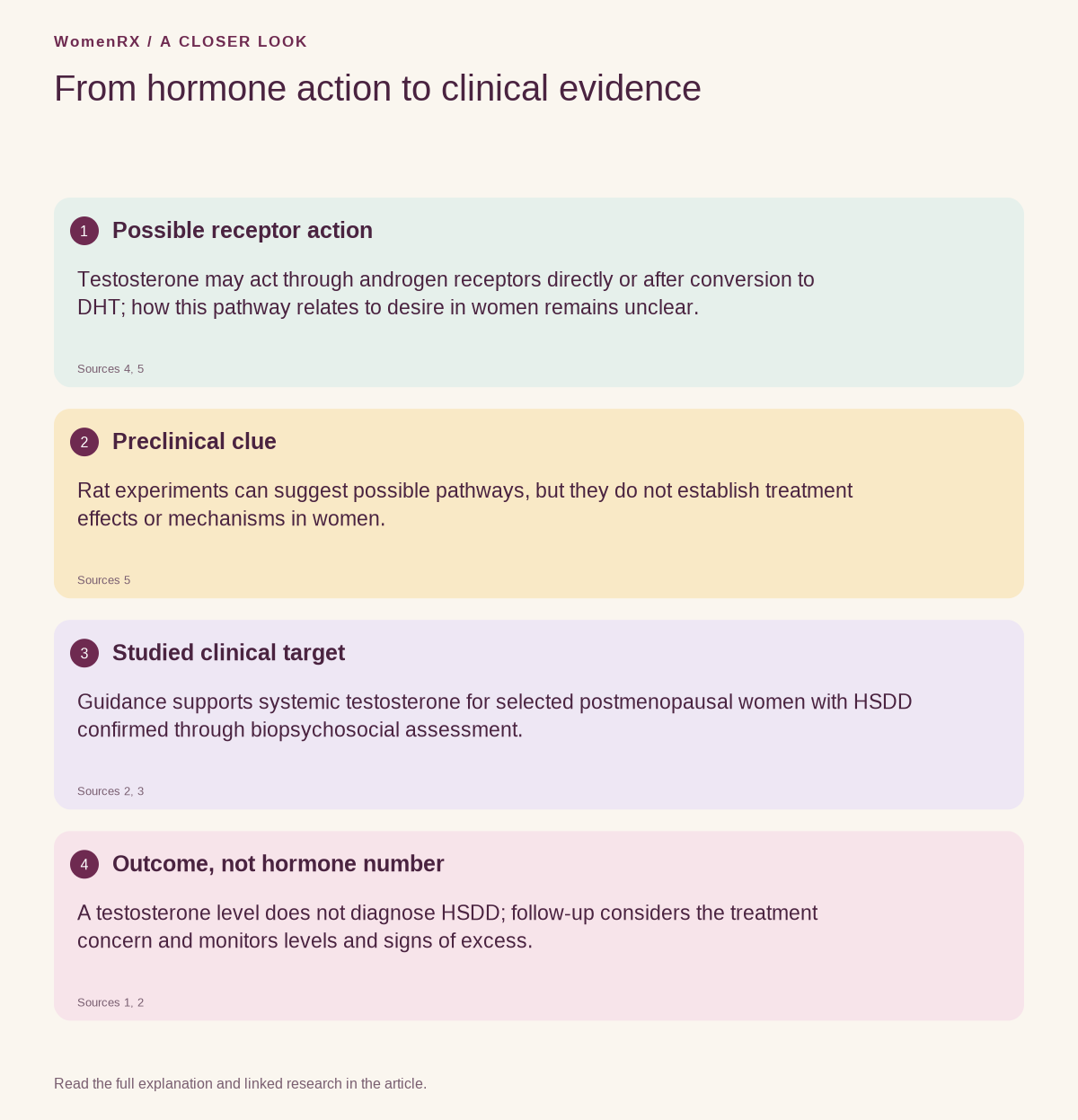
From hormone action to clinical evidence
Possible receptor action: Testosterone may act through androgen receptors directly or after conversion to DHT; how this pathway relates to desire in women remains unclear.45
Preclinical clue: Rat experiments can suggest possible pathways, but they do not establish treatment effects or mechanisms in women.5
Studied clinical target: Guidance supports systemic testosterone for selected postmenopausal women with HSDD confirmed through biopsychosocial assessment.23
Outcome, not hormone number: A testosterone level does not diagnose HSDD; follow-up considers the treatment concern and monitors levels and signs of excess.12
Read the figure as text
This figure separates a plausible biological pathway from the clinical outcome supported by guidance, so a mechanism isn’t mistaken for proof of broad benefit.- Possible receptor action: Testosterone may act through androgen receptors directly or after conversion to DHT; how this pathway relates to desire in women remains unclear.45
- Preclinical clue: Rat experiments can suggest possible pathways, but they do not establish treatment effects or mechanisms in women.5
- Studied clinical target: Guidance supports systemic testosterone for selected postmenopausal women with HSDD confirmed through biopsychosocial assessment.23
- Outcome, not hormone number: A testosterone level does not diagnose HSDD; follow-up considers the treatment concern and monitors levels and signs of excess.12
More questions, answered
Can a testosterone test show whether I have HSDD?
No. A testosterone level isn’t used to diagnose HSDD. Guidance describes a baseline measurement and follow-up testing as part of monitoring if treatment is considered, while diagnosis depends on the sexual concern and its impact. 1 2
Does testosterone treat menopause symptoms broadly?
The clinical guidance cited here supports a specific role for selected postmenopausal women with HSDD. It doesn’t establish testosterone as a general treatment for menopause symptoms. 2 3
Sources you can check
- Androgen therapy in midlife and older women: a position statement of the Latin American Association of Gynecological Endocrinology (ALEG).Pilnik S, Belardo A, Marchesan LB, Camero-Lascano A, Acuña-San Martín M, Elizalde-Cremonte A, Ojeda E, Manzur A, Chedraui P. · Climacteric : the journal of the International Menopause Society · 2025Return to first citation
- International Society for the Study of Women's Sexual Health Clinical Practice Guideline for the Use of Systemic Testosterone for Hypoactive Sexual Desire Disorder in Women.Parish SJ, Simon JA, Davis SR, Giraldi A, Goldstein I, Goldstein SW, Kim NN, Kingsberg SA, Morgentaler A, Nappi RE, Park K, Stuenkel CA, Traish AM, Vignozzi L. · The journal of sexual medicine · 2021Return to first citation
- International Society for the Study of Women's Sexual Health Clinical Practice Guideline for the Use of Systemic Testosterone for Hypoactive Sexual Desire Disorder in Women.Parish SJ, Simon JA, Davis SR, Giraldi A, Goldstein I, Goldstein SW, Kim NN, Kingsberg SA, Morgentaler A, Nappi RE, Park K, Stuenkel CA, Traish AM, Vignozzi L. · Journal of women's health (2002) · 2021Return to first citation
- [Testosterone therapy in female hypoactive sexual desire disorder].Meyer P. · Revue medicale suisse · 2016Return to first citation
- Aromatization Is Not Required for the Facilitation of Appetitive Sexual Behaviors in Ovariectomized Rats Treated With Estradiol and Testosterone.Jones SL, Rosenbaum S, Gardner Gregory J, Pfaus JG. · Frontiers in neuroscience · 2019Return to first citation