Hair-Loss Options When Oral Minoxidil Isn’t Right
The right alternative depends on why oral minoxidil isn’t a fit and what’s causing the thinning.
If you have female pattern hair loss, topical minoxidil offers a different route, while spironolactone and low-level light therapy are different approaches to discuss. PRP has also been studied, but a relevant trial paired it with topical minoxidil. If your hair loss began after childbirth or its cause is unclear, identifying the pattern comes before choosing a substitute. Pregnancy plans can change the medication discussion. 3 4 6 2
First, find out what kind of thinning you have
A widening part or less fullness across the top of your head may prompt a discussion about female pattern hair loss. But persistent shedding can have other causes, including chronic telogen effluvium; diffuse alopecia areata and scarring hair loss can also need a different approach. A clinician may examine your scalp and hair and use tools such as trichoscopy to look for the pattern of change. 4
Timing helps make that examination useful. For example, if shedding began after childbirth, say when it started and whether it has changed. If you’ve noticed thinning around menopause, mention that too, but don’t assume the timing alone identifies the cause. The treatments below are mainly discussed or studied for female pattern hair loss. They shouldn’t automatically be applied to every kind of shedding. 4
Topical minoxidil changes the route, not the medicine
If the problem with oral minoxidil is taking a pill, topical minoxidil may be the clearest alternative to discuss. It remains minoxidil, applied to the scalp rather than taken by mouth. A review focused on women identifies it as the only FDA-approved treatment for female pattern hair loss and lists oral minoxidil among off-label options. 4
There’s no good reason to assume the pill must work better. In a randomized trial of 65 people with androgenetic alopecia, both oral and topical minoxidil groups improved in hair diameter over six months, without a statistically significant difference between groups. Results weren’t reported separately for women, which limits what the comparison can tell you about your likely result. 5
The everyday tradeoff is different: topical treatment requires scalp application, and some people find it irritating. In a separate randomized trial of 75 people with androgenetic alopecia, scalp itching and dryness were reported with topical minoxidil. The trial did not report that finding separately for women. If your reason for stopping oral treatment is that minoxidil itself isn’t suitable, changing how you use it may not solve the problem. 3
Options that don’t simply switch minoxidil’s route
Low-level light therapy is a non-drug option with a women-specific trial to discuss. In a randomized study of 90 women with female pattern hair loss, groups using a particular light device, topical minoxidil, or both showed improved hair density and diameter. The combination did better on those measures than either treatment alone. This supports a conversation about light therapy, not a promise that every device will perform alike. It also means the strongest result in that study involved adding treatment rather than replacing minoxidil. 6
Spironolactone is a prescription anti-androgen discussed as an off-label option for female pattern hair loss. It isn’t an equivalent swap for minoxidil. Because spironolactone can raise potassium, the discussion needs to include your health history and other medicines, not just whether you’d prefer a different pill. 4 1
Pregnancy plans make that conversation more consequential. US spironolactone prescribing information advises avoiding the medicine during pregnancy because of a potential risk to development of a male fetus. That concern is based on how the drug works and animal findings; the human pregnancy reports described in the labeling are limited. If you’re pregnant or planning pregnancy, raise it before settling on a hair-loss medication. 2
Platelet-rich plasma (PRP) deserves a precise question: PRP alone, or PRP with minoxidil? A randomized trial enrolled 75 people with androgenetic alopecia, and 60 completed 32 weeks. Its PRP group also used topical minoxidil. The study did not report a women-only result, so it cannot tell you whether PRP alone is an effective minoxidil-free replacement for women. PRP also involves procedures rather than a home scalp application; participants in that group reported transient pain during the procedure. 3
Match the choice to the reason you’re switching
If taking an oral medicine is the sticking point, topical minoxidil changes the route. If you want to avoid minoxidil altogether, neither topical minoxidil nor the PRP-plus-minoxidil regimen studied above meets that goal. Light therapy offers a different approach, while spironolactone brings prescription-specific safety questions, especially around pregnancy. And if your pattern of hair loss hasn’t been identified, choosing among these treatments is premature. 3 4 6 2
A useful way to start the conversation is: “What kind of hair loss do you think this is, and which option actually avoids the reason oral minoxidil isn’t right for me?” That keeps the focus on the cause and the tradeoff that matters in your life.
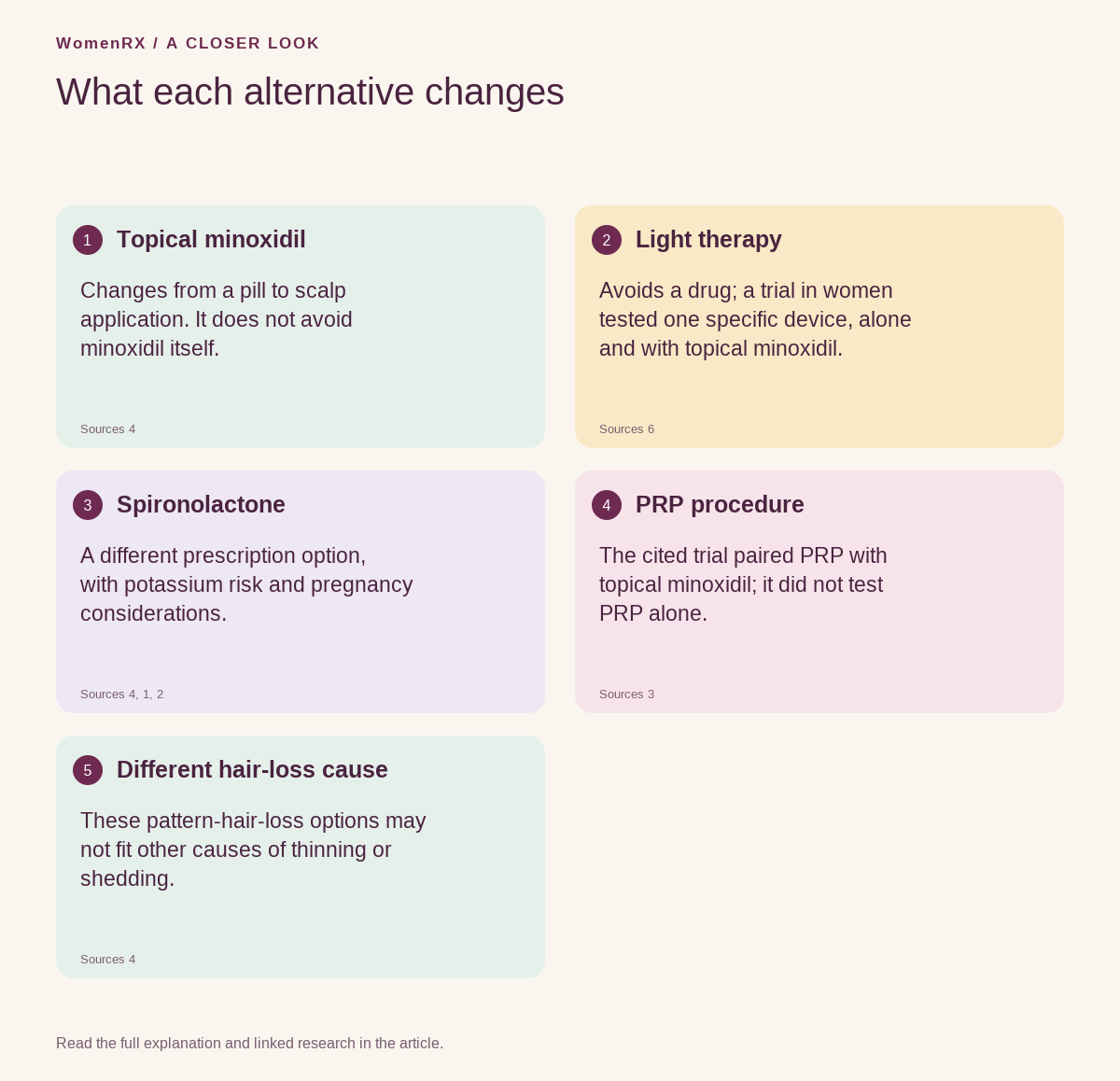
What each alternative changes
Topical minoxidil: Changes from a pill to scalp application. It does not avoid minoxidil itself.4
Light therapy: Avoids a drug; a trial in women tested one specific device, alone and with topical minoxidil.6
Spironolactone: A different prescription option, with potassium risk and pregnancy considerations.412
PRP procedure: The cited trial paired PRP with topical minoxidil; it did not test PRP alone.3
Different hair-loss cause: These pattern-hair-loss options may not fit other causes of thinning or shedding.4
Read the figure as text
Compare the options by whether they still involve minoxidil and what else shapes the decision.- Topical minoxidil: Changes from a pill to scalp application. It does not avoid minoxidil itself.4
- Light therapy: Avoids a drug; a trial in women tested one specific device, alone and with topical minoxidil.6
- Spironolactone: A different prescription option, with potassium risk and pregnancy considerations.412
- PRP procedure: The cited trial paired PRP with topical minoxidil; it did not test PRP alone.3
- Different hair-loss cause: These pattern-hair-loss options may not fit other causes of thinning or shedding.4
More questions, answered
Is PRP a minoxidil-free alternative?
The randomized PRP trial tested PRP with topical minoxidil, not PRP alone. It also did not report results separately for women, so it cannot establish PRP alone as a replacement for women with pattern hair loss. 3
What if my shedding started after childbirth?
Tell the clinician when the shedding began and how it has changed. Female pattern hair loss is only one possible explanation for thinning, and the treatments discussed here should not be assumed to fit postpartum shedding without identifying its cause. 4
Sources you can check
- Spironolactone - NHSAccessed 2026-09-25Return to first citation
- SPIRONOLACTONE TABLET, FILM COATED [REMEDYREPACK INC.] | US prescribing information and patient instructionsAccessed 2026-09-25Return to first citation
- Analysing efficacy of low-dose oral minoxidil, topical minoxidil, and platelet-rich plasma with topical minoxidil combination in patients with androgenetic alopecia: a randomized controlled observer blinded trial.Janaani P, Vinay K, Mehta H, Kumar V, Kumar N, Kumaran MS. · Archives of dermatological research · 2025Return to first citation
- Androgenetic Alopecia in Women: A Narrative Review of Pathophysiology, Clinical Evaluation, and Treatments.Kearney CA, Brinks AL, Lawrence CN, Maas DE, Spindler AJ, Coric C, Gener-Pangilinan LA, Lasheras-Pérez MA, Shapiro J, Lo Sicco KI. · American journal of clinical dermatology · 2026Return to first citation
- Clinical efficacy and safety of low-dose oral minoxidil versus topical solution in the improvement of androgenetic alopecia: A randomized controlled trial.Asilian A, Farmani A, Saber M. · Journal of cosmetic dermatology · 2024Return to first citation
- Comparison of low-level light therapy and combination therapy of 5% minoxidil in the treatment of female pattern hair loss.Liu Y, Jiang LL, Liu F, Qu Q, Fan ZX, Guo Z, Miao Y, Hu ZQ. · Lasers in medical science · 2021Return to first citation