How to Tell Whether a Hair-Loss Treatment Is Working
A single shed-heavy day or changing photo isn’t a verdict; consistent comparisons give you a clearer read.
There isn’t one evidence-backed deadline for judging every hair-loss treatment. A trial in women with female pattern hair loss measured topical minoxidil results at 24 weeks, but that’s a study endpoint, not a personal deadline. 4 Take baseline photos, then compare them about once a month using the same setup. Treat that schedule as a practical way to spot a trend, not a test of whether treatment has succeeded.
Start with what the treatment is meant to change
Before judging results, make sure you know what kind of hair loss is being treated. Female pattern hair loss is not the only cause of thinning, and treatment options differ by diagnosis. A guideline on androgenetic alopecia describes trichoscopy, a close examination of the scalp and hair, as a tool for diagnosis and for monitoring changes and treatment response. 3 A 2026 review also describes other possible diagnoses, including chronic telogen effluvium, diffuse alopecia areata, and scarring hair loss. 5
That matters because a treatment study in people with one diagnosis cannot set a reliable timetable for someone with another. If the diagnosis or treatment goal is unclear, clarify it before deciding that a treatment has failed.
What the minoxidil study timeline can tell you
A randomized, open-label trial followed 245 women with mild-to-moderate androgenetic alopecia for 24 weeks. Participants used 2% topical minoxidil alone or with microneedling every two or four weeks. At week 24, the study reported increased target-area hair counts from baseline in all three groups, with no significant differences between the groups. 4
This gives you a real study endpoint to discuss, not a promise that you will see a change by then. The trial was single-center and open-label, and it didn’t include patient-reported outcome data. It also compared three minoxidil-based approaches, so it doesn’t show how every person will respond or establish a universal stopping point. 4
Track a trend, not a snapshot
A simple record can make comparisons more useful. At the start, take photos of the same areas you want to monitor, such as your part, temples, or crown. Repeat them in the same room, lighting, camera position, and hairstyle; if possible, keep hair similarly dry and unstyled. These are practical consistency tips, not a validated scoring system.
For a manageable routine, take one set at the start and another about once a month. Put the images side by side rather than relying on memory or comparing different lighting. Monthly photos are an organizational choice, not a clinically proven interval for detecting regrowth. If you’re using topical minoxidil for diagnosed female pattern hair loss, the trial’s 24-week endpoint gives you a longer comparison point to discuss alongside your baseline and intervening photos. 4
Alongside each set of photos, jot down the treatment you’re using, whether you’ve been able to follow the plan, and any changes you’ve noticed in shedding, coverage, or scalp comfort. Note major changes in health or routine too, so you have context for the comparison. Don’t let one photo or one high-shedding day stand in for a longer pattern.
If you have access to scalp examinations or measurements as part of your care, ask whether the same method can be used at follow-up. The guideline identifies trichoscopy as one way to monitor treatment response. 3
Review points depend on the treatment
The 24-week assessment comes from a specific minoxidil study in women, not from studies of all hair-loss medicines. It’s a useful study reference for a discussion about topical minoxidil for female pattern hair loss, not a standard deadline or guarantee. 4
A review lists spironolactone and finasteride among off-label approaches for female pattern hair loss and notes gaps in randomized trials that include women. 5 Don’t borrow a timeline for finasteride from guidance about its use for an enlarged prostate; that is a different condition. 2
Your circumstances can change what belongs in that discussion. If you’ve recently given birth, mention when the thinning began rather than assuming it has the same cause as earlier hair loss. If you’re making menopause-related care decisions, bring those into the treatment conversation too. The diagnosis matters more than fitting every change into a minoxidil trial timeline.
Your treatment plan may also need to account for pregnancy. US prescribing information advises avoiding spironolactone during pregnancy because of a potential risk to a male fetus. If you’re pregnant or planning a pregnancy, raise that before continuing or changing a treatment plan. 1
Make the review about more than hair count
At your review point, compare the same photos and records, then consider three questions: Is the change moving toward the goal you set? Has the treatment been manageable to use? Does the diagnosis or plan need another look? A lack of obvious early change in a photo alone doesn’t prove failure.
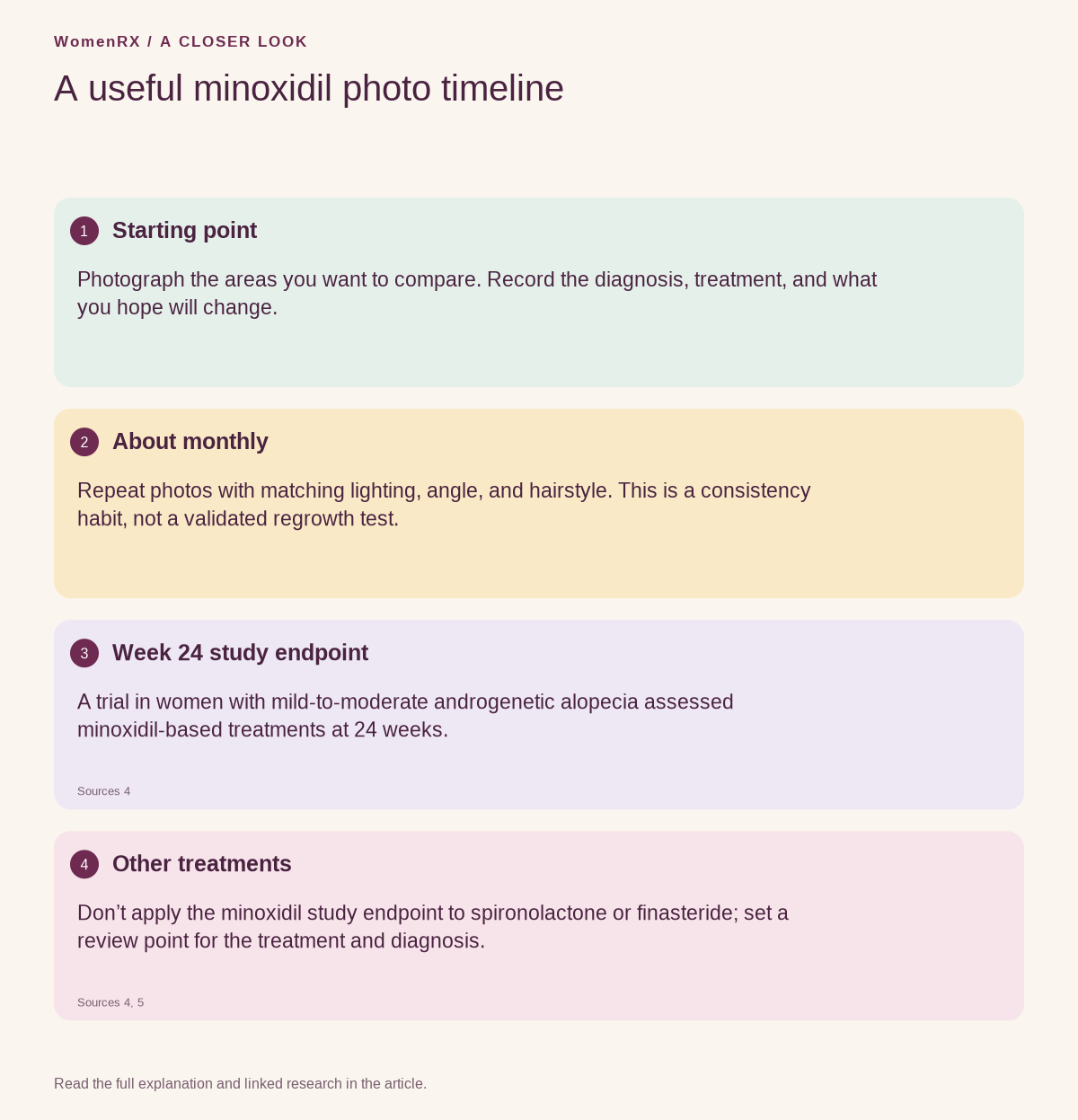
A useful minoxidil photo timeline
Starting point: Photograph the areas you want to compare. Record the diagnosis, treatment, and what you hope will change.
About monthly: Repeat photos with matching lighting, angle, and hairstyle. This is a consistency habit, not a validated regrowth test.
Week 24 study endpoint: A trial in women with mild-to-moderate androgenetic alopecia assessed minoxidil-based treatments at 24 weeks.4
Other treatments: Don’t apply the minoxidil study endpoint to spironolactone or finasteride; set a review point for the treatment and diagnosis.45
Read the figure as text
The photo intervals are a practical comparison routine. Only the 24-week point comes from the cited trial, and it is not an individual response deadline.- Starting point: Photograph the areas you want to compare. Record the diagnosis, treatment, and what you hope will change.
- About monthly: Repeat photos with matching lighting, angle, and hairstyle. This is a consistency habit, not a validated regrowth test.
- Week 24 study endpoint: A trial in women with mild-to-moderate androgenetic alopecia assessed minoxidil-based treatments at 24 weeks.4
- Other treatments: Don’t apply the minoxidil study endpoint to spironolactone or finasteride; set a review point for the treatment and diagnosis.45
Sources you can check
- SPIRONOLACTONE TABLET, FILM COATED [REMEDYREPACK INC.] | US prescribing information and patient instructionsAccessed 2026-09-25Return to first citation
- About finasteride - NHSAccessed 2026-09-25Return to first citation
- Androgenetic alopecia in women and men: Italian guidelines adapted from European Dermatology Forum/European Academy of Dermatology and Venereology guidelines.Alessandrini A, Starace M, D'Ovidio R, Villa L, Rossi A, Stan TR, Calzavara-Pinton P, Piraccini BM. · Giornale italiano di dermatologia e venereologia : organo ufficiale, Societa italiana di dermatologia e sifilografia · 2020Return to first citation
- Microneedle frequency adjunct to 2% minoxidil in female androgenetic alopecia: A randomized controlled trial.Liu Y, Luo H, Yang S, Wang Z, Chen Y, Wu F, Xian H, Yang C, Xu DR, Luo Y. · Journal of the American Academy of Dermatology · 2026Return to first citation
- Androgenetic Alopecia in Women: A Narrative Review of Pathophysiology, Clinical Evaluation, and Treatments.Kearney CA, Brinks AL, Lawrence CN, Maas DE, Spindler AJ, Coric C, Gener-Pangilinan LA, Lasheras-Pérez MA, Shapiro J, Lo Sicco KI. · American journal of clinical dermatology · 2026Return to first citation