How to Tell Whether Semaglutide Is Working
The right sign of progress depends on which semaglutide product you take and what it was prescribed to help with.
Start with the exact product and the goal in your prescription: weight management, blood sugar, or cardiovascular risk may call for different ways to assess progress. One observational study of adults with obesity tracked weight, waist circumference, fasting glucose, and HbA1c; those are examples of study measures, not universal monitoring rules. Preventing a cardiovascular event can’t be checked through a short-term symptom or scale change, so review the risk factors your prescriber is tracking over time. 1 2 3 4
Begin with the product and its purpose
Semaglutide is the active ingredient in more than one product, and product information is specific to the product and formulation. Check the name on your prescription or medication packaging, then confirm what it was prescribed to address. Don’t assume that a result measured for one product or treatment goal defines progress for another. 1 2
A useful first question for your next follow-up is: What outcome are we trying to improve, and how will we measure it? That answer gives you a fairer way to judge progress than using weight alone.
Match the measure to the goal
If your goal is weight management, weight and, when useful, waist measurement can help show the direction of change. Compare the trend with your own starting point rather than judging a single weigh-in. In a small retrospective study of 70 adults with obesity, researchers tracked weight, waist circumference, blood sugar measures, blood pressure, and other outcomes. Those are measures used in research, not a universal checklist or a promised result for an individual. 4
If your goal is blood sugar, ask which glucose measures your prescriber is using to judge change. An observational study of adults with obesity tracked fasting glucose and HbA1c, with more pronounced glycemic improvements among participants with type 2 diabetes. It doesn’t establish a response threshold for every person or product. 4
If cardiovascular risk is part of your treatment goal, preventing a heart attack, stroke, or cardiovascular death can’t be checked through a short-term symptom change or a scale reading. In SELECT, a randomized trial of 17,604 people with established cardiovascular disease and overweight or obesity, but not diabetes, semaglutide reduced major adverse cardiovascular events compared with placebo over a mean follow-up of 39.8 months. That is a group-level trial outcome, not an individual progress test. At follow-up, ask your prescriber to review the cardiovascular risk plan and the measures they’re tracking for you. For example, an observational study of adults with obesity tracked blood pressure and metabolic measures, but it doesn’t establish a universal checklist for cardiovascular follow-up. 3 4
Follow the trend, and include the context
Keep a simple record of the measures tied to your goal, along with when they were taken. Bring it to follow-up so you and your prescriber can compare it with your starting point. The useful question is whether the overall pattern is moving in the intended direction, not whether every measurement changes at once.
Also note changes that could affect how the trend is interpreted: interruptions in treatment, a switch from another GLP-1 medicine, difficulty getting the medication, or side effects that make it hard to continue. In a real-world adult obesity cohort, early weight response was lower among people switching from another GLP-1 medicine, although one-year outcomes were similar; discontinuations were also reported because of gastrointestinal effects or cost. Because this was an observational study, it can’t establish why any one person responds differently. 5
Some measures may change before others. In a prespecified analysis of SELECT, hsCRP, a marker of inflammation, fell with semaglutide and its reduction was associated with cardiovascular outcomes. The analysis does not establish hsCRP as a stand-alone, routine measure of whether an individual’s treatment is working. 3
When to revisit the plan
Bring the plan back to your prescriber if the measure linked to your goal isn’t moving as expected, if side effects or access problems are getting in the way, or if the goal itself has changed. Ask what the current trend means in light of your treatment course and whether any other measure is relevant.
In one real-world study of 248 adults with overweight or obesity without diabetes, 77.5% of whom were women, the researchers reported no significant differences in anthropometric outcomes by sex. That observational result doesn’t prove responses are identical, and it doesn’t answer questions about pregnancy, breastfeeding, or plans for pregnancy. If any of those situations apply, raise them directly when discussing the specific product and your treatment plan. 5
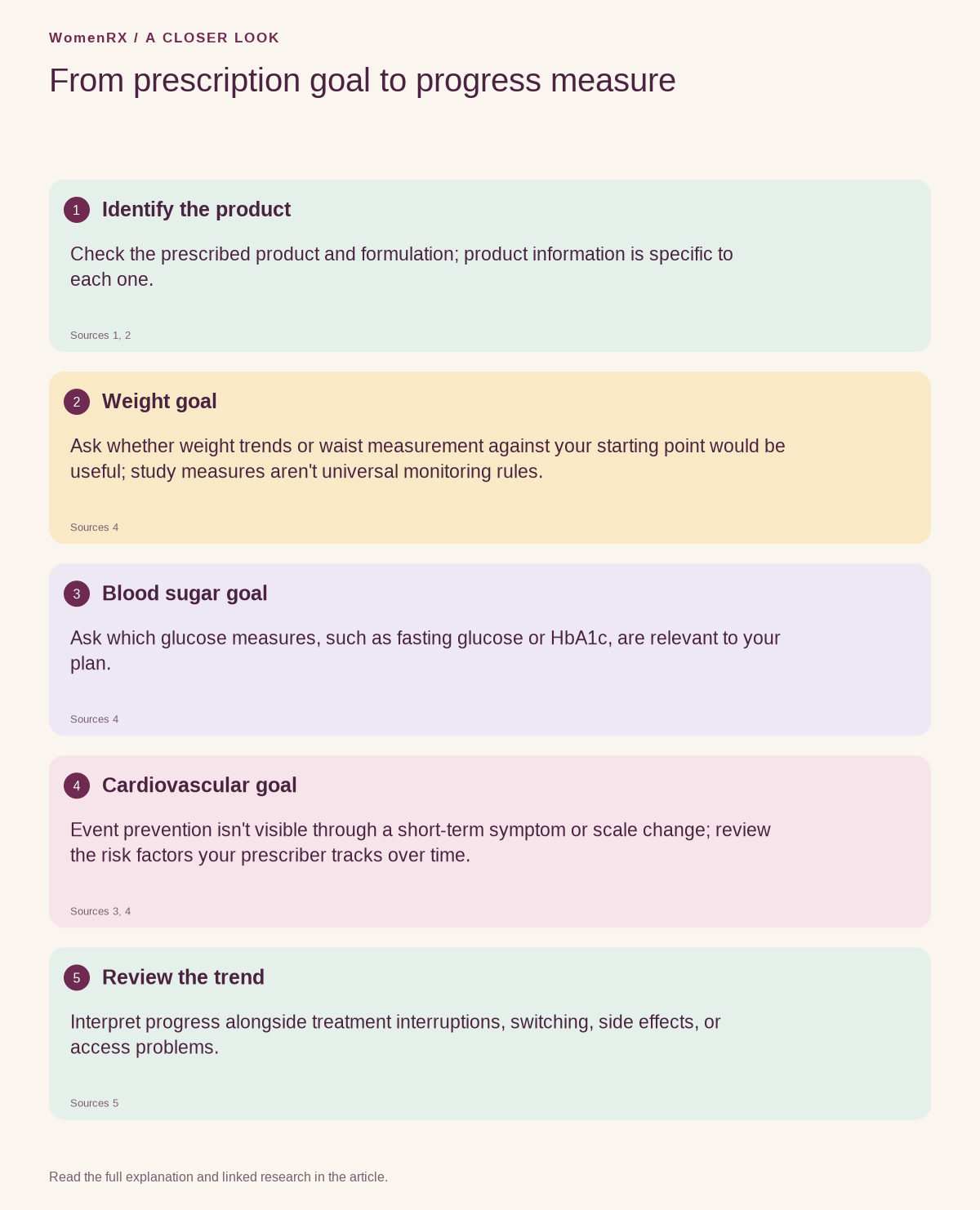
From prescription goal to progress measure
Identify the product: Check the prescribed product and formulation; product information is specific to each one.12
Weight goal: Ask whether weight trends or waist measurement against your starting point would be useful; study measures aren't universal monitoring rules.4
Blood sugar goal: Ask which glucose measures, such as fasting glucose or HbA1c, are relevant to your plan.4
Cardiovascular goal: Event prevention isn't visible through a short-term symptom or scale change; review the risk factors your prescriber tracks over time.34
Review the trend: Interpret progress alongside treatment interruptions, switching, side effects, or access problems.5
Read the figure as text
Choose the outcome that matches the reason for treatment, then review its trend in context rather than relying on one universal measure.- Identify the product: Check the prescribed product and formulation; product information is specific to each one.12
- Weight goal: Ask whether weight trends or waist measurement against your starting point would be useful; study measures aren't universal monitoring rules.4
- Blood sugar goal: Ask which glucose measures, such as fasting glucose or HbA1c, are relevant to your plan.4
- Cardiovascular goal: Event prevention isn't visible through a short-term symptom or scale change; review the risk factors your prescriber tracks over time.34
- Review the trend: Interpret progress alongside treatment interruptions, switching, side effects, or access problems.5
More questions, answered
Does early weight change tell me whether semaglutide will work?
Not by itself. An observational study found lower early weight response among people who switched from another GLP-1 medicine, but similar outcomes at one year. That finding is not a rule for an individual; review your trend in the context of your treatment course. 5
Should I use hsCRP to check whether semaglutide is working?
Not as a stand-alone progress test based on this evidence. A SELECT secondary analysis linked hsCRP changes with cardiovascular outcomes, but it did not establish hsCRP as a routine individual response measure. 3
Sources you can check
- WEGOVY (SEMAGLUTIDE) INJECTION, SOLUTION WEGOVY (SEMAGLUTIDE) TABLET [NOVO NORDISK PHARMACEUTICAL INDUSTRIES, LP] | US prescribing information and patient instructionsAccessed 2026-09-25Return to first citation
- OZEMPIC (ORAL SEMAGLUTIDE) TABLET RYBELSUS (ORAL SEMAGLUTIDE) TABLET [NOVO NORDISK PHARMACEUTICAL INDUSTRIES, LP] | US prescribing information and patient instructionsAccessed 2026-09-25Return to first citation
- Effect of Semaglutide on the Inflammatory Biomarker High-Sensitivity CRP in Patients With Established Cardiovascular Disease and Overweight or Obesity in SELECT: A Prespecified Secondary Analysis.Plutzky J, Bogdański P, Colhoun HM, Dağdelen S, Deanfield JE, Emerson SS, Hovingh GK, Kahn SE, Ekström K, Latkovskis G, Lehrke M, Hardt-Lindberg S, Lingvay I, Nicholls SJ, Kalayci ... · Circulation · 2026Return to first citation
- Effects of Semaglutide on Cardiometabolic Risk in People with Obesity, With and Without Type 2 Diabetes: A Retrospective Observational Study.Deaconu L, Albai O, Timar B, Braha A, Popescu S, Sorescu T, Gaita L, Iordan L, Timar R. · Journal of clinical medicine · 2026Return to first citation
- Real-world semaglutide in obesity cohort: effectiveness, safety and persistence across sex, BMI, and prior GLP-1RA treatment.Milani I, Parrotta ME, Chinucci M, Franzò E, Gintoli E, Franco F, Sbraccia P, Guglielmi V, Capoccia D. · Frontiers in endocrinology · 2026Return to first citation