How to Tell Whether Tirzepatide Is Meeting Your Goal
The right sign of progress depends on why you were prescribed tirzepatide: glucose control, weight management, or both.
Start with the goal written into your treatment plan. If it’s glucose control, review measures such as A1C and any glucose readings your prescriber has asked you to track. If it’s weight management, look at the longer-term weight trend and related health measures, not one weigh-in. Dose stage, time on treatment, and side effects all matter when interpreting progress. 2 5
First, name the goal you’re measuring
“Tirzepatide is working” can mean different things depending on why you’re taking it. For glucose control, the central question is whether your blood sugar is moving toward the goal set for you. For weight management, it’s whether your weight trend and, when relevant, related health measures are moving in a useful direction. Some people have both goals, but one outcome doesn’t automatically tell you how the other is going. 2 5
Before a follow-up, check the goal in your treatment plan or ask your prescriber to clarify it. Don’t assume that different tirzepatide prescriptions have identical approved uses or that every person should track the same outcome.
Match the measure to the reason for treatment
If your goal is glucose control: A1C is one measure used to assess glycemic outcomes in tirzepatide studies. Your prescriber may also want to review glucose readings, depending on your treatment plan. A number is most useful when you know what target you’re comparing it with and what period it reflects. 2 5
If your goal is weight management: Consider the trend over time, rather than treating a single weigh-in as a verdict. Clinical trials have also assessed waist circumference and cardiometabolic measures, including blood pressure and blood lipids. Which of these matter for you depends on your starting health and personal treatment goal. 2
If you have more than one goal: Review each one separately. For example, your weight may be changing while your glucose measure needs a different kind of follow-up. That doesn’t make either result meaningless; it means the measures answer different questions.
Allow for dose stage and time on treatment
A response can’t be interpreted without knowing where you are in treatment. Tirzepatide studies used dose escalation, and gastrointestinal symptoms in a maintenance trial occurred mostly during escalation. At follow-up, share how long you’ve been taking it, whether your dose has changed, and whether side effects are affecting your ability to continue. 2 4
An early weight check is not a reliable pass-or-fail test. A post hoc analysis of two phase 3 trials grouped participants by whether they had lost at least 5% of their weight by week 8. Participants below that early threshold still had clinically meaningful weight reduction and improvements in cardiometabolic measures by week 72, although the early responders had greater average improvements. This analysis describes groups; it does not establish a week-8 cutoff for deciding whether an individual’s treatment is failing. 2
Weight management can also include maintaining a loss, not only continuing to lose. In a trial of adults with obesity who first completed a 60-week weight-loss period on tirzepatide, continuing treatment maintained more of the weight reduction over the following year than switching to placebo. That trial studied a specific group and treatment period, so it doesn’t determine what every person should do. 4
Treat tolerability as part of the result
Progress isn’t useful if side effects make treatment hard to manage. Make a note of symptoms that persist or interfere with eating, drinking, or daily life. The Zepbound patient information warns that ongoing nausea, vomiting, or diarrhea can lead to dehydration and kidney problems, and advises telling your healthcare provider right away if these symptoms don’t go away. 1
A useful follow-up conversation can be simple: “My main goal is . The trend in ___ is . I’m currently at this stage of treatment, and these side effects are affecting me in this way. How should we judge progress from here?” That gives your prescriber the context needed to discuss whether the plan is meeting your goal or needs reassessment.
What the evidence says about women
Women were included in tirzepatide studies, but the findings don’t establish a single response women should expect. In a post hoc analysis, early weight responders were more likely to be female; that association doesn’t prove that sex predicts an individual woman’s outcome. A subgroup analysis in Japanese adults with obesity disease found broadly similar weight reduction across subgroups, with some numerical differences between female and male participants. Those results are specific to that study population. 2 3
If pregnancy planning or contraception is relevant to your situation, bring it up with your prescriber, since the right discussion depends on the medicine and your circumstances.
So your own measured progress, treatment stage, and tolerability are more useful for a treatment review than assumptions based on sex alone.
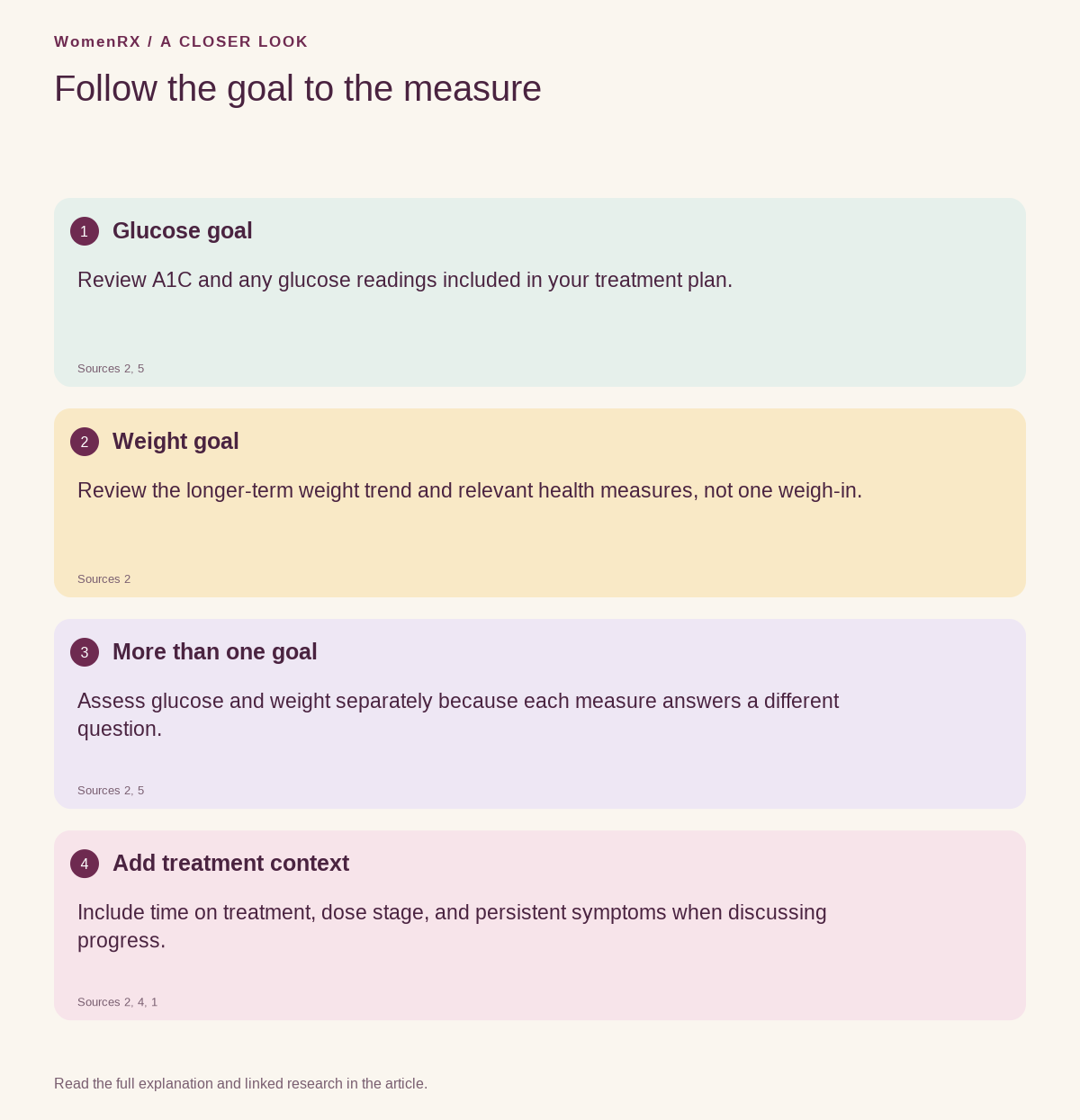
Follow the goal to the measure
Glucose goal: Review A1C and any glucose readings included in your treatment plan.25
Weight goal: Review the longer-term weight trend and relevant health measures, not one weigh-in.2
More than one goal: Assess glucose and weight separately because each measure answers a different question.25
Add treatment context: Include time on treatment, dose stage, and persistent symptoms when discussing progress.241
Read the figure as text
Use the reason for treatment to choose what to review, then add treatment stage and tolerability before judging progress.- Glucose goal: Review A1C and any glucose readings included in your treatment plan.25
- Weight goal: Review the longer-term weight trend and relevant health measures, not one weigh-in.2
- More than one goal: Assess glucose and weight separately because each measure answers a different question.25
- Add treatment context: Include time on treatment, dose stage, and persistent symptoms when discussing progress.241
More questions, answered
Does losing less than 5% by week 8 mean tirzepatide isn’t working?
No. In a post hoc analysis, participants below that early weight-loss threshold still had clinically meaningful weight and cardiometabolic improvements by week 72. The analysis doesn’t make week 8 a treatment-failure cutoff for an individual. 2
Sources you can check
- ZEPBOUND (TIRZEPATIDE) INJECTION, SOLUTION ZEPBOUND (TIRZEPATIDE) INJECTION, SOLUTION ZEPBOUND KWIKPEN (TIRZEPATIDE) INJECTION, SOLUTION [ELI LILLY AND COMPANY] | US prescribing information and patient instructionsAccessed 2026-09-25Return to first citation
- Tirzepatide Efficacy and Tolerability According to Early Weight Response: A Post Hoc Analysis of the SURMOUNT-1 and SURMOUNT-2 Trials.Kokkinos A, Thethi T, Lee CJ, Neff LM, Stefanski A, Cao D, Rodriguez A, Bartee A. · Diabetes, obesity & metabolism · 2026Return to first citation
- Association of baseline characteristics with clinical outcomes of tirzepatide treatment in Japanese patients with obesity disease: A subgroup analysis of the SURMOUNT-J trial.Yokote K, Fukushima Y, Shingaki T, Oura T, Ogawa W. · Diabetes, obesity & metabolism · 2026Return to first citation
- Tirzepatide for maintenance of bodyweight reduction in people with obesity in the USA (SURMOUNT-MAINTAIN): a multicentre, double-blind, randomised, placebo-controlled trial.Horn DB, Aronne LJ, Wharton S, Bays HE, le Roux CW, Srinath R, Gomez-Valderas E, Arad AD, Das S, Dunn JP, Ribeiro A, Glass LC, Lee CJ. · Lancet (London, England) · 2026Return to first citation
- TirzepatideFarzam K, Patel P. · 2026Return to first citation