How to Tell Whether Mounjaro Is Working for You
The clearest sign depends on your treatment goal: review glucose measures for diabetes care and treat weight change as a separate outcome.
Mounjaro is prescribed in the US to improve blood sugar control in type 2 diabetes, so judge that goal by your diabetes measures, including HbA1c when it’s measured, and the target you and your prescriber set. Weight change can be useful to track too, but early results during dose increases don’t tell the whole story. The starting dose is for treatment initiation, not glycemic control. 1 2
Start with the reason you were prescribed it
Mounjaro (tirzepatide) is indicated in the US to improve blood sugar control in people with type 2 diabetes. That makes your glucose-related goal the main measure of whether it’s working for that indication. Weight may matter to you and your care plan as well, but a change on the scale is not a substitute for assessing blood sugar. 1
Before weighing the results, clarify the goal you’re assessing. For example, you might be looking at whether your blood sugar is moving toward a target set for your diabetes care, while also keeping an eye on weight because it matters to you. Those are related but distinct outcomes: tirzepatide trials report glucose and weight results separately. 2
Give dose changes context
The first dose is intended to start treatment, not to provide glycemic control. The US prescribing information says the dose increases after four weeks, and further increases for adults may be considered after at least four weeks at the current dose when more glucose control is needed. That schedule helps explain why results early in treatment, or soon after a dose change, may not reflect the effect of a later, steady treatment plan. Don’t change your dose on your own. 1
The SURPASS studies reported HbA1c outcomes at weeks 40 to 52, but those study points aren’t instructions to wait that long before reviewing your treatment. At follow-up, your clinician can interpret your glucose measures in light of your dose, how long you’ve been taking it, and whether side effects have made dose increases difficult. 2
Compare the outcome with the goal
For a diabetes goal, look at the glucose measurements used in your care, including HbA1c when it’s measured, and whether they’re moving toward your personal target. If your goal also includes weight, track that separately rather than assuming that no scale change means no glucose benefit, or that weight loss alone means glucose is at goal. Tirzepatide studies assess both HbA1c and weight, but they don’t provide one response rule for every individual. 1 2
Dose is one part of the picture, not a scorecard. People's responses vary, and dose and time on treatment are among several factors associated with outcomes. Gastrointestinal side effects can also limit dose increases. If you’re tolerating treatment poorly, or your measurements aren’t moving toward the goal, that’s a reason to review the plan rather than simply assume the medicine has failed or increase it yourself. 2
At a follow-up, a useful discussion is: What outcome are we trying to improve? Which measurements show whether it’s changing? Have I been on the current dose long enough for you to interpret those measurements? Have side effects or other medicines affected the plan? These questions keep the review tied to your prescribed goal rather than to a single number.
What research says about women
A narrative review identifies sex as one possible factor in tirzepatide response, but it does not quantify sex-specific effects. It cannot tell you to expect a different result simply because you’re a woman. 2
If you’re pregnant or planning pregnancy, include that in your medication review. The Mounjaro Medication Guide says it isn’t known whether the medicine may harm an unborn baby. It also says oral birth-control pills may be less effective after starting Mounjaro and for four weeks after each dose increase; ask your prescriber about what this means for your contraception plan. 1
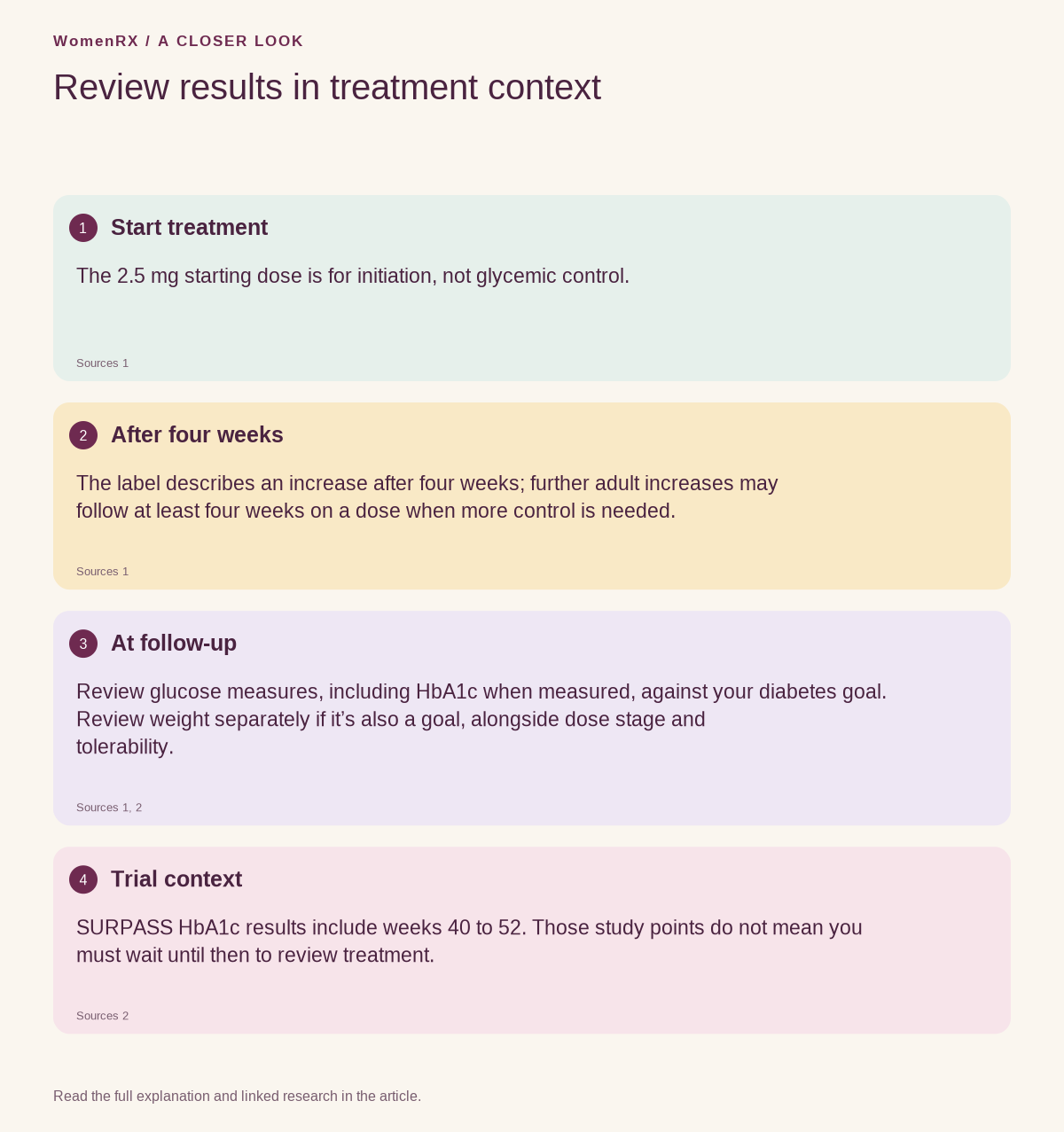
Review results in treatment context
Start treatment: The 2.5 mg starting dose is for initiation, not glycemic control.1
After four weeks: The label describes an increase after four weeks; further adult increases may follow at least four weeks on a dose when more control is needed.1
At follow-up: Review glucose measures, including HbA1c when measured, against your diabetes goal. Review weight separately if it’s also a goal, alongside dose stage and tolerability.12
Trial context: SURPASS HbA1c results include weeks 40 to 52. Those study points do not mean you must wait until then to review treatment.2
Read the figure as text
Connect the prescribed goal to dose stage, follow-up measurements, and tolerability. Trial timepoints do not set a personal waiting period.- Start treatment: The 2.5 mg starting dose is for initiation, not glycemic control.1
- After four weeks: The label describes an increase after four weeks; further adult increases may follow at least four weeks on a dose when more control is needed.1
- At follow-up: Review glucose measures, including HbA1c when measured, against your diabetes goal. Review weight separately if it’s also a goal, alongside dose stage and tolerability.12
- Trial context: SURPASS HbA1c results include weeks 40 to 52. Those study points do not mean you must wait until then to review treatment.2
More questions, answered
Does weight loss prove Mounjaro is controlling my diabetes?
No. Weight and blood sugar are separate outcomes, so weight change alone can’t establish whether your diabetes goal is being met. Review your glucose measures, including HbA1c when it’s measured, against the target used in your care plan. 1 2
Should I expect a full response on the starting dose?
The US prescribing information describes the starting dose as being for treatment initiation, not glycemic control. Your prescriber can interpret results as your dose and time on treatment change. 1
What should I ask about if I use oral birth control?
Ask how the label’s warning about oral birth-control pills applies to you. It says they may be less effective for four weeks after starting Mounjaro and for four weeks after each dose increase. 1
Sources you can check
- MOUNJARO (TIRZEPATIDE) INJECTION, SOLUTION [A-S MEDICATION SOLUTIONS] | US prescribing information and patient instructionsAccessed 2026-09-25Return to first citation
- Multidimensional Predictors of Tirzepatide Efficacy: Clinical, Genetic, and Molecular Biomarkers for Glycemic, Weight, and Organ Protection.Shin MH, Jeong JW, Ha SE, Singh R, Lee MY, Ro S, Yu TY. · Pharmaceuticals (Basel, Switzerland) · 2026Return to first citation