How Long Does Tirzepatide Take to Show Results?
There isn’t one universal wait: tirzepatide’s results are assessed over months, and the right measure depends on whether you’re treating blood sugar or weight.
Tirzepatide doesn’t have one set timeline for a “meaningful” result. In a Mounjaro trial for adults with type 2 diabetes, blood sugar and weight outcomes were reported at week 40, separately for three doses. Weight-loss studies have also followed outcomes for 72 weeks. These are group-level measurements, not a personal forecast or a dose plan. The useful checkpoint depends on your treatment goal and response. 2 4
“Working” depends on what you’re treating
Tirzepatide is sold as Mounjaro for type 2 diabetes and as Zepbound for weight reduction. The outcomes that matter aren’t identical: diabetes treatment is assessed in part by blood sugar measures, while weight treatment focuses on changes in body weight and related health goals. There isn’t one week when everyone should expect to meet a meaningful-result threshold. 1 2
That distinction can make early progress hard to interpret. A weight change is not the same measure as blood sugar control, and a scale reading by itself doesn’t capture every aspect of health. Day-to-day weight can also reflect water and other factors, not just body fat. 3
What the trial timelines tell you
In one Mounjaro trial in adults with type 2 diabetes, researchers reported HbA1c and weight changes at week 40. Participants assigned to tirzepatide had average HbA1c decreases of 1.7 to 1.8 percentage points, compared with 0.1 percentage points with placebo. Average weight changes ranged from a loss of 6.3 to 7.8 kilograms with tirzepatide, compared with 1.0 kilogram with placebo. These are averages from that particular trial, not a forecast for one person or a timeline that applies to every indication. 2
Weight studies have also used longer observation windows. For example, a post hoc analysis of participants in the SURMOUNT weight trials who were taking certain weight-inducing medications compared weight outcomes through week 72 in two trials and week 88 in another. Because this was an analysis of a subgroup, those results shouldn’t be treated as a universal expectation. These examples show weight outcomes being assessed over many months, rather than relying on a few early weigh-ins. 4
The studies use set assessment points so researchers can compare outcomes across groups. They don’t establish that an individual should lose a particular amount by a particular week. Your response may not follow the trial average, and an early result alone can’t tell you what the longer-term outcome will be.
Choose a checkpoint that matches your goal
If you’re taking tirzepatide for type 2 diabetes, ask which blood sugar measure your care team is using to judge progress and when they plan to review it. The week-40 Mounjaro trial reported results separately for 5 mg, 10 mg, and 15 mg. Those dose-group averages describe the study results, but they don’t set your personal checkpoint or tell you what dose is right for you. 2
If your goal is weight reduction, discuss how your care team will assess the trend over time, rather than using one weigh-in as a verdict. The longer trial windows help show why a quick change, or a slow start, shouldn’t automatically be read as success or failure. Weight is only one health measure, and everyday factors can affect it. 3 4
If you’re being treated for both diabetes and weight, be clear about which goals you’re reviewing. Your care team can interpret the relevant measures alongside how you’re doing with treatment. This is more useful than comparing your week-by-week progress with a trial average.
Pregnancy planning changes the timing conversation
If you’re pregnant, trying to become pregnant, or planning a pregnancy, bring that up before starting or continuing tirzepatide. Zepbound’s US prescribing information says weight loss is not recommended during pregnancy and advises stopping Zepbound when pregnancy is recognized. It also says available data in pregnant patients are insufficient to evaluate the risk of major birth defects, miscarriage, or other adverse outcomes. Ask your prescriber how to plan treatment timing for your situation. 1
A practical way to assess progress
At a follow-up, focus on three things: the health goal you’re treating, the measure being used to assess it, and the time period that makes sense for that measure. If your results aren’t moving as hoped, that is a reason to review the plan together, not proof by itself that treatment has failed. The trial averages describe groups over time; they cannot predict your personal week-by-week response.
Trial checkpoints are months apart
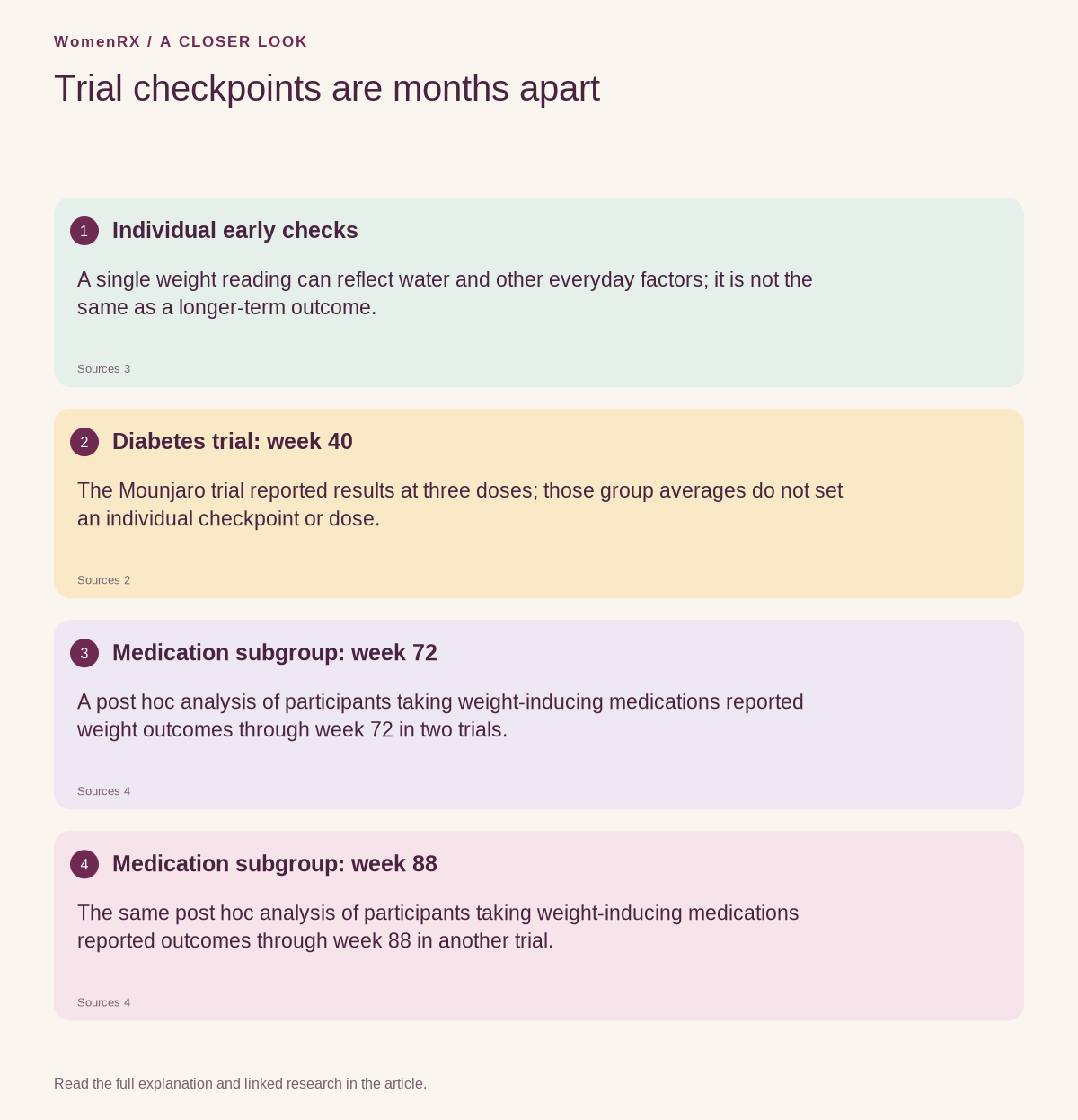
Individual early checks: A single weight reading can reflect water and other everyday factors; it is not the same as a longer-term outcome.3
Diabetes trial: week 40: The Mounjaro trial reported results at three doses; those group averages do not set an individual checkpoint or dose.2
Medication subgroup: week 72: A post hoc analysis of participants taking weight-inducing medications reported weight outcomes through week 72 in two trials.4
Medication subgroup: week 88: The same post hoc analysis of participants taking weight-inducing medications reported outcomes through week 88 in another trial.4
Read the figure as text
These endpoints show how long some studies followed outcomes. They are study measurement points, not deadlines for an individual response or a personal dose plan.- Individual early checks: A single weight reading can reflect water and other everyday factors; it is not the same as a longer-term outcome.3
- Diabetes trial: week 40: The Mounjaro trial reported results at three doses; those group averages do not set an individual checkpoint or dose.2
- Medication subgroup: week 72: A post hoc analysis of participants taking weight-inducing medications reported weight outcomes through week 72 in two trials.4
- Medication subgroup: week 88: The same post hoc analysis of participants taking weight-inducing medications reported outcomes through week 88 in another trial.4
More questions, answered
Does no quick weight loss mean tirzepatide isn’t working?
Not by itself. Trial weight outcomes were assessed over longer periods, and an individual’s early scale readings aren’t a reliable substitute for reviewing the longer-term trend and the treatment goal. 4
Do the trial doses tell me what dose I should be on?
No. A Mounjaro type 2 diabetes trial reported group results separately for 5 mg, 10 mg, and 15 mg at week 40. Those findings show how the study groups did; they don’t determine an individual dose or response timeline. 2
Should I discuss tirzepatide if I’m planning a pregnancy?
Yes. Discuss treatment timing with your prescriber before pregnancy. The Zepbound prescribing information says weight loss is not recommended during pregnancy and advises stopping it when pregnancy is recognized. 1
Sources you can check
- ZEPBOUND (TIRZEPATIDE) INJECTION, SOLUTION ZEPBOUND (TIRZEPATIDE) INJECTION, SOLUTION ZEPBOUND KWIKPEN (TIRZEPATIDE) INJECTION, SOLUTION [ELI LILLY AND COMPANY] | US prescribing information and patient instructionsAccessed 2026-09-25Return to first citation
- MOUNJARO (TIRZEPATIDE) INJECTION, SOLUTION MOUNJARO KWIKPEN (TIRZEPATIDE) INJECTION, SOLUTION [ELI LILLY AND COMPANY] | US prescribing information and patient instructionsAccessed 2026-09-25Return to first citation
- Body Weight: MedlinePlusAccessed 2026-09-25Return to first citation
- Weight Changes With Tirzepatide and Concomitant Weight-Inducing Medications: Post Hoc Analysis of Randomized Clinical Trials.Galindo RJ, Gudzune KA, Look M, Lee CJ, Benabbad I, Cao D, Meng Q, Mojdami D. · JAMA network open · 2026Return to first citation