What Six Months of Tirzepatide Can, and Can’t, Show
Six-month studies offer useful reference points, but their results describe particular groups, not a promised result for you.
Six months can show how your weight has changed during treatment, but it can’t set a personal target or predict what happens next. In one obesity-clinic study, 208 of 260 people completed six months, and most completers lost at least 5% of starting weight. A separate 24-week trial measured weight change in people receiving tirzepatide, but its adjusted group results aren’t an individual forecast. 4 5
Six months is a checkpoint, not a personal forecast
A six-month weigh-in can show whether your weight has changed during treatment. It can’t tell you exactly what another person should lose, or what your longer-term result will be. The studies at this timeframe differ in who took part, how treatment was given, and what was measured.
For example, a multicenter observational study followed adults with obesity starting tirzepatide at 15 endocrinology clinics in Greece. Of 260 people who began treatment, 208 completed six months. In the study’s reported results, 94.2% achieved at least 5% weight loss, 77.9% at least 10%, 47.1% at least 15%, and about 20% at least 20%. These are proportions reaching thresholds, not an average amount that every participant lost. The study was observational, so it describes outcomes in that group rather than proving what any one person will experience. 4
Another study measured outcomes at 24 weeks, close to six months. It was a randomized trial of 102 adults with overweight or obesity who received tirzepatide along with either apitegromab, an investigational medicine, or placebo. Among participants with a week-24 scan, the adjusted mean weight change was −11.2 kg in the apitegromab group and −12.5 kg in the placebo-add-on group. The latter group received tirzepatide without another active study medicine, but the trial had no group receiving no tirzepatide. Its result describes that treatment arm; it doesn’t measure tirzepatide’s effect against no tirzepatide or promise the same change for you. 5
Check the treatment context before comparing numbers
Indication matters. A study of people treated for obesity isn’t automatically a good match for someone using tirzepatide in a type 2 diabetes treatment context. For instance, a separate real-world study followed adults 65 and older with type 2 diabetes. Weight and BMI decreased over six months in that group, but the study does not give a percentage weight-loss figure to compare directly with the obesity-clinic results. 6
Dose and escalation matter. People may spend part of the first months increasing their dose, and studies do not all use the same approach. In a nonrandomized study of 112 non-diabetic Japanese adults with obesity, participants either stayed at 2.5 mg or increased to 5 mg after four weeks. Mean six-month weight change was −15.3% and −16.1%, respectively; the study did not find a significant difference between these groups. This cohort and its specific dosing comparison shouldn’t be treated as a general U.S. prediction or proof that dose makes no difference for an individual. 7
Follow-up and persistence matter. The Greek clinic study’s results came from people with six-month follow-up; 52 of the 260 people who started did not complete that period. Its reported thresholds therefore help describe outcomes among those completing treatment, not everyone who starts. Discontinuation occurred for several reasons, including cost, goal achievement, non-response, and adverse events. 4
What your own six-month result can tell you
Compare your starting weight with a measurement taken around the same point in treatment, and note how long you were actually taking tirzepatide and whether your dose was still changing. A percentage change can make comparisons across different starting weights easier: divide your weight change by your starting weight, then multiply by 100. That calculation describes your change; it doesn’t make you directly comparable to a study with a different population or treatment plan.
If you menstruate, bloating around your period can change how your abdomen feels. That feeling alone doesn’t measure weight change. Treat one scale reading as one data point rather than a verdict on the whole treatment course. 3
One real-world study reported greater percentage weight loss among women than men, but that was an observation in one clinic cohort. It doesn’t establish a sex-specific response or predict how much an individual woman will lose. 4
The six-month result is also different from the question of how long to continue treatment. These studies measure a checkpoint, not the course of your weight over all later months. If you’re assessing progress, use the six-month measurement alongside your treatment history; don’t extend its rate of change forward as though it will stay constant. 4 5
Pregnancy planning is a separate decision
Weight change shouldn’t be the only consideration if pregnancy is possible or planned. U.S. Zepbound medication information says the medicine may harm an unborn baby and advises people who are pregnant or planning pregnancy to tell their prescriber. Mounjaro’s medication information says it isn’t known whether it will harm an unborn baby and gives similar advice to discuss pregnancy. These are distinct product-label statements, not evidence that one product is a safer choice for pregnancy. 1 2
Both labels also warn that oral birth-control pills may work less well after starting tirzepatide and after dose increases. They describe additional contraception guidance for those periods. If you use oral contraception, include that in your treatment discussion rather than treating it as part of the weight-loss comparison. 1 2
Reading a Six-Month Tirzepatide Result
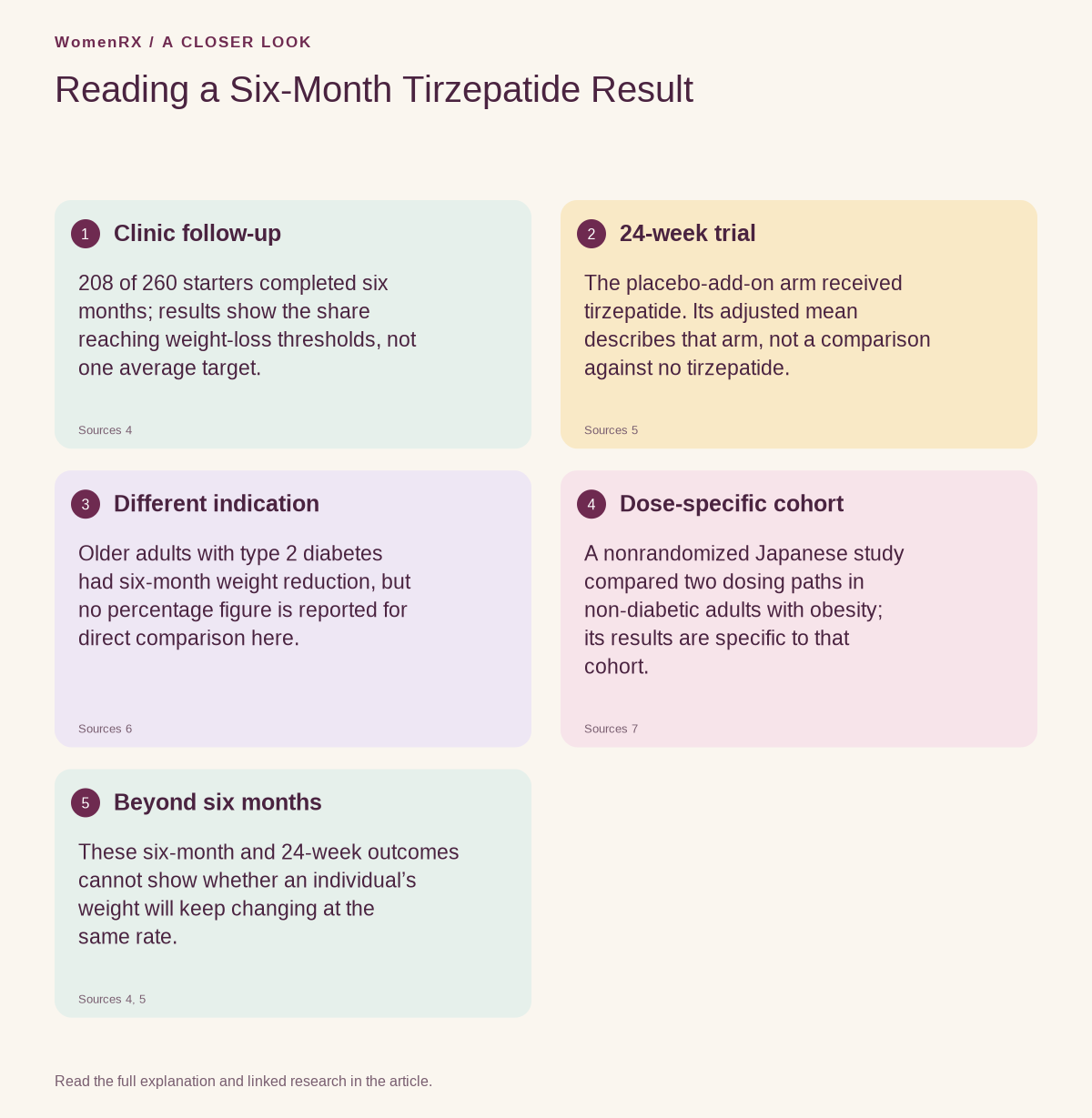
Clinic follow-up: 208 of 260 starters completed six months; results show the share reaching weight-loss thresholds, not one average target.4
24-week trial: The placebo-add-on arm received tirzepatide. Its adjusted mean describes that arm, not a comparison against no tirzepatide.5
Different indication: Older adults with type 2 diabetes had six-month weight reduction, but no percentage figure is reported for direct comparison here.6
Dose-specific cohort: A nonrandomized Japanese study compared two dosing paths in non-diabetic adults with obesity; its results are specific to that cohort.7
Beyond six months: These six-month and 24-week outcomes cannot show whether an individual’s weight will keep changing at the same rate.45
Read the figure as text
These snapshots differ in design and treatment context. They also stop at a checkpoint rather than showing an individual’s longer course.- Clinic follow-up: 208 of 260 starters completed six months; results show the share reaching weight-loss thresholds, not one average target.4
- 24-week trial: The placebo-add-on arm received tirzepatide. Its adjusted mean describes that arm, not a comparison against no tirzepatide.5
- Different indication: Older adults with type 2 diabetes had six-month weight reduction, but no percentage figure is reported for direct comparison here.6
- Dose-specific cohort: A nonrandomized Japanese study compared two dosing paths in non-diabetic adults with obesity; its results are specific to that cohort.7
- Beyond six months: These six-month and 24-week outcomes cannot show whether an individual’s weight will keep changing at the same rate.45
More questions, answered
Why not use a 24-week trial result as my six-month target?
Twenty-four weeks is close to six months. In the trial’s placebo-add-on arm, participants received tirzepatide without another active study medicine, and their reported weight change was an adjusted group mean. There was no no-tirzepatide group, and a group mean isn’t a guaranteed result for an individual. 5
Does a six-month study show what happens with longer treatment?
Not by itself. The six-month and 24-week results describe outcomes at those follow-up points. They don’t establish your later weight trajectory or show that weight will keep changing at the same rate. 4 5
Sources you can check
- ZEPBOUND (TIRZEPATIDE) INJECTION, SOLUTION ZEPBOUND (TIRZEPATIDE) INJECTION, SOLUTION ZEPBOUND KWIKPEN (TIRZEPATIDE) INJECTION, SOLUTION [ELI LILLY AND COMPANY] | US prescribing information and patient instructionsAccessed 2026-09-25Return to first citation
- MOUNJARO (TIRZEPATIDE) INJECTION, SOLUTION MOUNJARO KWIKPEN (TIRZEPATIDE) INJECTION, SOLUTION [ELI LILLY AND COMPANY] | US prescribing information and patient instructionsAccessed 2026-09-25Return to first citation
- Bloating - NHSAccessed 2026-09-25Return to first citation
- Six-Month Real-World Effectiveness, Persistence and Safety of Low-to-Moderate Dose Tirzepatide in Adults With Obesity: A Multicentre Observational Study.Angelopoulos N, Zianni D, Livadas S, Androulakis I, Fousteris E, Paparodis R, Petkova V, Florakis D, Mouslech Z, Rizoulis A, Perogamvros I, Tzoulis P, Askitis D, Argyrakopoulou G, ... · Diabetes, obesity & metabolism · 2026Return to first citation
- Apitegromab for lean mass preservation during tirzepatide-induced weight loss: a randomized, double-blind, placebo-controlled phase 2 trial.Pratley RE, Denham DS, Trivedi R, Watkins E, Connery L, Barnes J, Yu D, Hong J, Simard C, Umans K, Liu L, Tirucherai GS, Marantz JL. · Nature medicine · 2026Return to first citation
- Real-world clinical outcomes of tirzepatide administration in older patients with type 2 diabetes, with a focus on the risk of hypoglycemia and weight loss-related parameters.Kitsunai H, Maruyama F, Miyano Y, Abe T, Kurihara H, Tsuji K, Abiko A, Miyamoto Y, Homma R, Nakamura A, Nomoto H, Hokkaido-TZP Study Group. · Endocrine journal · 2026Return to first citation
- Low-Dose Tirzepatide for Obesity: Comparative Efficacy of 2.5 mg Versus 5 mg in Non-Diabetic Japanese Adults.Amioka M, Amioka H, Kinoshita H, Sairaku A, Nakano Y. · Diabetes, obesity & metabolism · 2026Return to first citation