Semaglutide at Six Months: What the Results Show
A strong semaglutide trial result is not a six-month forecast, and the most useful comparison depends on how long the study ran and what it measured.
There isn’t a single six-month weight-loss figure that works as a personal benchmark. A Cochrane review found an average 10.73-percentage-point greater reduction in body weight with semaglutide than placebo across studies lasting 6 to 17 months, not at one exact six-month checkpoint. 3 Your dose progression, time on treatment, side effects, and goals all matter when interpreting your own result.
Start with the right comparison
If you’re checking your progress at six months, the first question is whether the number you’re comparing it with is actually a six-month semaglutide result. In the Cochrane review, the main weight-loss estimate combines 15 studies and 8,651 participants followed for 6 to 17 months. Semaglutide reduced percentage body weight by an average of 10.73 percentage points more than placebo over those varied follow-up periods. That is a placebo comparison across a time range, not a six-month average and not a prediction for one person. 3
The distinction matters because “six months” can describe different things: a study’s duration, a visit partway through a longer study, or the point when someone personally checks their progress. Those aren’t interchangeable. The review also included trials with participants whose average BMI ranged from 31.9 to 40.3, so its pooled result reflects groups of people, not a matched comparison for every reader. 3
Why study averages don’t map neatly onto you
A trial average summarizes what happened across participants under study conditions. Your own result is a change from your starting point, and your experience may include interruptions, side effects, or a different treatment course. The pooled result doesn’t isolate a precise six-month estimate for each dose, starting weight, or individual circumstance. So an average can provide context, but it can’t tell you what you “should” have lost by now.
Be careful with numbers that compare different medicines rather than semaglutide with placebo. One meta-analysis reported a six-month comparison of tirzepatide and semaglutide, but it combined seven studies, including both observational studies and randomized trials, and reported very high variation between study results. It answers a different question from “How much weight did people lose on semaglutide by six months?” 2
To compare your own progress consistently, calculate the percentage change from your starting weight: subtract your current weight from your starting weight, divide by your starting weight, then multiply by 100. This makes the change easier to compare across starting weights, but it still doesn’t turn a study average into a personal target.
Make the six-month check-in useful
Rather than asking only whether you match a headline number, consider the details that explain your result. You might ask your prescriber:
- What dose have I reached, and how long have I been at it?
- Have side effects, missed doses, or other interruptions affected my treatment?
- How does my progress fit the goal we set for me, including health goals beyond the scale?
- Given my experience so far, what should we reassess about tolerability or the plan?
These questions help put a result in context without treating a group average as a pass-or-fail score. In the Cochrane review, semaglutide was associated with more non-serious adverse events than placebo, and adverse events leading to withdrawal were more likely in relative terms; the review described the absolute difference in withdrawals as little to none at medium-term follow-up. If side effects are making treatment difficult, that’s relevant information for the conversation, not a reason to hide or minimize what’s happening. 3
Women’s results and pregnancy planning
The pooled estimate describes adults with obesity as a group. It isn’t a women-specific estimate, so it can’t tell you whether women’s average weight loss at six months differs from the overall result. 3
Pregnancy planning is a separate treatment consideration, not a question answered by a six-month weight-loss average. The US Wegovy prescribing information reports fetal findings in animal studies. 1 If you’re planning pregnancy or think you may be pregnant, raise that with your prescriber before making treatment decisions.
The practical takeaway
Use six months as a moment to review what has happened and what you need next, not as a deadline for matching a trial average. The best comparison is one that accounts for the study’s actual follow-up, your treatment course, how you’re tolerating it, and the goals you and your prescriber set.
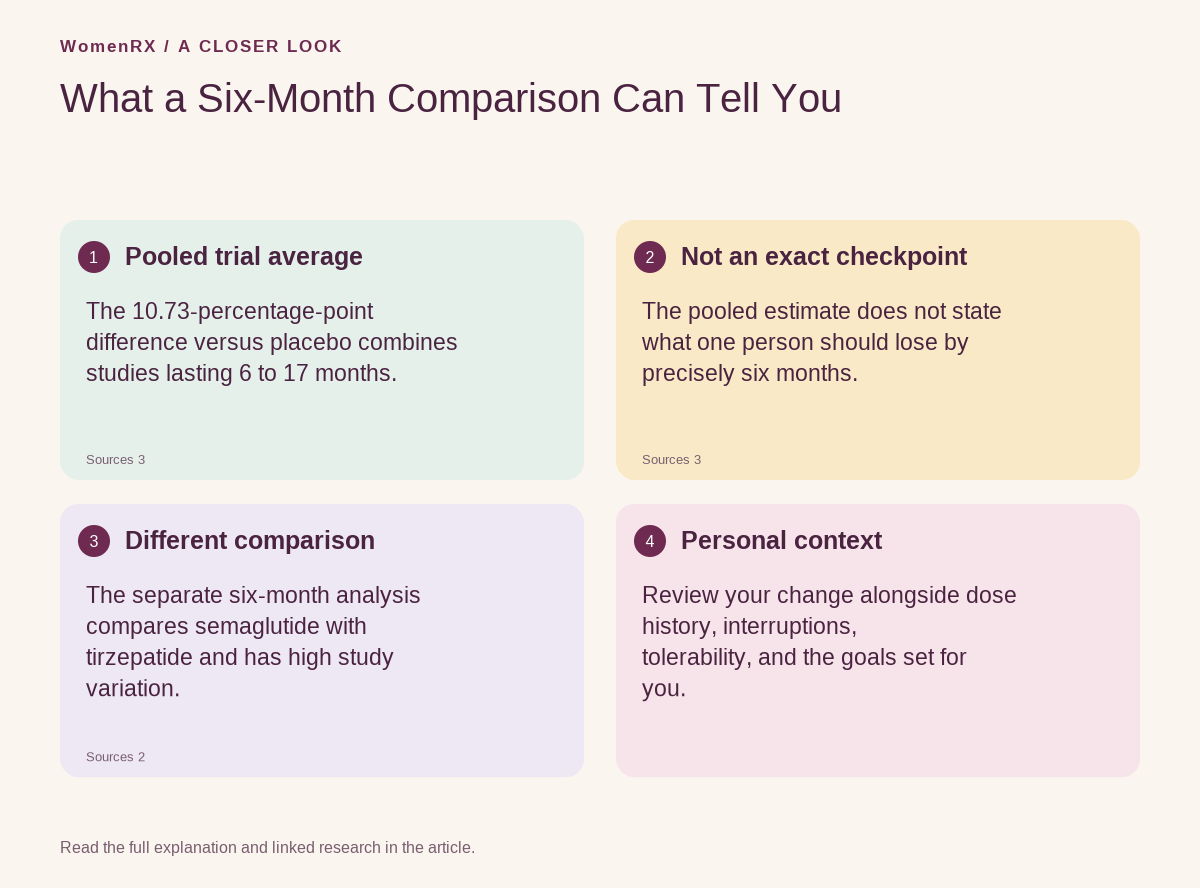
What a Six-Month Comparison Can Tell You
Pooled trial average: The 10.73-percentage-point difference versus placebo combines studies lasting 6 to 17 months.3
Not an exact checkpoint: The pooled estimate does not state what one person should lose by precisely six months.3
Different comparison: The separate six-month analysis compares semaglutide with tirzepatide and has high study variation.2
Personal context: Review your change alongside dose history, interruptions, tolerability, and the goals set for you.
Read the figure as text
Separate a pooled study result from an exact six-month measurement and from your own treatment check-in.- Pooled trial average: The 10.73-percentage-point difference versus placebo combines studies lasting 6 to 17 months.3
- Not an exact checkpoint: The pooled estimate does not state what one person should lose by precisely six months.3
- Different comparison: The separate six-month analysis compares semaglutide with tirzepatide and has high study variation.2
- Personal context: Review your change alongside dose history, interruptions, tolerability, and the goals set for you.
More questions, answered
Does the 10.73-percentage-point difference mean I should lose that much by six months?
No. It is the average difference in percentage body weight between semaglutide and placebo across studies lasting 6 to 17 months. It is not a result measured at exactly six months or an individual target. 3
Do the results show how much women lose specifically?
The cited pooled estimate describes adults with obesity as a group, not women separately. It can give you context, but it isn’t a women-specific six-month benchmark. 3
Sources you can check
- WEGOVY (SEMAGLUTIDE) INJECTION, SOLUTION WEGOVY (SEMAGLUTIDE) TABLET [NOVO NORDISK PHARMACEUTICAL INDUSTRIES, LP] | US prescribing information and patient instructionsAccessed 2026-09-25Return to first citation
- Tirzepatide Versus Semaglutide for Weight Loss in Overweight and Obese Adults: A Systematic Review and Meta-Analysis of Direct Comparative Studies.Munawar N, Mahato A, Rawat A, Gill FS, Kumar D, Katwal S, Wei CR, Ali N. · Cureus · 2025Return to first citation
- Semaglutide for adults living with obesity.Bracchiglione J, Meza N, Franco JV, Escobar Liquitay CM, Novik A V, Ocara Vargas M, Lazcano G, Poloni D, Rinaldi Langlotz F, Roqué-Figuls M, Munoz SR, Madrid E. · The Cochrane database of systematic reviews · 2025Return to first citation