Semaglutide Results Over Time: What Trials Measure
A 20-week response category and later study endpoints answer different questions about semaglutide results.
One analysis based on a semaglutide trial looked separately at people who had lost at least 5% of their starting weight after 20 weeks. That was a way to group participants for analysis, not a test that predicts anyone’s final result. Other studies report outcomes at roughly one year or 68 weeks. To read those results well, look at what was measured and who was included, not just the week. 312
The useful timeline is a set of study checkpoints
There isn’t one trial-based schedule that can tell you what your scale should show each week. Studies compare groups at planned follow-up points, and results depend on the population, treatment protocol, comparison group, and outcome being measured. A result reported at one year describes the difference between groups at that point; it doesn’t show that every participant lost weight at the same pace. 1
For example, a network meta-analysis of 262 randomized trials estimated that, at one year, adults with overweight or obesity taking subcutaneous semaglutide had a mean weight change 9.8 percentage points greater than those receiving lifestyle modification alone (95% confidence interval, 9.1 to 10.6 percentage points greater). This is a group-level comparison, not a forecast for an individual, and it is not the same as saying every person lost 9.8% of her starting weight. The review found larger weight reductions in longer-duration semaglutide trials, but that pattern doesn’t establish how a particular person’s early progress will unfold. 1
The same follow-up window can measure different things
At 68 weeks, the STEP 6 trial in Japan and South Korea reported average body-weight changes of −13.2% with semaglutide and −2.1% with placebo, a difference of 11.1 percentage points. That’s an endpoint for that trial’s participants, not a universal target for week 68. 2
A separate analysis based on the STEP-10 trial reported 52-week results for people with obesity and prediabetes. At that point, the analysis reported BMI decreases of 13.9% with semaglutide plus diet and exercise and 2.7% with diet and exercise alone, as well as prediabetes reversal in 80% and 12% of participants, respectively. This was an analysis using STEP-10 trial data, not a separate clinical trial report; its outcomes answer different questions from the body-weight comparison above. 3
One year and 52 weeks are near-equivalent follow-up intervals, but these figures come from different analyses, populations, comparisons, and outcomes. The week an outcome is measured is also different from the time spent at a stable treatment dose. These reports don’t give enough phase-specific detail to place the checkpoints within dose escalation or maintenance. 123
What a 20-week response can and can’t tell you
The STEP-10-based analysis also examined people who had lost at least 5% of their starting weight after 20 weeks as a separate group of “responders.” That gives us an earlier checkpoint, but it served a different purpose from the later trial endpoints: it defined a group for an economic analysis. It wasn’t a finding that everyone should reach 5% by week 20, or evidence that reaching or missing that mark predicts an individual’s eventual result. 3
An early measurement is one observation, while the averages above describe outcomes after longer follow-up. The network meta-analysis found greater weight reduction in longer-duration subcutaneous semaglutide trials, but that is a comparison across study durations. It doesn’t show that someone who loses less early will later catch up, or that someone who loses quickly will keep the same pace. 1
It also matters what the study counted. Body weight, BMI, and the share of participants whose prediabetes reversed aren’t interchangeable outcomes. For a meaningful comparison, consider the study’s population, treatment duration, outcome, and comparator together. An average measured at 52 or 68 weeks can’t tell you what will happen by a particular week in your own treatment.
What the evidence says about women
The reported results don’t provide a separate semaglutide weight timeline by sex or reproductive stage. They don’t establish different expected checkpoints for cycling years, perimenopause, or postmenopause. Overall trial averages shouldn’t be treated as women-specific forecasts, and a woman’s personal response can’t be read from a group average alone. 12
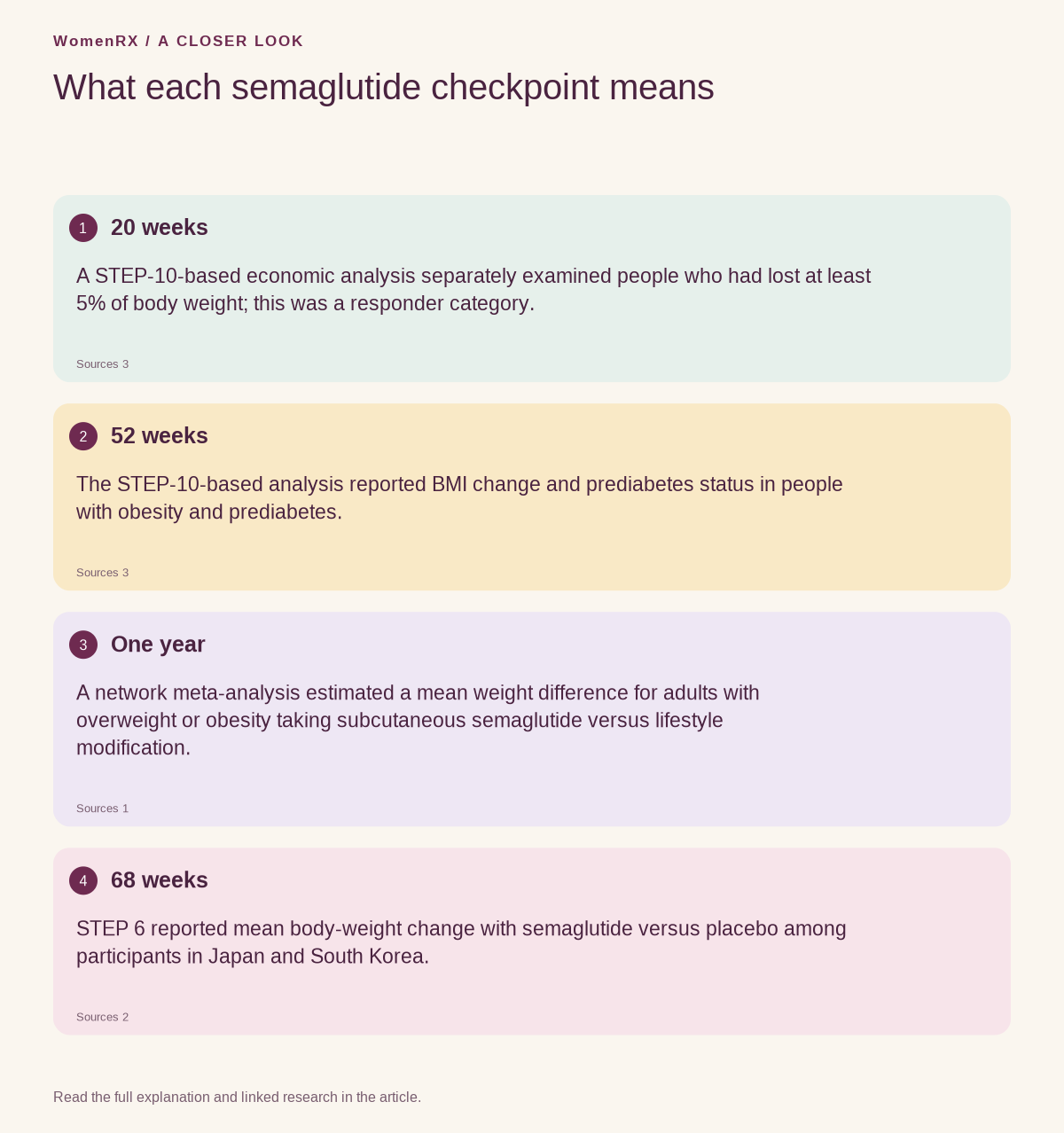
What each semaglutide checkpoint means
20 weeks: A STEP-10-based economic analysis separately examined people who had lost at least 5% of body weight; this was a responder category.3
52 weeks: The STEP-10-based analysis reported BMI change and prediabetes status in people with obesity and prediabetes.3
One year: A network meta-analysis estimated a mean weight difference for adults with overweight or obesity taking subcutaneous semaglutide versus lifestyle modification.1
68 weeks: STEP 6 reported mean body-weight change with semaglutide versus placebo among participants in Japan and South Korea.2
Read the figure as text
The earlier point groups participants for analysis; the later points report outcomes. None is a week-by-week target.- 20 weeks: A STEP-10-based economic analysis separately examined people who had lost at least 5% of body weight; this was a responder category.3
- 52 weeks: The STEP-10-based analysis reported BMI change and prediabetes status in people with obesity and prediabetes.3
- One year: A network meta-analysis estimated a mean weight difference for adults with overweight or obesity taking subcutaneous semaglutide versus lifestyle modification.1
- 68 weeks: STEP 6 reported mean body-weight change with semaglutide versus placebo among participants in Japan and South Korea.2
Sources you can check
- Comparative effects of drugs for adults with overweight or obesity: systematic review and network meta-analysis.Nong K, Shi Q, Xie X, Wang Y, Agarwal A, Guyatt GH, Zhang H, Gao Y, Khunti K, Le Roux CW, Widyahening IS, Fan Q, Liu T, Mao Y, Florez ID, Du H, Pan X, Zou X, Wang C, Sun X, Li J, H... · BMJ (Clinical research ed.) · 2026Return to first citation
- Cost-Effectiveness of Semaglutide 2.4 mg for Obesity Disease Management in Japan: A Lifetime Economic Modeling Study Incorporating Retreatment Scenarios.Kamada Y, Wada S, Matsuda H, Dai Y. · Journal of health economics and outcomes research · 2026Return to first citation
- The cost-effectiveness of subcutaneous semaglutide 2.4 mg in the management of people living with obesity and prediabetes in England.Ramos M, Larsen S, Fusco F, Lamotte M, Capehorn M. · Journal of medical economics · 2025Return to first citation