Can PCOS Go Into Remission? What Changes Over Time
Your cycles or symptoms can change without proving that PCOS has been cured.
PCOS features can shift over time, and some hormone levels may decline with age, but the research doesn’t establish a reliable point when PCOS is cured. A change in periods or symptoms alone can’t confirm that the condition has resolved. It’s still worth keeping metabolic health in the conversation: studies find a higher type 2 diabetes risk in women with PCOS, even though individual outcomes vary. 12
When symptoms change, what does that mean?
If your periods have become more regular, or you’ve noticed a change in acne or excess hair growth, it’s reasonable to wonder what that means. Your observation matters, but it does not by itself show that PCOS has gone away. PCOS is a varied condition, and the features used to recognize it can change or be hard to interpret across the lifespan. Researchers have also noted that diagnostic norms and cutoffs across ages and ethnic groups need better definition. 35
A review of longitudinal studies found limited, conflicting evidence about how most reproductive features change over time. It did find that testosterone and DHEAS levels appear to decline more in women with PCOS than in women without it, based on a limited number of studies. That finding doesn’t mean every woman’s symptoms improve, or that a change in hormone levels proves PCOS has resolved. 1
So, if your cycles have changed, it may be useful to think of that as a change in one feature, not a verdict on the whole condition. A clinician can revisit how your symptoms and test results fit together if the diagnosis is in question. The research does not offer a dependable symptom-based test for declaring PCOS cured. 13
What changes across life stages?
During the cycling years: PCOS features vary, and how they appear at one age may not be the same later. The evidence does not support one predictable course for everyone. If periods change, that is useful information about what is happening now, but it cannot settle the question of whether PCOS is gone. 13
During pregnancy: Pregnancy is not proof that PCOS has resolved. In a review of longitudinal studies, pregnant women with PCOS had a higher risk of gestational diabetes than pregnant women without PCOS. That is a reason to keep PCOS in the health conversation during pregnancy, not a prediction that you will develop gestational diabetes. 1
Around and after menopause: Menstrual patterns can no longer serve as the same kind of clue once periods have stopped. One prospective study following women in Tehran found an association between PCOS and age at natural menopause. It doesn’t establish a predictable menopause age for an individual woman or show that PCOS disappears at menopause. 4
Why keep health follow-up in view?
Feeling better is worth recognizing, but symptom relief and metabolic health are not interchangeable. A systematic review of cardiometabolic studies found a higher risk of type 2 diabetes among women with PCOS than among women without PCOS. It found that BMI changes were similar between groups of adult women and that coronary heart disease risk was similar, while evidence for many other outcomes was conflicting or inadequate. Those group findings cannot tell you exactly what will happen to you, but they explain why improving symptoms alone may not answer every health question. 2
This doesn’t mean you should expect a complication or need the same follow-up as someone else. It means that when you review PCOS care, it can be useful to discuss both the symptoms you notice and your metabolic health, including how your personal history affects what deserves attention. The studies summarized here do not establish a specific testing schedule for every woman.
The most honest answer is that PCOS features can change, but current long-term evidence does not show a clear, universal path to remission. If a diagnosis seems not to fit your current experience, ask for it to be reconsidered in light of your age, symptoms, and test results. That is different from assuming that quieter symptoms prove the original diagnosis was wrong. 13
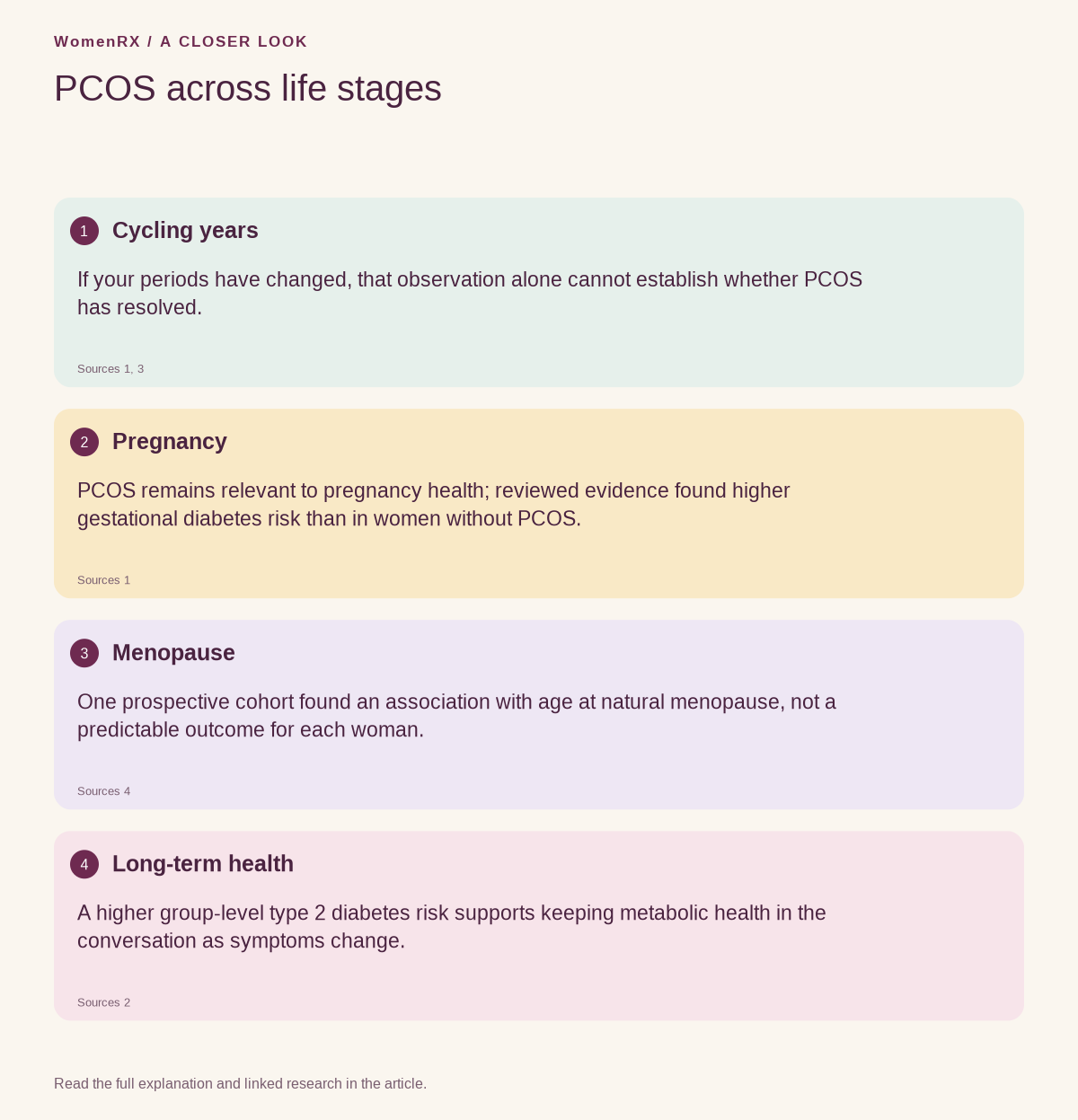
PCOS across life stages
Cycling years: If your periods have changed, that observation alone cannot establish whether PCOS has resolved.13
Pregnancy: PCOS remains relevant to pregnancy health; reviewed evidence found higher gestational diabetes risk than in women without PCOS.1
Menopause: One prospective cohort found an association with age at natural menopause, not a predictable outcome for each woman.4
Long-term health: A higher group-level type 2 diabetes risk supports keeping metabolic health in the conversation as symptoms change.2
Read the figure as text
These stages show questions that can change over time, not a predicted path every woman with PCOS will follow.- Cycling years: If your periods have changed, that observation alone cannot establish whether PCOS has resolved.13
- Pregnancy: PCOS remains relevant to pregnancy health; reviewed evidence found higher gestational diabetes risk than in women without PCOS.1
- Menopause: One prospective cohort found an association with age at natural menopause, not a predictable outcome for each woman.4
- Long-term health: A higher group-level type 2 diabetes risk supports keeping metabolic health in the conversation as symptoms change.2
More questions, answered
If my periods are regular now, does that mean PCOS is gone?
Not by itself. Period patterns are one feature, and research has not established a reliable symptom-based test for declaring PCOS resolved. A change in cycles can be discussed as part of reassessing how the diagnosis fits now. 13
Does PCOS always get better after menopause?
Longitudinal evidence about changes in PCOS reproductive features is limited and conflicting, so it doesn’t establish that PCOS always improves after menopause. A study of menopause timing assessed age at natural menopause, not whether symptoms improve or disappear afterward. 14
Sources you can check
- Where are we in understanding the natural history of polycystic ovary syndrome? A systematic review of longitudinal cohort studies.Kiconco S, Tay CT, Rassie KL, Azziz R, Teede HJ, Joham AE. · Human reproduction (Oxford, England) · 2022Return to first citation
- Natural history of polycystic ovary syndrome: A systematic review of cardiometabolic outcomes from longitudinal cohort studies.Kiconco S, Tay CT, Rassie KL, Azziz R, Teede HJ, Joham AE. · Clinical endocrinology · 2022Return to first citation
- The Need to Reassess the Diagnosis of Polycystic Ovary Syndrome (PCOS): A Review of Diagnostic Recommendations from the International Evidence-Based Guideline for the Assessment and Management of PCOS.Kiconco S, Teede HJ, Azziz R, Norman RJ, Joham AE. · Seminars in reproductive medicine · 2021Return to first citation
- A prospective study on the relationship between polycystic ovary syndrome and age at natural menopause.Amiri M, Rahmati M, Firouzi F, Azizi F, Ramezani Tehran F, Ramezani Tehran F. · Menopause (New York, N.Y.) · 2024Return to first citation
- Challenges in diagnosis and understanding of natural history of polycystic ovary syndrome.Joham AE, Piltonen T, Lujan ME, Kiconco S, Tay CT. · Clinical endocrinology · 2022Return to first citation