Can PCOS Be Reversed, or Is It Managed Over Time?
PCOS symptoms and health measures can improve, but improvement in one area doesn’t mean the condition has permanently gone away.
PCOS is generally managed over time, with treatment chosen for what you want to improve. Periods may become more predictable or metabolic measures may change, but neither outcome alone establishes a permanent cure. If pregnancy is your goal, care may focus on approaches intended to induce ovulation rather than simply make bleeding more predictable.1567
What does “reversed” mean to you?
If your periods have become more predictable, that’s a meaningful improvement. It doesn’t show that PCOS has permanently gone away. PCOS can involve irregular ovulation, higher androgen levels, and metabolic concerns in different combinations. Symptoms vary from person to person.7
It helps to name the outcome you care about. Are you hoping for fewer unpredictable periods? Better metabolic health? A chance to conceive? Those goals overlap, but they aren’t interchangeable. Research showing a change in cycle length or weight, for example, cannot by itself establish a lasting cure or a better chance of having a baby.34
If unpredictable periods are the main concern
PCOS can disrupt ovulation, which may make periods irregular or absent. But PCOS isn’t the only possible reason a cycle changes; thyroid problems and the transition toward menopause can also affect timing. A new change in your usual pattern, bleeding between periods, or periods lasting longer than seven days deserves a care conversation rather than an assumption that it’s “just PCOS.”17
When pregnancy isn’t the goal, treatment may focus on managing bleeding and other symptoms rather than prompting ovulation. The combined birth control pill is one option that may make periods more regular when PCOS is the cause. That’s a different aim from fertility treatment. 167
Lifestyle changes may affect cycles, too, though a result in one study won’t predict yours. In a six-month trial that randomized 120 college students ages 18 to 22 with PCOS, a complete-case analysis of 86 participants found shorter average cycles with dietary changes plus Tai Chi than with dietary changes alone. The trial’s intention-to-treat sensitivity analysis confirmed its primary lifestyle-score finding, not this cycle-length result. The trial did not establish whether participants ovulated regularly, whether the changes lasted after the intervention, or whether Tai Chi offered a benefit beyond other forms of exercise.3
If you’re focused on metabolic health
PCOS is associated with metabolic risks, but having PCOS doesn’t mean you have every related condition. Blood sugar, blood pressure, and cholesterol are distinct concerns; a change in weight doesn’t tell you how all three are doing. Lifestyle measures such as physical activity and a nutritious eating pattern can be useful for metabolic health without being framed as a requirement to “cure” PCOS.257
Metformin is also used in PCOS care, but its potential value depends on the outcome being considered. A review of 16 randomized trials in non-menopausal women with PCOS compared metformin and other medications or supplements for weight and selected metabolic measures. Some treatments reduced weight, while none showed a significant effect on the review’s measure of insulin resistance. The review did not assess reproductive outcomes or overall PCOS improvement, so it cannot identify one best treatment for every goal.5
If you’re trying to conceive
The question shifts from When will I bleed? to Am I ovulating, and what will help me conceive? Irregular periods can make pregnancy harder because ovulation may not happen regularly. PCOS is a common cause of infertility, but many women with PCOS can still become pregnant.17
Lifestyle support and fertility treatment needn’t be viewed as competing choices. Ovulation-inducing medicines are among the approaches used in PCOS care when pregnancy is the goal; a treatment intended to make bleeding more predictable serves a different purpose.61 And weight change is not a reliable stand-in for a live birth: in a randomized trial of 127 women with infertility and obesity, including some with PCOS, a six-month lifestyle program produced more weight loss than usual fertility care but did not establish an improvement in live births from pregnancies conceived within 18 months. The trial did find more natural pregnancies in the lifestyle group, but it did not report a separate PCOS result in the cited findings.4
As you approach menopause
Cycles commonly become less regular near menopause, so a changing period pattern may not be explained by PCOS alone. If pregnancy is no longer a goal, it makes sense to judge management by the concerns that remain, such as symptoms and metabolic health, rather than by whether an intervention promotes ovulation. The medication review described above studied non-menopausal women, so it cannot tell us how well those treatments work after menopause.5
The useful distinction is between progress and permanence. A better cycle pattern, an improved health measure, or a pregnancy can matter a great deal. Each is an outcome worth assessing on its own, not proof that PCOS can no longer affect you.347
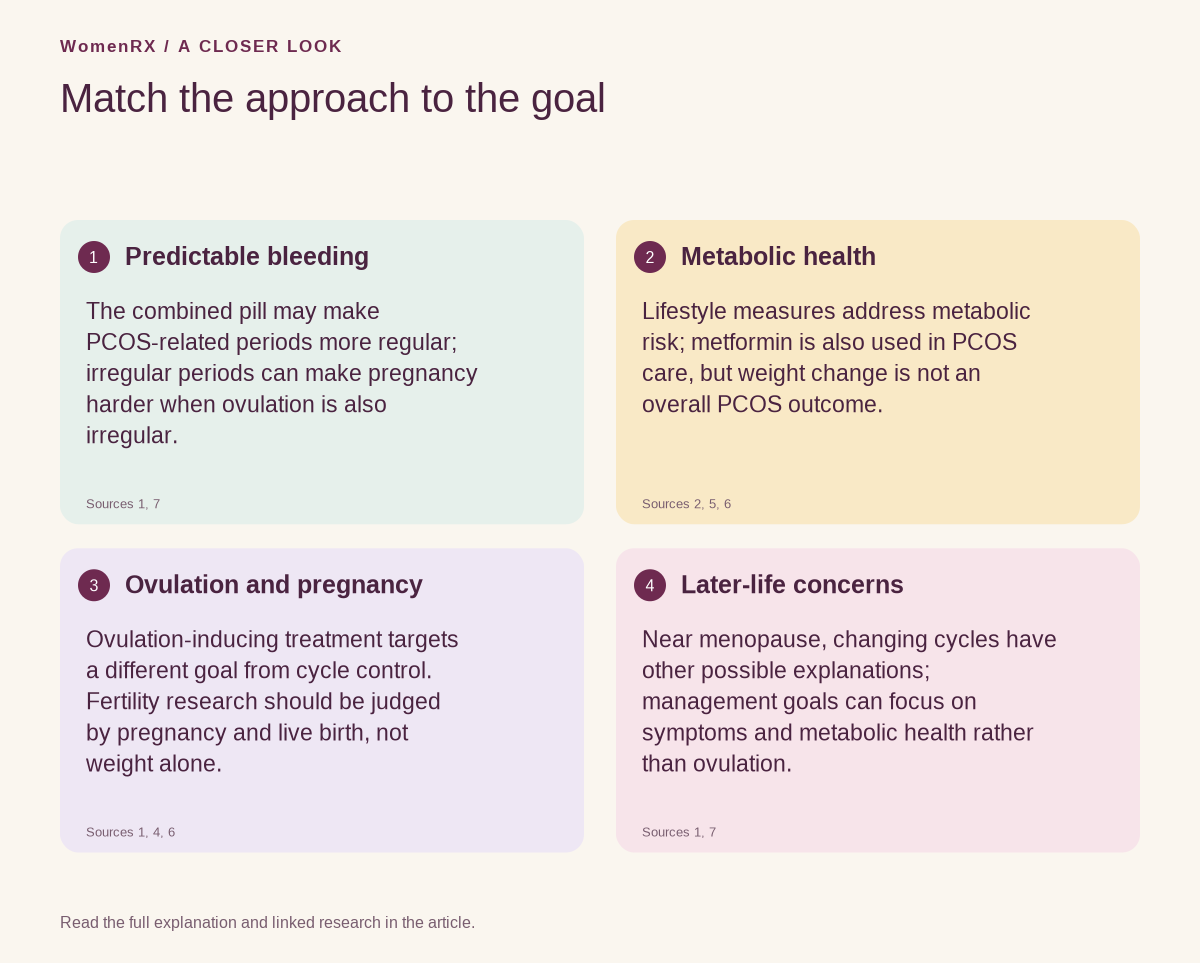
Match the approach to the goal
Predictable bleeding: The combined pill may make PCOS-related periods more regular; irregular periods can make pregnancy harder when ovulation is also irregular.17
Metabolic health: Lifestyle measures address metabolic risk; metformin is also used in PCOS care, but weight change is not an overall PCOS outcome.256
Ovulation and pregnancy: Ovulation-inducing treatment targets a different goal from cycle control. Fertility research should be judged by pregnancy and live birth, not weight alone.146
Later-life concerns: Near menopause, changing cycles have other possible explanations; management goals can focus on symptoms and metabolic health rather than ovulation.17
Read the figure as text
These are different outcomes, not different ways to prove PCOS has gone away.- Predictable bleeding: The combined pill may make PCOS-related periods more regular; irregular periods can make pregnancy harder when ovulation is also irregular.17
- Metabolic health: Lifestyle measures address metabolic risk; metformin is also used in PCOS care, but weight change is not an overall PCOS outcome.256
- Ovulation and pregnancy: Ovulation-inducing treatment targets a different goal from cycle control. Fertility research should be judged by pregnancy and live birth, not weight alone.146
- Later-life concerns: Near menopause, changing cycles have other possible explanations; management goals can focus on symptoms and metabolic health rather than ovulation.17
Sources you can check
- Irregular periods - NHSAccessed 2026-09-25Return to first citation
- Metabolic Syndrome | MedlinePlusAccessed 2026-09-25Return to first citation
- Effects of Tai Chi combined with dietary intervention on health-promoting lifestyle and metabolic and reproductive outcomes in female college students with polycystic ovary syndrome: a randomized controlled trial.Ren J, Chen H, Zhang L, Cui C, Wang L, He Q, Feng Y, Liang L. · Frontiers in endocrinology · 2026Return to first citation
- Lifestyle intervention before and during fertility treatment in women with obesity or with overweight and PCOS-a RCT.Belan M, Giguère-Johnson M, Carranza-Mamane B, Pesant MH, AinMelk Y, Langlois MF, Lavoie H, Greenblatt EM, Laredo S, Sagle M, Waddell G, Jean-Denis F, Baillargeon JP. · The Journal of clinical endocrinology and metabolism · 2026Return to first citation
- Comparative analysis of glucagon-like peptide-1 receptor agonists, metformin, and inositol in improving anthropometric and metabolic outcomes in women with polycystic ovary syndrome: a network meta-analysis.Omarion A, Ayasa Y, Omarion Z, Jayouse B, Ayesh H. · Frontiers in endocrinology · 2026Return to first citation
- Efficacy and safety of SarogLItazar as an add-on medication to Metformin and lifestyle intervention in women with PolyCystic Ovary Syndrome (SLIM-PCOS trial): study protocol for a randomized, open-label, parallel group clinical trial.Mittal N, Singhal S, Mittal R. · Trials · 2026Return to first citation
- PCOS | Polycystic Ovary Syndrome | MedlinePlusAccessed 2026-09-25Return to first citation