Creatine Over Time: What Long-Term Safety Studies Show
Long-term evidence is reassuring in some groups, but it doesn’t cover every dose, product, or stage of life.
Creatine has been studied for up to a year in a small trial of postmenopausal women and for as long as five years in a review focused mainly on healthy athletes and bodybuilders. That’s useful, but it doesn’t establish safety for every dose, formulation, or health condition. Creatine can also raise blood creatinine, which may affect creatinine-based kidney estimates without proving kidney injury. 3 5 1
If you take creatine regularly, the useful question isn’t simply whether it’s “safe long term.” It’s how closely your use matches the people, product, amount, and duration actually studied, and whether a change in a kidney blood test could be related to creatine.
What “long term” means in the research
The evidence covers several different situations, not one continuous study of all creatine users. A 2018 review of 19 clinical and experimental reports described studies lasting from five days to five years, mostly in healthy athletes and bodybuilders without known kidney disease. The studies used different amounts, so that range describes what was studied, not a recommended dose or proof that every amount is safe for everyone. 5
A separate randomized trial followed 109 postmenopausal women with osteopenia for one year. The creatine group took 1 gram daily; the comparison group took placebo. The study found no significant changes in safety laboratory measures or the health and function outcomes it assessed. But this was one year at a low dose in a specific group, not evidence about all doses or all women. 3
A systematic review of 17 randomized trials in older adults examined creatine alongside exercise. It found limited evidence across different outcomes, and called for more research on dose and duration. Results in older adults can’t automatically be applied to younger women or to people with health conditions. 4
So when reviewing your own routine, separate the number of months or years you’ve used creatine from the duration studied in people like you. Also check the product’s form and daily amount against the study you’re using as a comparison. The available studies do not establish that findings for one product or study group apply equally to every creatine product.
Creatinine can complicate a kidney test
Creatine can affect serum creatinine, a blood marker used in some kidney assessments. In a 2026 systematic review and meta-analysis of 26 randomized trials involving 1,036 participants, creatine was associated with an average serum creatinine increase of 0.14 mg/dL compared with placebo. Estimates of filtration based on creatinine also fell. However, the review found no significant difference in filtration measured with Cr-EDTA, or in several urine and blood markers it assessed. The authors said the pattern likely reflected altered creatinine metabolism rather than kidney injury. 1
That doesn’t mean you should dismiss a high creatinine result. It means a result needs context: your health history, creatine use, and the other information available to the person interpreting your labs. If you have bloodwork coming up or are discussing a result, mention the product and amount you take. Don’t interpret a creatinine value on its own or assume creatine is the cause.
Health conditions and life stages matter
The reassuring findings in healthy adults don’t settle the question for people with existing kidney disease. The long-term review focused on people without underlying kidney disease, while the newer meta-analysis included some studies involving people with chronic kidney disease but still found that creatinine-based measures can be difficult to interpret. These findings don’t establish that creatine is safe for you if you have kidney disease; make that a specific question for the clinician who knows your situation. 5 1
Women’s evidence is especially specific rather than broad. The one-year trial in postmenopausal women offers some direct information for that group, but its low dose and limited duration don’t answer questions about higher amounts, cycling years, or perimenopause. A review of older-adult trials also noted that evidence on dose and duration remains limited. 3 4
Pregnancy and breastfeeding need separate consideration. A study of pregnant women and health professionals explored attitudes toward creatine as a pregnancy supplement; it was not a trial testing safety or outcomes in pregnant people taking creatine. It therefore can’t establish whether taking creatine during pregnancy is safe. This evidence also doesn’t establish safety during breastfeeding. 2
A practical way to review your routine
Write down the product form, the amount you take, how long you’ve taken it, and any kidney condition or recent kidney-related test result you’re concerned about. Then compare your use with the population and duration in the evidence, rather than treating the longest reported study as a guarantee. The one-year women’s trial, for example, applies most directly to its postmenopausal participants and its specific low-dose regimen. 3
If your kidney results have changed, share your creatine use when the results are reviewed. A rise in creatinine can complicate a creatinine-based estimate, but the finding alone cannot tell you whether your kidneys are healthy or whether creatine is responsible. 1
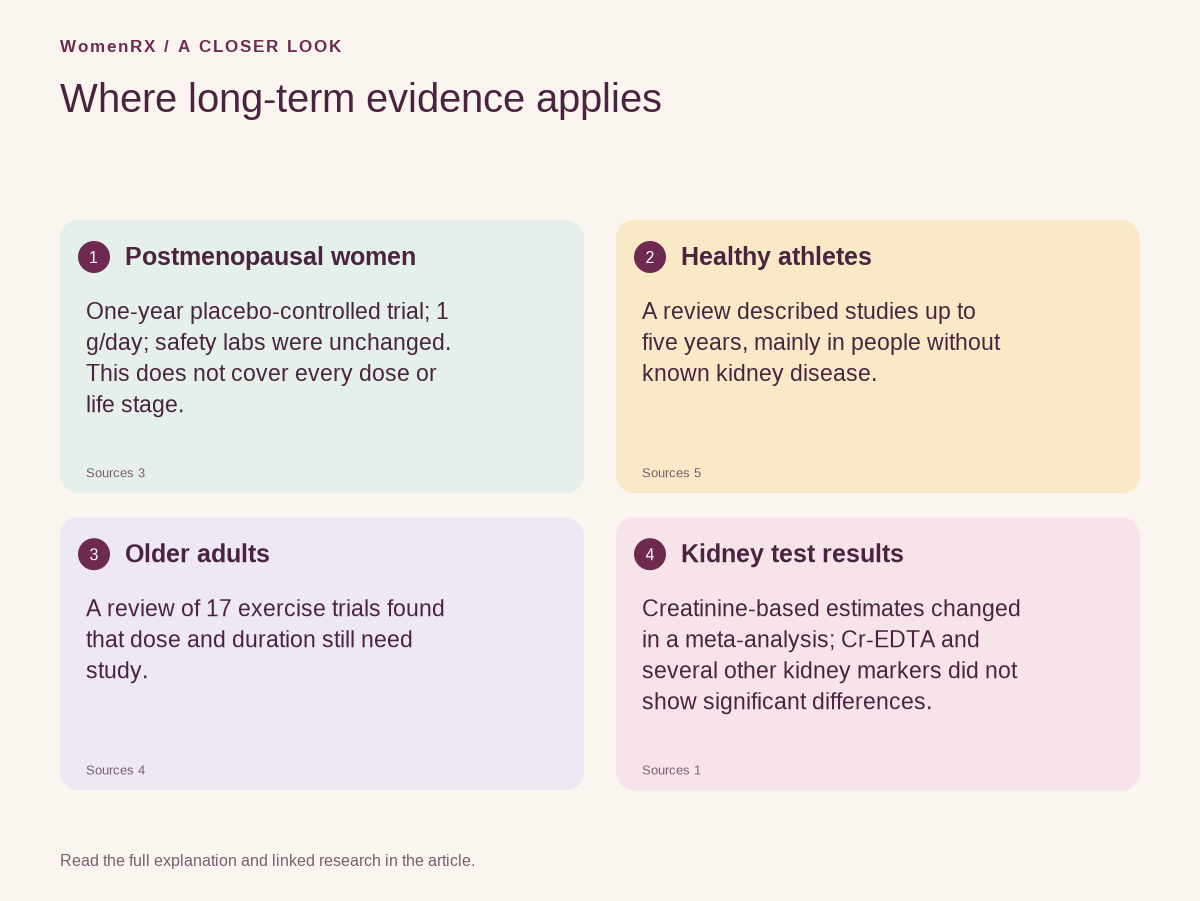
Where long-term evidence applies
Postmenopausal women: One-year placebo-controlled trial; 1 g/day; safety labs were unchanged. This does not cover every dose or life stage.3
Healthy athletes: A review described studies up to five years, mainly in people without known kidney disease.5
Older adults: A review of 17 exercise trials found that dose and duration still need study.4
Kidney test results: Creatinine-based estimates changed in a meta-analysis; Cr-EDTA and several other kidney markers did not show significant differences.1
Read the figure as text
These study groups and measurements answer different questions. Match your situation to the closest evidence, and treat gaps as gaps rather than guarantees.- Postmenopausal women: One-year placebo-controlled trial; 1 g/day; safety labs were unchanged. This does not cover every dose or life stage.3
- Healthy athletes: A review described studies up to five years, mainly in people without known kidney disease.5
- Older adults: A review of 17 exercise trials found that dose and duration still need study.4
- Kidney test results: Creatinine-based estimates changed in a meta-analysis; Cr-EDTA and several other kidney markers did not show significant differences.1
More questions, answered
Does a creatinine increase mean creatine damaged my kidneys?
Not by itself. A meta-analysis found higher serum creatinine and lower filtration estimates calculated from creatinine, but no significant difference in filtration measured with Cr-EDTA or in several other kidney markers. A lab result still needs interpretation in your individual context. 1
Does the one-year study apply to all women?
No. It studied postmenopausal women with osteopenia taking a specific low dose for one year. It doesn’t establish what happens with other amounts, longer use, or in women at other life stages. 3
Sources you can check
- Impact of creatine supplementation on kidney health: a systematic review and meta-analysis.de Souza Almeida A, da Silva LOD, Takahasi BNA, Terada BD, Gonçalves FGA, Porto BC, da Silva Sardenberg RA, Passerotti CC, Maia RS, Samaan F, Thoman M, Molina WR, Shiomi da Cruz JA... · International urology and nephrology · 2026Return to first citation
- Acceptability of dietary or nutritional supplementation in pregnancy (ADONS) - Exploring the consumer's perspective on introducing creatine monohydrate as a pregnancy supplement.de Guingand DL, Palmer KR, Bilardi JE, Ellery SJ. · Midwifery · 2020Return to first citation
- Effects of long-term low-dose dietary creatine supplementation in older women.Lobo DM, Tritto AC, da Silva LR, de Oliveira PB, Benatti FB, Roschel H, Nieß B, Gualano B, Pereira RM. · Experimental gerontology · 2015Return to first citation
- The Additive Effects of Creatine Supplementation and Exercise Training in an Aging Population: A Systematic Review of Randomized Controlled Trials.Stares A, Bains M. · Journal of geriatric physical therapy (2001) · 2020Return to first citation
- Potential Adverse Effects of Creatine Supplement on the Kidney in Athletes and Bodybuilders.Davani-Davari D, Karimzadeh I, Ezzatzadegan-Jahromi S, Sagheb MM. · Iranian journal of kidney diseases · 2018Return to first citation