Evening Primrose Oil: What Long-Term Safety Studies Show
Studies offer some short-term reassurance for breast pain, but they don’t tell us whether taking evening primrose oil for years is safe.
Evening primrose oil has been studied in women with breast pain, including one six-month trial, and a review of 13 trials found no increase in several reported side effects compared with other treatments. That’s not the same as establishing safety with years of use. Evidence for menopause, pregnancy, and breastfeeding is not interchangeable with breast-pain research, and specific medicine interactions need an individual check. 4 5
If you’ve been taking evening primrose oil (EPO) regularly, the most useful distinction is between no increase in selected reported side effects during breast-pain studies and evidence that continued use is safe over the long term. The cited findings don’t establish whether serious harms were assessed, or whether years of use are safe. 4 5
What the breast-pain studies can tell you
A 2021 systematic review and meta-analysis included 13 randomized trials, with 1,752 participants, studying EPO for mastalgia, or breast pain. Compared with placebo or other treatments, the review found no difference in reported nausea, abdominal bloating, headache or dizziness, weight gain, or altered taste. This is reassuring about those reported effects in the trials, but it doesn’t establish safety over years of use. 4
A separate randomized study followed 126 premenopausal women with cyclical breast pain for six months. It reported that adverse effects were minimal and similar across treatment groups. The authors specifically said that longer follow-up is needed to understand prolonged use and potential adverse effects. Six months is a useful study window, but it isn’t evidence about taking EPO indefinitely. 5
These studies address EPO used for breast pain. They don’t automatically answer questions about a different product, another symptom, or another life stage. The meta-analysis compared EPO with several treatments, but its reported safety results don’t provide a single long-term exposure period that you can use as a general safety benchmark. 4
Your reason for taking it matters
Cyclical breast pain: This is where the breast-pain trials are most directly relevant. They give some information about reported side effects during treatment, including a six-month study, but not about years of continued use. The meta-analysis also found no clear pain-relief advantage over placebo or other treatments, so a decision to keep taking it shouldn’t assume that benefit is established. 4 5
Menopausal symptoms: A study of premenopausal women with cyclical breast pain isn’t a menopause safety study. The findings above can’t establish long-term safety for using EPO for hot flashes or other menopausal symptoms. 5
Pregnancy: Pregnancy changes the decision. General guidance notes that herbs and supplements may harm a developing fetus and advises checking before taking them during pregnancy. That warning isn’t proof that EPO causes harm, but the breast-pain trials don’t establish that it’s safe during pregnancy. 3 4
Breastfeeding: Breastfeeding needs its own assessment, too. General guidance notes that some medicines can pass through breast milk, but that information doesn’t establish what happens with EPO specifically. The breast-pain findings don’t answer whether EPO is safe while breastfeeding. 1 4
Medicines and side effects: what to check
The cited breast-pain review and six-month trial don’t establish which specific medicines interact with EPO. 4 5 These studies don’t support naming a particular prescription drug as a confirmed interaction, but they don’t rule out interactions either. MedlinePlus notes that some herbal products can interact with prescription and over-the-counter medicines generally. 2
If you take medicines, have a pharmacist or prescriber check your specific product and medication list before you keep using EPO. Include the product label, since “evening primrose oil” alone doesn’t tell them every detail of what you’re taking. This is especially relevant when you’re adding a supplement to ongoing treatment or considering continued use beyond the period studied.
In the mastalgia review, reported effects included nausea, bloating, headache or dizziness, weight gain, and altered taste; the review did not find these more often with EPO than with comparison treatments. If you notice a new or troublesome effect, don’t treat the study’s group-level results as proof that EPO can’t be responsible. 4
A practical way to weigh continued use
Think about three separate questions: What symptom are you treating? What benefit have you noticed? What duration and life-stage evidence actually matches your situation? For cyclical breast pain, there is limited adverse-effect information up to six months, but not a clear answer about years of use. For menopause, pregnancy, or breastfeeding, the breast-pain safety findings don’t fill the evidence gap. If you’re weighing ongoing use, bring the product label and your medication list to a pharmacist or prescriber for a specific review, rather than assuming “natural” means interaction-free. 2 4 5
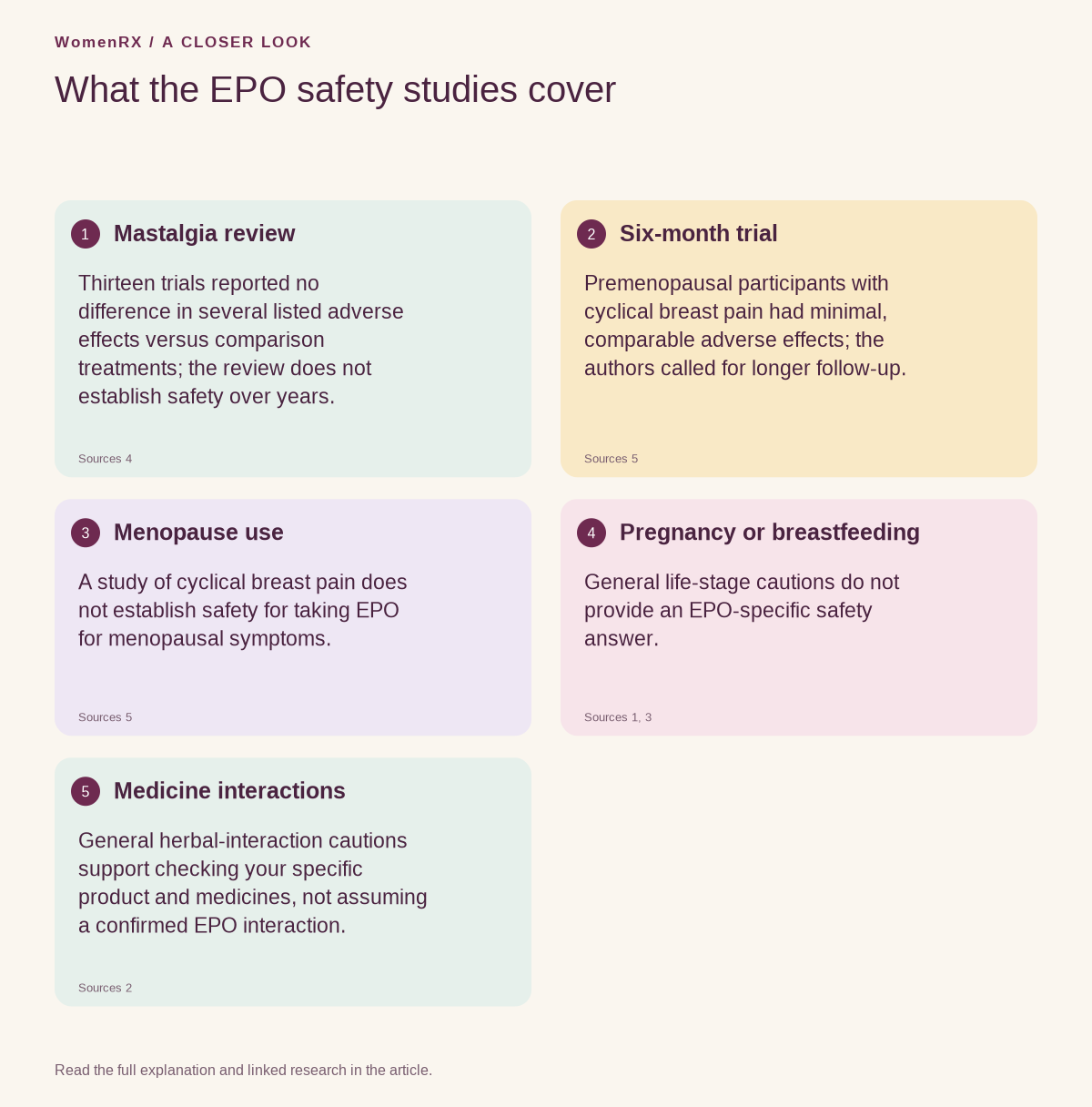
What the EPO safety studies cover
Mastalgia review: Thirteen trials reported no difference in several listed adverse effects versus comparison treatments; the review does not establish safety over years.4
Six-month trial: Premenopausal participants with cyclical breast pain had minimal, comparable adverse effects; the authors called for longer follow-up.5
Menopause use: A study of cyclical breast pain does not establish safety for taking EPO for menopausal symptoms.5
Pregnancy or breastfeeding: General life-stage cautions do not provide an EPO-specific safety answer.13
Medicine interactions: General herbal-interaction cautions support checking your specific product and medicines, not assuming a confirmed EPO interaction.2
Read the figure as text
The evidence is clearest for reported side effects during breast-pain treatment, not for years of use or every life stage.- Mastalgia review: Thirteen trials reported no difference in several listed adverse effects versus comparison treatments; the review does not establish safety over years.4
- Six-month trial: Premenopausal participants with cyclical breast pain had minimal, comparable adverse effects; the authors called for longer follow-up.5
- Menopause use: A study of cyclical breast pain does not establish safety for taking EPO for menopausal symptoms.5
- Pregnancy or breastfeeding: General life-stage cautions do not provide an EPO-specific safety answer.13
- Medicine interactions: General herbal-interaction cautions support checking your specific product and medicines, not assuming a confirmed EPO interaction.2
More questions, answered
Does a six-month study mean evening primrose oil is safe to take for years?
No. A six-month study can describe what researchers observed during that period, but it can’t establish safety with years of use. In the study of women with cyclical breast pain, the authors said longer follow-up was needed to assess prolonged use and potential adverse effects. 5
Do we know which medicines interact with evening primrose oil?
The cited breast-pain studies don’t establish a dependable EPO-specific interaction list. Herbal products can interact with prescription and over-the-counter medicines generally, so have a pharmacist or prescriber check your actual product against your medicines. 2 4 5
Sources you can check
- Breastfeeding | Benefits of Breastfeeding | MedlinePlusAccessed 2026-09-25Return to first citation
- Herbal Medicine: MedlinePlusAccessed 2026-09-25Return to first citation
- Pregnancy and Medicines | MedlinePlusAccessed 2026-09-25Return to first citation
- A Systematic Review and Meta-Analysis of the Efficacy of Evening Primrose Oil for Mastalgia Treatment.Ahmad Adni LL, Norhayati MN, Mohd Rosli RR, Muhammad J. · International journal of environmental research and public health · 2021Return to first citation
- Effectiveness of Evening Primrose and Vitamin E for Cyclical Mastalgia: A Prospective Study.Kumari J, Amrita, Sinha A, Kumari S, Biswas P, Poonam. · Cureus · 2024Return to first citation