Evening Primrose Oil: Does Taking It With Food Help?
The clinical findings described here don’t establish whether food prevents evening primrose oil’s digestive side effects, but your label and your own comfort can guide when you take it.
Clinical findings don’t establish whether food changes stomach symptoms from evening primrose oil (EPO). Research reports mild nausea in some women taking it for menopausal hot flashes, and a review of oral use mentions stomach upset, heartburn, and flatulence. Neither finding establishes that a meal prevents these effects. Check your product’s directions; if it upsets your stomach, trying it with food is a reasonable personal test, not a proven fix. 1 2
What clinical findings do and don’t say
If EPO bothers your stomach, it’s understandable to wonder whether taking it with a meal will help. The findings described in research on menopausal hot flashes and oral EPO use don’t establish whether food changes the chance or severity of digestive symptoms. So there’s no supported reason to expect an empty stomach to improve the experience, or to promise that a meal will prevent discomfort. 1 2
A systematic review of EPO for menopausal hot flashes reported mild nausea among some participants. A separate review of oral EPO use lists flatulence, heartburn, and stomach upset as possible reactions. Neither finding tells us whether those symptoms are more likely when the oil is taken without food. 1 2
If your product label allows it, you could try taking a dose with a meal and notice whether that feels better for you. Think of this as a practical personal test, not a proven way to prevent side effects. Follow the label rather than changing how much you take to make a meal-time experiment easier.
Check whether a study matches your product
“Evening primrose oil” doesn’t necessarily mean every capsule is identical. Products can differ in their oil preparation and fatty-acid content, and results from one supplement may not apply neatly to another. A review of EPO preparations for facilitating parturition in peripartum people reported fatty-acid ranges for preparations used in those studies; that doesn’t tell you the composition of your own bottle. 2 A review discussing supplements also notes that products can vary in their actual ingredients or amounts, so study results may not transfer to every product. 3
For a useful comparison, check the label for the amount of oil per serving and any stated gamma-linolenic acid (GLA) content. Then compare those details with the preparation and amount described in the research you’re reading, if they’re reported. A similar product label still doesn’t show that taking it with food will be more tolerable; it just helps you judge whether the study is relevant to your product.
Keep pregnancy and breastfeeding separate
Timing advice for an ordinary supplement routine isn’t a safety answer for pregnancy or breastfeeding. Research on EPO around labor has important limitations, and a systematic review concluded that its use to facilitate parturition is not recommended. 2 That conclusion concerns use around childbirth; it doesn’t establish the safety of every EPO product or use during pregnancy. If you’re pregnant, considering labor-related use, or breastfeeding, don’t treat a with-food strategy as evidence that the supplement is appropriate for you.
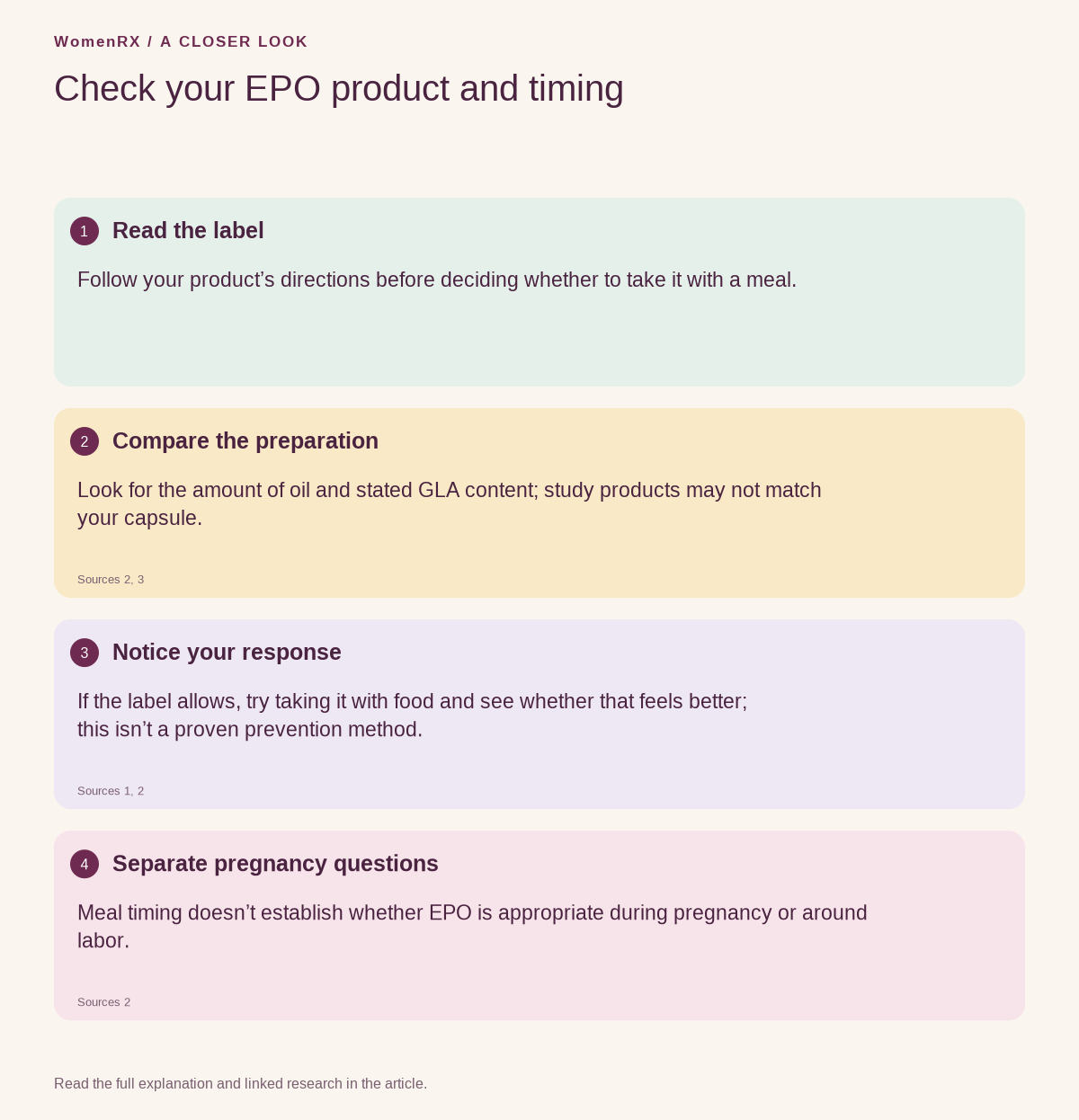
Check your EPO product and timing
Read the label: Follow your product’s directions before deciding whether to take it with a meal.
Compare the preparation: Look for the amount of oil and stated GLA content; study products may not match your capsule.23
Notice your response: If the label allows, try taking it with food and see whether that feels better; this isn’t a proven prevention method.12
Separate pregnancy questions: Meal timing doesn’t establish whether EPO is appropriate during pregnancy or around labor.2
Read the figure as text
Use these checks to separate product details and personal comfort from what clinical findings establish.- Read the label: Follow your product’s directions before deciding whether to take it with a meal.
- Compare the preparation: Look for the amount of oil and stated GLA content; study products may not match your capsule.23
- Notice your response: If the label allows, try taking it with food and see whether that feels better; this isn’t a proven prevention method.12
- Separate pregnancy questions: Meal timing doesn’t establish whether EPO is appropriate during pregnancy or around labor.2
More questions, answered
Does taking evening primrose oil on an empty stomach improve absorption?
The clinical findings described here don’t establish that an empty stomach improves absorption. A review describes a study in which healthy volunteers received a single oral dose and had blood levels measured, but that account doesn’t establish whether food affects absorption. 2
What if it still upsets my stomach with food?
Don’t assume that food will resolve the problem. Recheck the product directions and consider whether the symptoms began after starting the supplement. If they continue or are concerning, get advice specific to your health and product rather than increasing or changing the dose on your own.
Sources you can check
- Evening Primrose Oil for Menopause Hot Flashes: Systematic Review and Meta-Analysis.Thevi T, De S, Soe HHK. · Journal of menopausal medicine · 2024Return to first citation
- Systematic Review of Evening Primrose (Oenothera biennis) Preparations for the Facilitation of Parturition.Hutcherson TC, Cieri-Hutcherson NE, Lycouras MM, Koehler D, Mortimer M, Schaefer CJ, Costa OS, Bohlmann AL, Singhal MK. · Pharmacy (Basel, Switzerland) · 2022Return to first citation
- Evening Primrose2006Return to first citation