Evening Primrose Oil: Does It Matter When You Take It?
The name doesn’t mean you need to take evening primrose oil at night, and studies haven’t established a best time of day.
There’s no established best time to take evening primrose oil. Research on breast pain and menopause has tested the oil for particular symptoms, but the reported study schedules don’t show that morning or evening works better. For PMS, a systematic review found no demonstrated effectiveness. So changing the time of day isn’t a research-supported way to make it work better. 2 3 4
The short answer: no proven evening advantage
“Evening” is part of the plant’s name, not a dosing instruction. The clinical findings described here don’t compare morning with evening use, so they can’t identify a best time of day. A study schedule tells you how researchers gave a supplement; it doesn’t show that the schedule is better than another one unless timing was actually compared.
The more useful question is whether evening primrose oil has evidence for the symptom you want to address. Results differ by condition, and they shouldn’t be treated as proof that the oil is a general remedy.
What studies say about different symptoms
PMS
A systematic review of clinical trials reported that evening primrose oil did not demonstrate effectiveness for premenstrual syndrome. That means there isn’t evidence here that taking it at a particular hour will relieve PMS. 3
Cyclical or other breast pain
A review and meta-analysis included 13 randomized trials with 1,752 participants. It found no difference in pain relief with evening primrose oil compared with placebo or the other treatments assessed, including topical anti-inflammatory medicines, danazol, and vitamin E. The review doesn’t establish that a particular time of day improves the result. 4
The review also found no difference in reported adverse events compared with those alternatives. That finding describes the trials included; it doesn’t settle safety for every person or situation. 4
Menopause
One randomized, placebo-controlled trial studied psychological symptoms in postmenopausal women. Participants took evening primrose oil daily for eight weeks, but the abstract doesn’t specify a time of day or compare different schedules. The study reported a difference in psychological symptom scores between groups, while its authors said longer trials were needed. It can’t tell you whether evening dosing is better, or establish benefits for every menopausal symptom. 2
A wider systematic review described the overall evidence as heterogeneous and not strong enough for firm recommendations. Findings for one menopause-related outcome shouldn’t be assumed to apply to another. 3
What a study schedule can and can’t tell you
The menopause trial used a daily schedule, but that is not evidence that once-daily use is optimal or that morning and evening are interchangeable. To answer a timing question, a study would need to compare times of day while keeping other relevant factors similar. The trials described above don’t do that. 2 4
If you’re considering evening primrose oil, first match the evidence to the symptom: the findings for PMS, breast pain, and postmenopausal psychological symptoms aren’t the same. Taking it at night because of its name, or changing the hour you take it, isn’t a research-supported way to improve results.
Pregnancy and breastfeeding are separate questions
A trial in 80 low-risk women at 40 weeks of pregnancy studied evening primrose oil in relation to labor, not PMS, breast pain, or routine supplement use. It found no significant differences in the reported labor outcomes between the study groups. This study does not establish a general pregnancy benefit or answer breastfeeding safety. 1
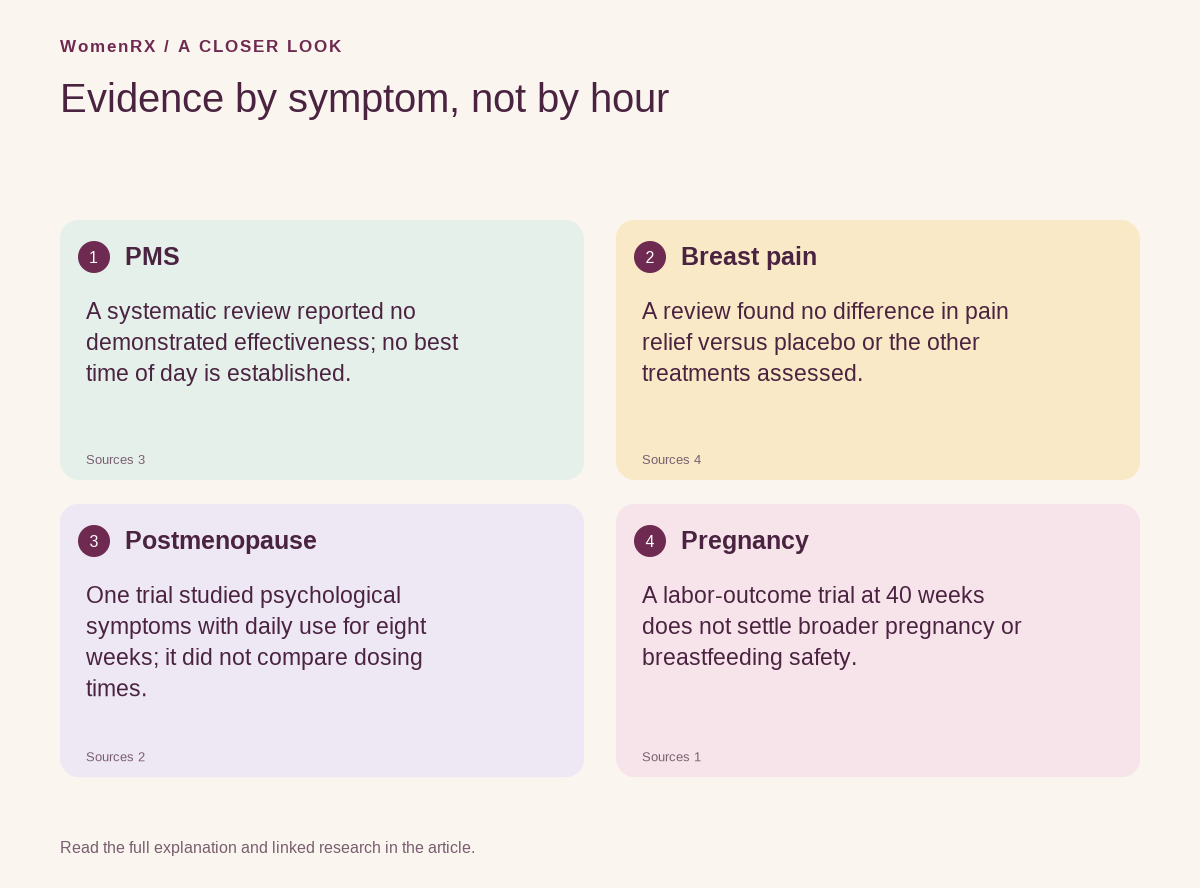
Evidence by symptom, not by hour
PMS: A systematic review reported no demonstrated effectiveness; no best time of day is established.3
Breast pain: A review found no difference in pain relief versus placebo or the other treatments assessed.4
Postmenopause: One trial studied psychological symptoms with daily use for eight weeks; it did not compare dosing times.2
Pregnancy: A labor-outcome trial at 40 weeks does not settle broader pregnancy or breastfeeding safety.1
Read the figure as text
These findings concern different symptoms and study designs. None establishes that taking evening primrose oil at night is better.- PMS: A systematic review reported no demonstrated effectiveness; no best time of day is established.3
- Breast pain: A review found no difference in pain relief versus placebo or the other treatments assessed.4
- Postmenopause: One trial studied psychological symptoms with daily use for eight weeks; it did not compare dosing times.2
- Pregnancy: A labor-outcome trial at 40 weeks does not settle broader pregnancy or breastfeeding safety.1
More questions, answered
Does evening primrose oil have to be taken at night?
No study cited here establishes that nighttime use is needed or works better. “Evening” is in the plant’s name, not proof of a preferred dosing time.
If I take it daily, does the study schedule tell me what time to choose?
Not by itself. The postmenopausal trial used a daily schedule, but did not report or compare times of day. It can’t identify an ideal hour. 2
Sources you can check
- Evening primrose oil and labour, is it effective? A randomised clinical trial.Kalati M, Kashanian M, Jahdi F, Naseri M, Haghani H, Sheikhansari N. · Journal of obstetrics and gynaecology : the journal of the Institute of Obstetrics and Gynaecology · 2018Return to first citation
- Impact of evening primrose oil consumption on psychological symptoms of postmenopausal women: a randomized double-blinded placebo-controlled clinical trial.Sharif SN, Darsareh F. · Menopause (New York, N.Y.) · 2020Return to first citation
- The effect of Oenothera biennis (Evening primrose) oil on inflammatory diseases: a systematic review of clinical trials.Sharifi M, Nourani N, Sanaie S, Hamedeyazdan S. · BMC complementary medicine and therapies · 2024Return to first citation
- A Systematic Review and Meta-Analysis of the Efficacy of Evening Primrose Oil for Mastalgia Treatment.Ahmad Adni LL, Norhayati MN, Mohd Rosli RR, Muhammad J. · International journal of environmental research and public health · 2021Return to first citation