Evening Primrose Oil: What Have Trials Actually Tested?
A study of menopause symptoms, pregnancy, or nerve pain can’t establish that evening primrose oil helps PMS or breast pain.
To judge a claim, match the study’s symptom and measured outcome, life stage, and product details, including route and formulation. Trials of postmenopausal psychological symptoms and pregnancy-related cervical preparation cannot establish benefits for PMS or breast pain. Look for a trial that measured your specific concern in a comparable group using a comparable product. 1269
Start with the symptom, not the ingredient
Evening primrose oil (EPO) is not one tested treatment for every concern. A trial’s result applies most directly to the people enrolled, the symptom they had, the outcome researchers measured, and the product and route they used. A result for cervical readiness late in pregnancy, for example, doesn’t show that EPO relieves breast pain or premenstrual symptoms.
That distinction matters because claims about EPO often group together different concerns. Researchers have studied postmenopausal psychological symptoms, cervical preparation in pregnancy, painful diabetic neuropathy, acne-related blood tests during isotretinoin treatment, and other specific outcomes. These findings do not transfer automatically from one condition to another. 12356
PMS and breast pain: look for a direct match
Trials measuring cervical preparation or postmenopausal psychological symptoms cannot answer whether EPO helps premenstrual syndrome or cyclical breast pain. That does not establish whether trials of those symptoms exist elsewhere. If a product claim mentions “women’s symptoms” without naming the symptom and the trial outcome, it doesn’t tell you whether the product was studied for your concern.
A closer match would enroll people with the same symptom and measure a relevant change, such as the particular psychological or physical symptom being claimed. A general change in a menopause rating score, a blood test, or a pregnancy-related measure is not the same as evidence for PMS or breast pain.
Menopause findings apply to a specific group and outcome
Two placebo-controlled trials studied psychological symptoms in postmenopausal women. One reported a difference between groups after eight weeks using the psychological subscale of the Menopause Rating Scale. Another reported lower median psychological-subscale scores in the EPO group at two and four weeks than at the start, while placebo scores changed little. These studies make the claim more directly relevant to postmenopausal psychological symptoms than to PMS, hot flashes, or breast pain. They do not establish that every EPO product will have the same result. 69
A third trial compared EPO, fennel, and placebo over eight weeks in postmenopausal women. Its abstract reports changes in hormone levels and psychological symptoms, but also says the groups differed in Menopause Rating Scale scores before treatment. That baseline difference makes a simple comparison harder to interpret. Hormone-level changes also aren’t the same thing as relief of a symptom you can feel. 8
These studies concern postmenopausal participants. They shouldn’t be treated as evidence for people who are still cycling, in perimenopause, pregnant, or postpartum unless a study actually includes and reports those groups.
Pregnancy studies used a different route and purpose
Several trials tested vaginal EPO capsules for cervical preparation around term pregnancy, a clinical question that is separate from symptom relief. In one randomized trial of 96 low-risk women at term, vaginal EPO was compared with vaginal placebo; the researchers reported a higher post-intervention Bishop score in the EPO group. Another randomized trial in 110 first-time pregnant women at 40 weeks or later compared vaginal EPO with misoprostol and reported a higher post-intervention Bishop score with EPO. 12
Results across pregnancy studies are not uniform. A placebo-controlled trial of 80 low-risk, first-time pregnant women at 40 weeks found no significant differences between EPO and placebo in gestational age at delivery, labor induction or augmentation, or duration of labor stages. Different routes, comparisons, and outcomes mean these studies can’t be collapsed into one simple claim, and none answers whether a supplement helps PMS or breast pain. 7
A separate trial used vaginal EPO alongside misoprostol in women with intrauterine fetal death at 12 to 20 weeks. That was a specific hospital-based pregnancy-care question, not evidence for self-treatment or for a routine supplement claim. 4
Check whether the product resembles the one studied
“Evening primrose oil” on the front of a bottle isn’t enough to establish a match. Compare:
- Route: Was the study product taken by mouth, placed vaginally, or was the route not stated in the report? Don’t assume routes are interchangeable. The term-pregnancy cervical studies above explicitly used vaginal capsules; the labor trial’s abstract describes capsules but does not specify a route. 127
- Product details: Does the report identify the oil source or give fatty-acid content? In one acne-related trial, the product was made from Oenothera paradoxa and the report specifies amounts of linoleic acid and gamma-linolenic acid per capsule. That study examined blood markers during isotretinoin treatment, not whether EPO improved acne itself. 5
- Participants and comparison: Were participants postmenopausal, pregnant, or being treated for another condition? Was EPO compared with placebo, another treatment, or added to a medicine? Each design answers a different question. 1256
- Outcome and duration: Did the study measure the symptom you care about, and for how long? A trial lasting eight weeks with a psychological rating scale does not establish an expected response time for another symptom or product. 69
Even matching a label to a study doesn’t guarantee the same effect: the study’s population, comparison, and measured outcome still matter.
A useful symptom log, without treating it as proof
If you’re trying to judge a claim, note the symptom itself, when it occurs, and how it changes over time. For a cycle-related concern, include cycle timing; for a postmenopausal concern, record the specific symptom rather than only writing “menopause.” Also record the product’s full label details and any other changes during the same period. This makes it easier to compare your experience with what a trial actually measured, but a personal log can’t establish that EPO caused a change.
A trial focused on symptoms or blood tests cannot establish that EPO is free of interactions with other medicines or supplements. If medication safety is the deciding question, review the product and your medication list with a pharmacist or prescribing clinician rather than inferring safety from a study that measured something else. 356
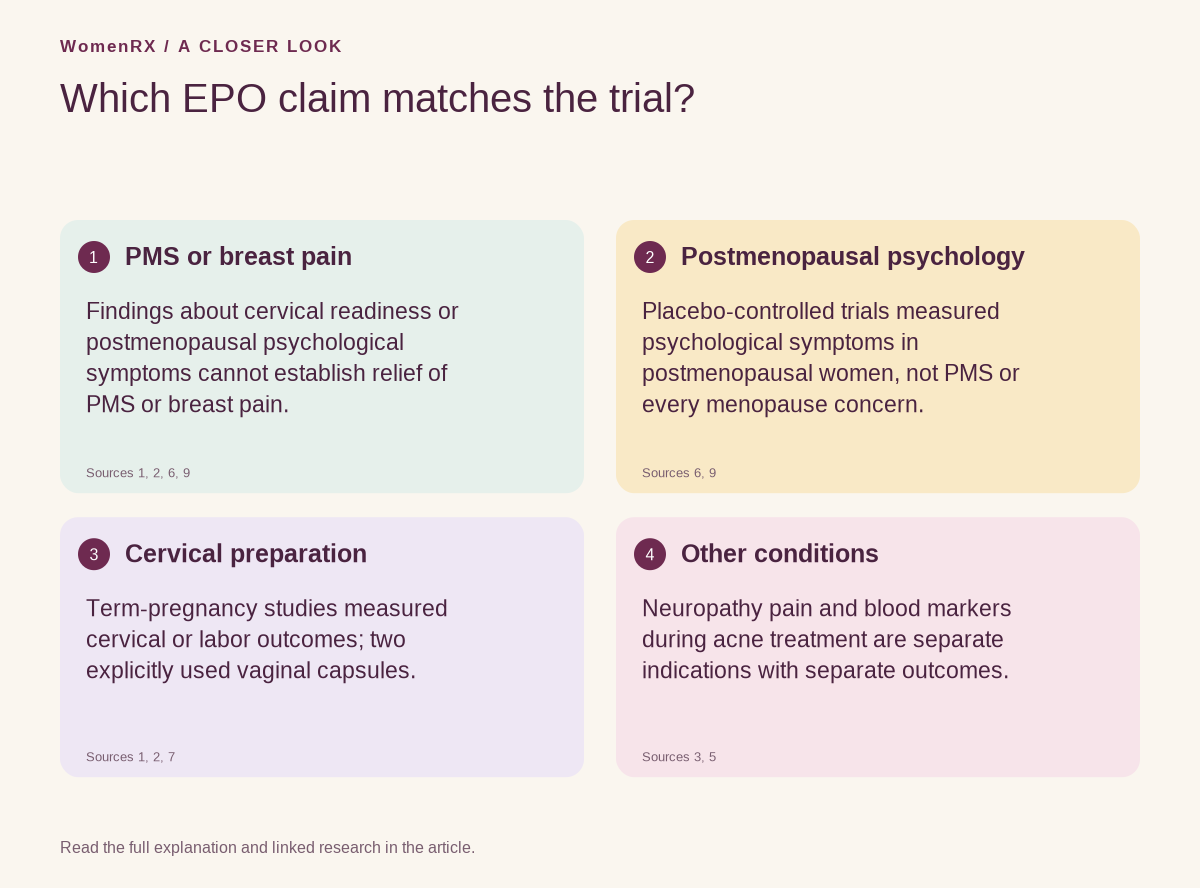
Which EPO claim matches the trial?
PMS or breast pain: Findings about cervical readiness or postmenopausal psychological symptoms cannot establish relief of PMS or breast pain.1269
Postmenopausal psychology: Placebo-controlled trials measured psychological symptoms in postmenopausal women, not PMS or every menopause concern.69
Cervical preparation: Term-pregnancy studies measured cervical or labor outcomes; two explicitly used vaginal capsules.127
Other conditions: Neuropathy pain and blood markers during acne treatment are separate indications with separate outcomes.35
Read the figure as text
The study population, product route, and measured outcome determine what a result can support.- PMS or breast pain: Findings about cervical readiness or postmenopausal psychological symptoms cannot establish relief of PMS or breast pain.1269
- Postmenopausal psychology: Placebo-controlled trials measured psychological symptoms in postmenopausal women, not PMS or every menopause concern.69
- Cervical preparation: Term-pregnancy studies measured cervical or labor outcomes; two explicitly used vaginal capsules.127
- Other conditions: Neuropathy pain and blood markers during acne treatment are separate indications with separate outcomes.35
More questions, answered
Can I use a labor study to judge a supplement for PMS?
No. Labor studies examined pregnancy-related outcomes such as cervical readiness or labor, not premenstrual symptoms. Also, one labor study describes capsules but does not specify their route in the report. 127
Does a study of EPO and menopause hormones prove symptom relief?
No. A change in a hormone test is a laboratory outcome; it does not by itself establish relief of a particular symptom. The menopause trials also studied postmenopausal participants, not PMS. 8
Sources you can check
- The Use of Evening Primrose Oil for Cervical Ripening in Low-Risk Women with Term Pregnancy: A Randomized Double-Blinded Controlled Trial.Ariana S, Amjadi N, Kazemi SN, Ahmadli Z. · Complementary medicine research · 2024Return to first citation
- Comparative Study of the Effect of Vaginal use of Primrose Oil with Misoprostol on Cervical Preparation of Prim Gravid Women: A Double-blind Clinical Trial.Shahraki AD, Mirhoseini S, Movahedi M, Hajihashemy M, Haghollahi F. · Advanced biomedical research · 2023Return to first citation
- Effects of evening primrose oil on treating painful diabetic neuropathy: a randomized, double-blind, clinical trial.Gholami A, Koulaeinejad N, Rahimi M. · Journal of complementary & integrative medicine · 2025Return to first citation
- Comparison of the effect of vaginal misoprostol and evening primrose oil capsule with misoprostol alone on the consequences of abortion in women with intrauterine fetal death: a randomized clinical trial.Hashemi H, Hasanpoor-Azghady SB, Farahani M, Amiri-Farahani L. · BMC complementary medicine and therapies · 2023Return to first citation
- Effect of Evening Primrose Oil Supplementation on Biochemical Parameters and Nutrition of Patients Treated with Isotretinoin for Acne Vulgaris: A Randomized Double-Blind Trial.Kaźmierska A, Bolesławska I, Jagielski P, Polańska A, Dańczak-Pazdrowska A, Kosewski G, Adamski Z, Przysławski J. · Nutrients · 2022Return to first citation
- Impact of evening primrose oil consumption on psychological symptoms of postmenopausal women: a randomized double-blinded placebo-controlled clinical trial.Sharif SN, Darsareh F. · Menopause (New York, N.Y.) · 2020Return to first citation
- Evening primrose oil and labour, is it effective? A randomised clinical trial.Kalati M, Kashanian M, Jahdi F, Naseri M, Haghani H, Sheikhansari N. · Journal of obstetrics and gynaecology : the journal of the Institute of Obstetrics and Gynaecology · 2018Return to first citation
- Comparison of the Effect of Fennel and Evening Primrose Oil on Menopausal Problems and Hormonal Levels: A Randomized Controlled Trial.Ghavi F, Shakeri F, Farahnaz H, Abdolahian S. · Iranian journal of nursing and midwifery research · 2023Return to first citation
- Effect of Evening Primrose Oil on Postmenopausal Psychological Symptoms: A Triple-Blind Randomized Clinical Trial.Safdari F, Motaghi Dastenaei B, Kheiri S, Karimiankakolaki Z. · Journal of menopausal medicine · 2021Return to first citation