Evening Primrose Oil: Side Effects and Safety
Evening primrose oil is usually reported to cause mild stomach symptoms or headaches, but short-term tolerability doesn’t establish safety for every person or situation.
In clinical trials for breast pain, reported side effects included stomach upset and headache; a review of 13 trials found no increase in several measured adverse effects compared with placebo or other treatments. That doesn’t prove long-term safety or settle medicine interactions. Avoid it during pregnancy, and ask a clinician or pharmacist before using it while breastfeeding or with medicines. 2 3
What side effects have been reported?
Evening primrose oil (EPO), made from the seeds of Oenothera biennis, can cause gastrointestinal symptoms such as abdominal discomfort, indigestion, nausea, or softer stools. Headache has also been reported. 2 3
A systematic review of 13 randomized trials involving 1,752 people treated for breast pain found no increase in nausea, abdominal bloating, headache, dizziness, weight gain, or altered taste compared with placebo or other treatments. That is reassuring for the effects measured in those trials, but it is not proof that EPO has no side effects: the trials were not designed to rule out every uncommon problem or establish long-term safety. 2
The reason you’re considering it matters
For cyclical breast pain, which often begins before a period and eases when bleeding starts, the best summary is that EPO has not shown a clear advantage. The review found no better pain relief than placebo or other treatments. NHS guidance likewise says there is little evidence that EPO helps breast pain. 1 2
That means taking it may expose you to side effects without a dependable benefit. Breast tenderness before a period is not the same question as PMS overall: an older evidence review also judged EPO likely ineffective for PMS, while noting that the trials had important limitations. The proposed fatty-acid mechanisms are theories, not proof that the supplement changes your hormones or treats PMS. 2 3
Pregnancy, breastfeeding, and medicines
Pregnancy: A review of EPO use concluded that its use during pregnancy was not supported by the literature and should be avoided. Don’t start it for breast tenderness or another symptom while pregnant. 3
Breastfeeding: Breastfeeding safety isn’t established by the breast-pain trials. Check with your clinician or pharmacist before taking it rather than assuming a supplement is safe because it is plant-derived.
Medicines: The breast-pain trials do not provide a reliable list of medicines that interact with EPO. That is not the same as proving there are no interactions. If you take prescription or over-the-counter medicines, show a pharmacist or clinician the exact product label before you start; don’t stop a prescribed medicine to make room for a supplement.
A quick check before buying or using it
- Purpose: Are you trying it for cyclical breast pain, PMS, or something else? Evidence for breast pain is unconvincing, and the PMS evidence is weak. 1 2 3
- Product: Check the full ingredient list and serving information, not just the words “evening primrose oil” on the front. The clinical findings don’t establish that every product has the same contents or effects.
- Medicines: Bring the label and your medication list to a pharmacist or clinician for an individual interaction check.
- Pregnancy or breastfeeding: Avoid EPO during pregnancy; seek advice before using it while breastfeeding. 3
- Your symptoms: Don’t use a supplement to put off getting persistent or changing breast pain checked. Seek prompt care for breast redness, heat or swelling with fever or chills, skin dimpling, or a new nipple rash or inward turning. 1
Breast pain often has causes other than a supplement-responsive problem. Pain linked to periods commonly affects both breasts and eases when the period ends, but pain can also be related to medicines or come from the chest wall, shoulder, or back. If it isn’t improving, get the cause assessed rather than relying on EPO. 1 2
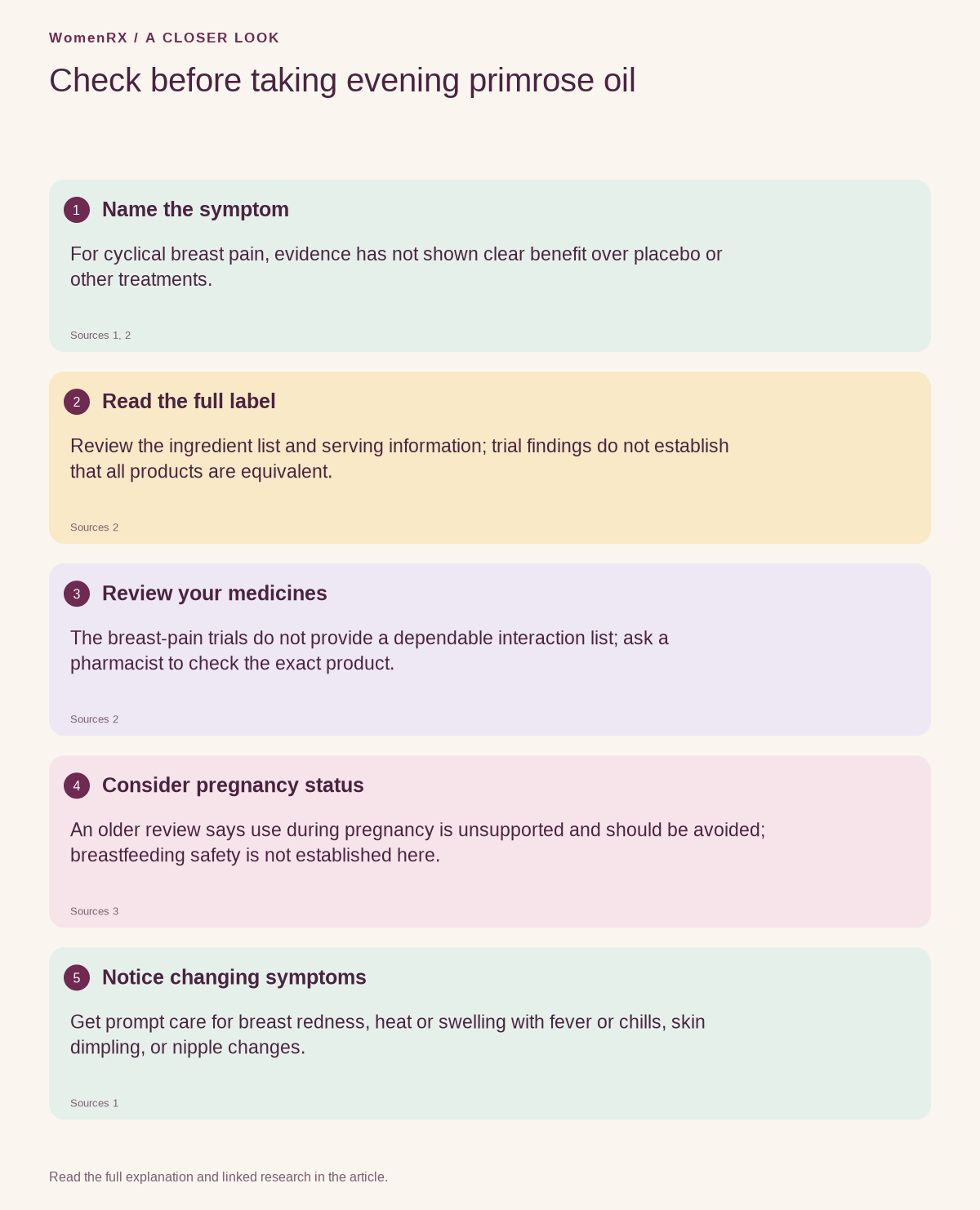
Check before taking evening primrose oil
Name the symptom: For cyclical breast pain, evidence has not shown clear benefit over placebo or other treatments.12
Read the full label: Review the ingredient list and serving information; trial findings do not establish that all products are equivalent.2
Review your medicines: The breast-pain trials do not provide a dependable interaction list; ask a pharmacist to check the exact product.2
Consider pregnancy status: An older review says use during pregnancy is unsupported and should be avoided; breastfeeding safety is not established here.3
Notice changing symptoms: Get prompt care for breast redness, heat or swelling with fever or chills, skin dimpling, or nipple changes.1
Read the figure as text
Use these checks to separate the hoped-for benefit from the safety questions that still need an individual answer.- Name the symptom: For cyclical breast pain, evidence has not shown clear benefit over placebo or other treatments.12
- Read the full label: Review the ingredient list and serving information; trial findings do not establish that all products are equivalent.2
- Review your medicines: The breast-pain trials do not provide a dependable interaction list; ask a pharmacist to check the exact product.2
- Consider pregnancy status: An older review says use during pregnancy is unsupported and should be avoided; breastfeeding safety is not established here.3
- Notice changing symptoms: Get prompt care for breast redness, heat or swelling with fever or chills, skin dimpling, or nipple changes.1
More questions, answered
Does evening primrose oil balance hormones?
The proposed effects on fatty acids and related pathways are theories; they do not establish that EPO changes hormone levels. The available review found no clear benefit for breast pain, and an older review judged it likely ineffective for PMS. 2 3
Sources you can check
- Breast pain - NHSAccessed 2026-09-25Return to first citation
- A Systematic Review and Meta-Analysis of the Efficacy of Evening Primrose Oil for Mastalgia Treatment.Ahmad Adni LL, Norhayati MN, Mohd Rosli RR, Muhammad J. · International journal of environmental research and public health · 2021Return to first citation
- Evening primrose oil.Bayles B, Usatine R. · American family physician · 2009Return to first citation