Evening Primrose Oil: Side Effects and Interactions
Stomach upset and headache are among the side effects reported; a possible interaction with some HIV medicines deserves a medication check.
Evening primrose oil can cause stomach upset, nausea, headache, dizziness, or changes in stools or taste. In a review of breast-pain trials, it did not increase overall adverse events compared with placebo or other treatments, but safety reporting was limited. A separate review reported higher levels of antiretroviral medicines with evening primrose oil. The clinical findings discussed here don’t establish safety during pregnancy or breastfeeding. 1 2
What side effects have been reported?
Reported side effects include nausea, abdominal discomfort or fullness, indigestion, softer stools, headache, dizziness, and an altered or unpleasant taste. Some trials also recorded weight gain. These are reported possibilities, not a list of effects everyone should expect. 1
A systematic review looked at 13 randomized trials involving 1,752 people treated for breast pain. It found no difference in reported adverse events between evening primrose oil and placebo or other treatments. That comparison is useful, but it doesn’t mean nobody had symptoms: the included trials reported effects such as nausea and abdominal bloating. 1
There’s also a limit to how much reassurance the comparison can offer. Only two trials, with 325 participants in total, contributed to the review’s overall adverse-event analysis. The results describe tolerability in the breast-pain studies reviewed; they can’t rule out uncommon effects or settle safety for every person, product, or reason for use. 1
If you notice a new symptom after starting evening primrose oil, note what you’re experiencing and when it began, and tell your pharmacist or care team if it’s bothering you. They can help consider whether the supplement, another medicine, or something else may be involved. The studies listed symptoms but don’t establish a rule for deciding which ones are caused by the oil.
One interaction signal involves HIV medicines
A systematic review of supplement interactions with HIV medicines reported that evening primrose oil was associated with increased antiretroviral drug levels. The review recommended monitoring for adverse effects. This is a medication-check signal, not proof that every HIV medicine interacts with evening primrose oil. 2
If you take antiretroviral treatment, tell your HIV-care team or pharmacist before adding the supplement. Bring the supplement container or its label and your current medication list so they can check the specific combination. 2
What about birth control or fertility medicines?
The antiretroviral review does not establish a particular interaction with hormonal birth control, fertility medicines, or other reproductive-health treatments. That isn’t proof that no interaction exists; it means the reported antiretroviral finding doesn’t answer those questions. If you use one of these medicines, include it in a pharmacist’s medication check rather than assuming the HIV-medicine finding applies to it. 2
Pregnancy and breastfeeding need a separate check
The clinical findings discussed here don’t establish whether evening primrose oil is safe during pregnancy or breastfeeding. The breast-pain review and the antiretroviral interaction review don’t report findings that answer those questions. If you’re pregnant or breastfeeding, discuss the supplement with your care team before using it. 1 2
A quick way to sort the cautions
The evidence points to different next steps, rather than one blanket warning. Reported stomach or head symptoms are tolerability concerns to notice. Antiretroviral treatment is the specific interaction signal identified in the review, so it calls for a medication check. Reproductive-health medicines, pregnancy, and breastfeeding remain questions the findings discussed here don’t settle. Keeping those categories separate avoids treating a possible interaction as proven for every medicine, or treating limited trial reassurance as universal safety. 1 2
Sort the safety questions
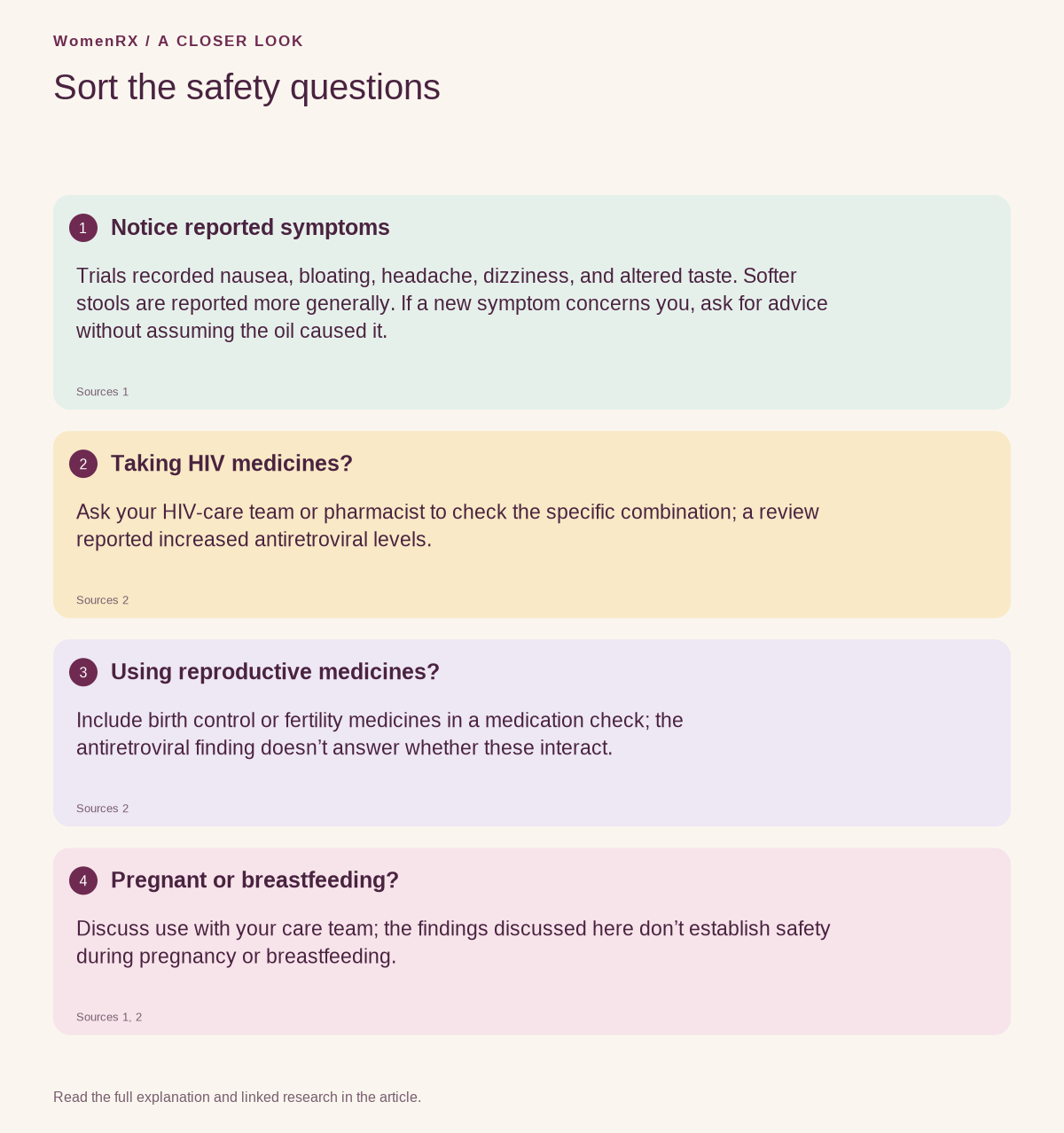
Notice reported symptoms: Trials recorded nausea, bloating, headache, dizziness, and altered taste. Softer stools are reported more generally. If a new symptom concerns you, ask for advice without assuming the oil caused it.1
Taking HIV medicines?: Ask your HIV-care team or pharmacist to check the specific combination; a review reported increased antiretroviral levels.2
Using reproductive medicines?: Include birth control or fertility medicines in a medication check; the antiretroviral finding doesn’t answer whether these interact.2
Pregnant or breastfeeding?: Discuss use with your care team; the findings discussed here don’t establish safety during pregnancy or breastfeeding.12
Read the figure as text
These checks separate reported symptoms from the interaction signal and from questions that remain unanswered.- Notice reported symptoms: Trials recorded nausea, bloating, headache, dizziness, and altered taste. Softer stools are reported more generally. If a new symptom concerns you, ask for advice without assuming the oil caused it.1
- Taking HIV medicines?: Ask your HIV-care team or pharmacist to check the specific combination; a review reported increased antiretroviral levels.2
- Using reproductive medicines?: Include birth control or fertility medicines in a medication check; the antiretroviral finding doesn’t answer whether these interact.2
- Pregnant or breastfeeding?: Discuss use with your care team; the findings discussed here don’t establish safety during pregnancy or breastfeeding.12
Sources you can check
- A Systematic Review and Meta-Analysis of the Efficacy of Evening Primrose Oil for Mastalgia Treatment.Ahmad Adni LL, Norhayati MN, Mohd Rosli RR, Muhammad J. · International journal of environmental research and public health · 2021Return to first citation
- Dietary supplement interactions with antiretrovirals: a systematic review.Jalloh MA, Gregory PJ, Hein D, Risoldi Cochrane Z, Rodriguez A. · International journal of STD & AIDS · 2017Return to first citation