Evening Primrose Oil After 40: What the Evidence Says
Being over 40 isn’t, by itself, a reason to take evening primrose oil; the evidence depends on which symptom you hope it will help.
Evening primrose oil hasn’t been shown to be a dependable treatment for menopause symptoms. A few short trials in postmenopausal women found possible benefits for psychological symptoms or night sweats, but results were mixed, and one trial found no improvement in hot flashes. These studies don’t establish that it helps during perimenopause, or that age alone creates a need for the supplement. 23456
Start with the symptom, not your age
Turning 40, 45, or 50 doesn’t automatically create a need for evening primrose oil. The useful question is whether it’s been shown to help with the specific symptom you’re experiencing, and whether that evidence applies to your stage of menopause.
The menopause trials in this evidence base studied postmenopausal women, not a clearly identified perimenopause group. In one trial, participants were 45 to 60 and had gone at least a year without a period. That makes the results more relevant to postmenopause than to the years when periods may still be changing. It doesn’t prove there are no perimenopause studies; it means these results can’t answer that question. 4
What the trials found, symptom by symptom
Hot flashes: One randomized trial in postmenopausal women found no significant improvement in hot-flash frequency, duration, or severity after eight weeks of evening primrose oil compared with placebo. 6
Night sweats: In that same trial, women taking evening primrose oil had lower night-sweat frequency and severity than the placebo group at the end of the study. That’s a potentially encouraging result, but it comes from one short trial, and it doesn’t show that the supplement helps hot flashes too. 6
Psychological symptoms: Two short randomized trials reported improvements on psychological symptom measures among postmenopausal women taking evening primrose oil. One followed 189 women for eight weeks; another included 100 women and reported lower scores at two and four weeks. These are signals worth distinguishing from no evidence at all, but they don’t establish a dependable treatment for mood disorders, and they don’t tell us whether results last longer term. 35
Overall menopause symptoms: A separate trial compared evening primrose oil, fennel, and placebo over eight weeks. Although the overall menopause symptom score changed in the study, the direct comparison between evening primrose oil and placebo did not reach statistical significance after adjustment. That makes a broad claim that evening primrose oil relieves menopause symptoms too strong. 4
Taken together, the findings aren’t a clear yes. The North American Menopause Society’s 2023 position statement does not recommend supplements or herbal remedies for menopause-related hot flashes, based on its review of the evidence. 2
Separate age, hot flashes and other reasons for taking it
- If you’re considering it because you’re over 40: Age alone isn’t an evidence-based reason to start it. First name the symptom you want to address.
- If hot flashes are the main concern: The trial evidence is not convincing, and the menopause position statement does not recommend supplements or herbal remedies for this symptom. Evidence-supported options include hormone therapy for appropriate candidates and several nonhormonal treatments. Which options make sense depends on your health and preferences. 12
- If night sweats or psychological symptoms are the concern: There are some positive trial results, but they’re short-term and not enough to make evening primrose oil a proven treatment. If a symptom is new, changing, or disrupting your life, you might choose to discuss it with a clinician rather than assume it’s menopause-related. These trials don’t establish what causes an individual symptom.
- If you’re in perimenopause: Don’t assume results from postmenopausal trials apply to you. Changing symptoms are worth considering in their own context rather than treating age as the explanation.
In one eight-week trial, one participant in the evening primrose oil group reported gastric upset. That small, brief study can’t establish how often side effects occur or provide a full picture of safety. 3
evening primrose oil may have a possible role for some symptoms, but current results are too limited and mixed to make it a reliable menopause remedy. Let the symptom and your life stage guide the next step, not the number on your birthday cake.
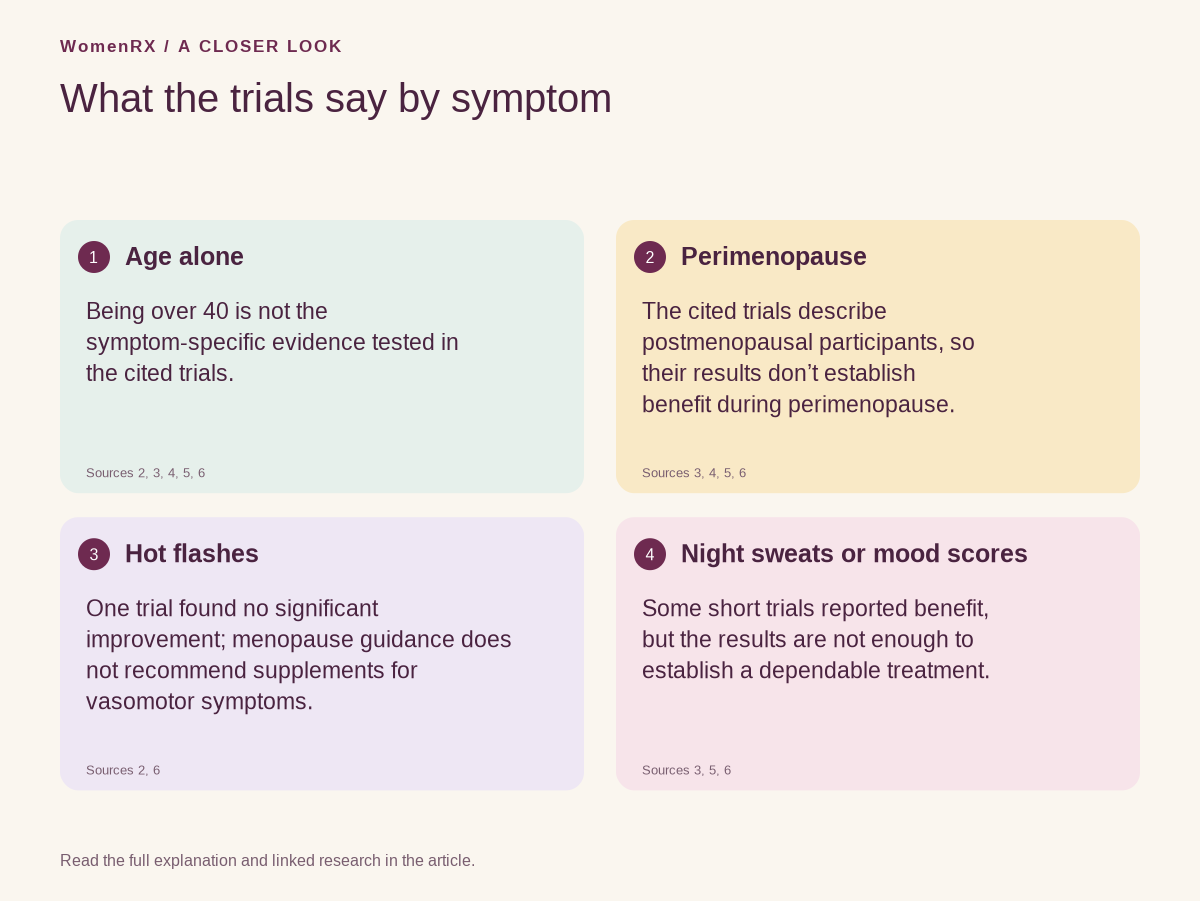
What the trials say by symptom
Age alone: Being over 40 is not the symptom-specific evidence tested in the cited trials.23456
Perimenopause: The cited trials describe postmenopausal participants, so their results don’t establish benefit during perimenopause.3456
Hot flashes: One trial found no significant improvement; menopause guidance does not recommend supplements for vasomotor symptoms.26
Night sweats or mood scores: Some short trials reported benefit, but the results are not enough to establish a dependable treatment.356
Read the figure as text
This is a symptom-by-symptom summary of the evening primrose oil findings in postmenopausal women, not a diagnostic guide or a recommendation to start the supplement.- Age alone: Being over 40 is not the symptom-specific evidence tested in the cited trials.23456
- Perimenopause: The cited trials describe postmenopausal participants, so their results don’t establish benefit during perimenopause.3456
- Hot flashes: One trial found no significant improvement; menopause guidance does not recommend supplements for vasomotor symptoms.26
- Night sweats or mood scores: Some short trials reported benefit, but the results are not enough to establish a dependable treatment.356
More questions, answered
Does evening primrose oil help with hot flashes?
One randomized trial in postmenopausal women found no significant improvement in hot-flash frequency, duration, or severity. The North American Menopause Society also does not recommend supplements or herbal remedies for menopause-related hot flashes. 26
Were women in perimenopause studied?
The cited menopause trials describe postmenopausal participants. Their findings therefore don’t establish whether evening primrose oil helps during perimenopause. 3456
Sources you can check
- The 2022 hormone therapy position statement of The North American Menopause Society.“The 2022 Hormone Therapy Position Statement of The North American Menopause Society” Advisory Panel. · Menopause (New York, N.Y.) · 2022Return to first citation
- The 2023 nonhormone therapy position statement of The North American Menopause Society.Menopause (New York, N.Y.) · 2023Return to first citation
- Impact of evening primrose oil consumption on psychological symptoms of postmenopausal women: a randomized double-blinded placebo-controlled clinical trial.Sharif SN, Darsareh F. · Menopause (New York, N.Y.) · 2020Return to first citation
- Comparison of the Effect of Fennel and Evening Primrose Oil on Menopausal Problems and Hormonal Levels: A Randomized Controlled Trial.Ghavi F, Shakeri F, Farahnaz H, Abdolahian S. · Iranian journal of nursing and midwifery research · 2023Return to first citation
- Effect of Evening Primrose Oil on Postmenopausal Psychological Symptoms: A Triple-Blind Randomized Clinical Trial.Safdari F, Motaghi Dastenaei B, Kheiri S, Karimiankakolaki Z. · Journal of menopausal medicine · 2021Return to first citation
- The Effect of Evening Primrose Oil Capsule on Hot Flashes and Night Sweats in Postmenopausal Women: A Single-Blind Randomized Controlled Trial.Kazemi F, Masoumi SZ, Shayan A, Oshvandi K. · Journal of menopausal medicine · 2021Return to first citation