Low-Dose Naltrexone Results: What Studies Measure
The weight-loss evidence people often point to involves naltrexone combined with bupropion, not low-dose naltrexone alone.
Low-dose naltrexone (LDN) has been studied mainly for specific conditions, with outcomes such as pain, function, fatigue, and disease activity. In a 12-month trial in women with fibromyalgia, 4.5 mg/day of LDN did not meaningfully outperform placebo for pain-related outcomes. Weight-management research on naltrexone-bupropion does not establish that LDN alone causes weight loss. 2 4
First, separate LDN from weight-loss medication
Low-dose naltrexone and naltrexone-bupropion are not the same treatment. LDN studies use naltrexone alone at a low dose, often for a particular chronic condition. Weight-management research on naltrexone-bupropion evaluates naltrexone as part of a combination with bupropion. Results from that combination can’t tell you whether LDN alone leads to weight loss. 4
That distinction matters when a before-and-after story credits “naltrexone” for a change on the scale. A specialist-service observational study offered people either liraglutide or naltrexone-bupropion, then reported some outcomes pooled across both medicines. Its combined results can’t show the separate effect of naltrexone-bupropion, much less LDN alone. 3
What LDN studies actually measure
Fibromyalgia is one condition with controlled trial evidence in women. In a 12-month randomized, double-blind trial, 98 women were randomized to LDN at 4.5 mg/day or placebo as an add-on treatment. Researchers measured pain intensity, function, anxiety and depressive symptoms, cognitive difficulties, disability, and participants’ impressions of change. At three months, average pain scores had fallen by 0.33 points with LDN and 0.64 points with placebo on a 0-10 scale. The difference between groups was not statistically significant, and secondary outcomes showed small, inconsistent changes. The trial did not demonstrate a clinically meaningful benefit over placebo. 2
A separate analysis of a 12-week trial in 99 women looked at the share of participants who reported at least 30% improvement in six symptoms, including fatigue, sleep problems, and memory difficulties. It found no significant difference between LDN and placebo in any of those symptom-response categories. That’s a useful reminder that a study can measure several outcomes without showing that the treatment improved them. 5
For Crohn’s disease, a small placebo-controlled trial tested 4.5 mg LDN daily for 12 weeks and stopped early because the researchers judged the results futile. Clinical remission occurred in 22.2% of the LDN group versus 70.0% of the placebo group (p=0.037), a result that favored placebo. Endoscopic remission occurred in 5.6% versus 18.8%, respectively (p=0.233). A fatigue questionnaire showed a difference between groups, but the trial did not show broader patient-reported benefit. This isolated result is not the same as evidence that LDN treats Crohn’s disease or reliably improves fatigue. 7
These are different conditions and different endpoints. A change in a pain score, a measure of bowel inflammation, and body weight answer different questions. A result in one condition shouldn’t be carried over to another as if LDN had one general effect. 2 7
Why a dramatic story isn’t the same as a trial result
A before-and-after account can describe what happened to one person, but it can’t show what would have happened without treatment. Symptoms can change over time, other treatments may change too, and people with a striking experience may be more likely to share it. Those are reasons to look for a comparison group, not reasons to dismiss someone’s account.
For example, a retrospective chart review described 10 people with fibromyalgia who had been prescribed LDN. Eight had recorded pain relief, but there was no placebo or untreated comparison group, and the results came from a small set of clinical records. This can suggest a question for a stronger study; it can’t estimate how often LDN works compared with placebo. 1 A 2026 narrative review covering LDN studies across several fields likewise reported that positive findings from uncontrolled studies were rarely replicated in placebo-controlled trials. 6
A better way to read “results”
When you see an LDN result, check four things: which condition was studied, what outcome was measured, whether there was a comparison group, and how long people were followed. Then ask whether the reported change was in symptoms, daily function, quality of life, disease activity, or weight. Those outcomes aren’t interchangeable.
For women, also check what the study actually reports about sex-specific or reproductive outcomes. The fibromyalgia trials summarized here enrolled women, which makes them directly relevant to women with that condition. Their reported outcomes centered on symptoms and function; they don’t establish effects on menstrual cycles, fertility, menopause, or weight. 2 5
The practical takeaway is straightforward: a testimonial may help you understand someone’s experience, but it can’t supply a reliable expected result. For LDN, the controlled findings described here are condition-specific, and they don’t support treating low-dose naltrexone as a proven weight-loss treatment.
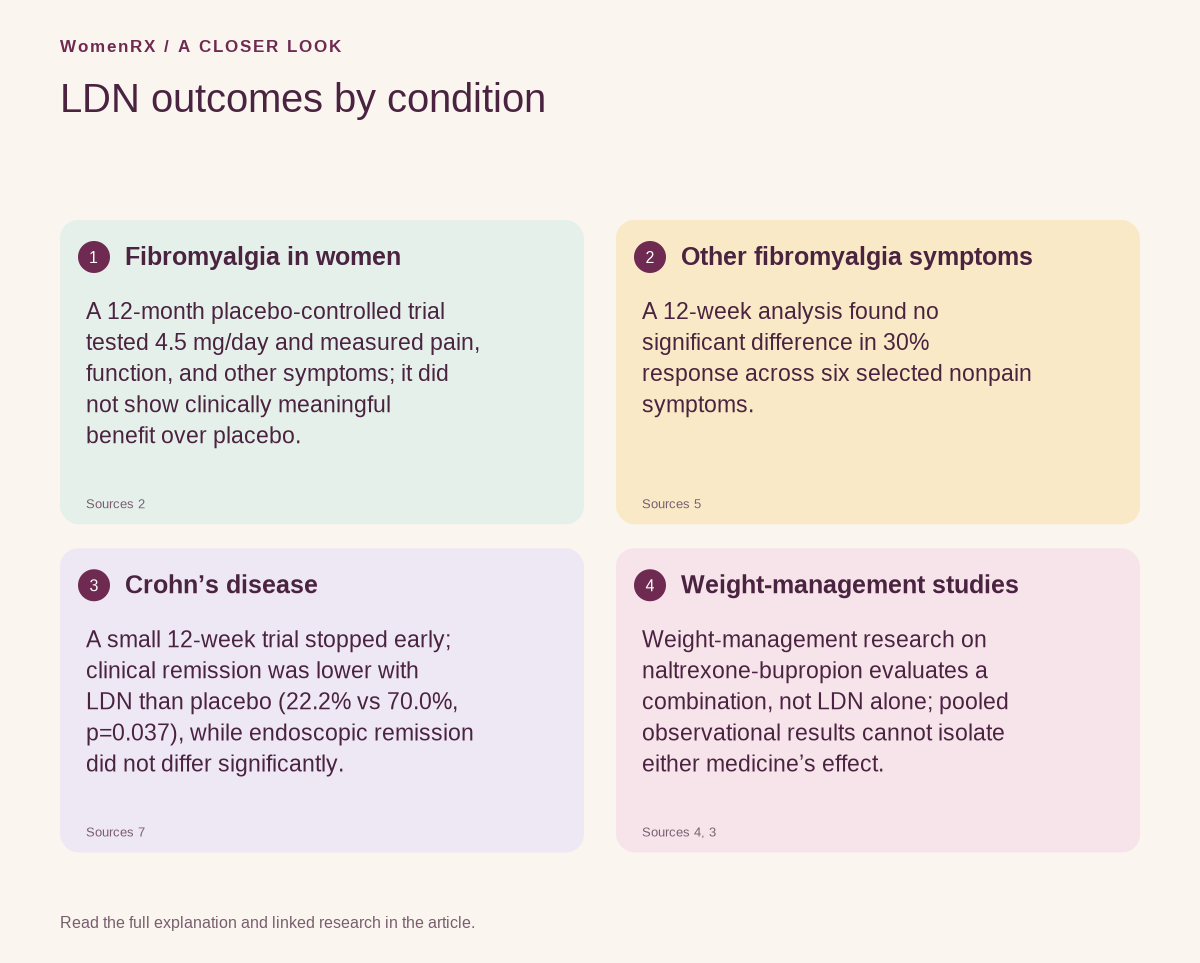
LDN outcomes by condition
Fibromyalgia in women: A 12-month placebo-controlled trial tested 4.5 mg/day and measured pain, function, and other symptoms; it did not show clinically meaningful benefit over placebo.2
Other fibromyalgia symptoms: A 12-week analysis found no significant difference in 30% response across six selected nonpain symptoms.5
Crohn’s disease: A small 12-week trial stopped early; clinical remission was lower with LDN than placebo (22.2% vs 70.0%, p=0.037), while endoscopic remission did not differ significantly.7
Weight-management studies: Weight-management research on naltrexone-bupropion evaluates a combination, not LDN alone; pooled observational results cannot isolate either medicine’s effect.43
Read the figure as text
These examples show why a symptom score, disease measure, and body-weight result should not be treated as the same kind of evidence.- Fibromyalgia in women: A 12-month placebo-controlled trial tested 4.5 mg/day and measured pain, function, and other symptoms; it did not show clinically meaningful benefit over placebo.2
- Other fibromyalgia symptoms: A 12-week analysis found no significant difference in 30% response across six selected nonpain symptoms.5
- Crohn’s disease: A small 12-week trial stopped early; clinical remission was lower with LDN than placebo (22.2% vs 70.0%, p=0.037), while endoscopic remission did not differ significantly.7
- Weight-management studies: Weight-management research on naltrexone-bupropion evaluates a combination, not LDN alone; pooled observational results cannot isolate either medicine’s effect.43
More questions, answered
Does a change in pain or fatigue mean LDN caused it?
Not on its own. A before-and-after change doesn’t show what would have happened without treatment. A placebo-controlled comparison helps separate a treatment effect from changes that also happen in the comparison group. 2 7
Sources you can check
- Low dose naltrexone for fibromyalgia: case series demonstrating pain relief and other health benefits.Junek A, Anderson M. · Frontiers in pain research (Lausanne, Switzerland) · 2026Return to first citation
- Efficacy of Low-Dose Naltrexone in Women With Fibromyalgia Syndrome: A 12-Month Randomised, Double-Blind, Placebo-Controlled Single-Centre Clinical Trial (INNOVA Study).Rodríguez-Freire C, Navarrete J, Rozadilla-Sacanell A, Sanabria-Mazo JP, Del Pino-Gaya B, Borràs X, Feliu-Soler A, Luciano JV. · European journal of pain (London, England) · 2026Return to first citation
- Outcomes of obesity medications in those with low response to a low-energy diet meal replacement programme: An observational study.Shand J, Jiang Y, Murphy R. · Obesity pillars · 2026Return to first citation
- Comparative effects of drugs for adults with overweight or obesity: systematic review and network meta-analysis.Nong K, Shi Q, Xie X, Wang Y, Agarwal A, Guyatt GH, Zhang H, Gao Y, Khunti K, Le Roux CW, Widyahening IS, Fan Q, Liu T, Mao Y, Florez ID, Du H, Pan X, Zou X, Wang C, Sun X, Li J, H... · BMJ (Clinical research ed.) · 2026Return to first citation
- Symptom Response to Low-Dose Naltrexone in Fibromyalgia: An Exploratory Analysis of the Randomized Placebo-Controlled FINAL Trial.Nielsen MJ, Vaegter HB, Bruun KD. · Pain management nursing : official journal of the American Society of Pain Management Nurses · 2026Return to first citation
- Low-Dose Naltrexone: What is the Evidence? A Narrative Review.Gouda AHK, Aitcheson NEC, Steadman KJ. · Advances in therapy · 2026Return to first citation
- Low-Dose Naltrexone in Crohn's Disease: A Prematurely Terminated Randomized Trial Showing Reduced Fatigue Without Clinical or Endoscopic Benefit.van de Pol N, Paulides E, Wolfhagen FHJ, West RL, Holster IL, Verweij KE, de Vries AC, Fuhler GM, van der Woude CJ. · Digestive diseases and sciences · 2026Return to first citation