Low-Dose Naltrexone and Weight: What to Expect
Weight findings for higher-dose naltrexone and naltrexone-bupropion don’t tell us what low-dose naltrexone will do for you.
There isn’t enough evidence to predict whether low-dose naltrexone (LDN) will change your weight for a specific condition. Reported findings from a small chronic-pain study and a fibromyalgia study in eight women don’t provide weight results. A separate 25 mg smoking-cessation trial found no statistically significant difference in weight gain. Naltrexone-bupropion is a different treatment, so its results don’t establish LDN’s effects. 2 3 4 5
Start with the exact treatment
“Naltrexone” can mean different doses and treatment setups. In one chronic-pain clinic study, researchers defined low-dose naltrexone as less than 10 mg. The study followed 31 adults, 71% of them women, and its reported findings concern pain and related functioning, not body weight. A small fibromyalgia study included eight women and reported symptoms and immune markers, but its reported findings don’t provide a weight result. Those findings can’t tell you whether LDN changes weight for chronic pain, fibromyalgia, or another condition. 2 3
That’s a specific evidence gap, not proof that weight never changes. It means these findings can’t give you an estimate of what to expect on LDN, or whether the answer differs by diagnosis.
What the 25 mg trial can and can’t tell you
A randomized trial studied 25 mg naltrexone in 172 people trying to quit smoking, alongside nicotine patches and behavioral counseling. Among participants who remained continuously abstinent, average weight gain at 26 weeks was 6.8 pounds with naltrexone and 9.7 pounds with placebo. The difference wasn’t statistically significant, so the study did not show that naltrexone reliably prevented post-quit weight gain. 4
This is not an LDN weight-loss study: its dose was higher than the less-than-10-mg definition used in the pain-clinic study, its participants were quitting smoking, and the outcome was weight gain after quitting, not weight change while treating pain or fibromyalgia. It shouldn’t be used to predict what will happen on LDN. 2 4
Why the combination-treatment finding is different
Naltrexone-bupropion combines two medicines in a prescription treatment for weight management. A systematic review of randomized trials reported weight reduction with this combination. That result belongs to the combination studied, not to naltrexone on its own. It can’t show that LDN alone causes weight loss, and it doesn’t predict the effect of LDN prescribed for another condition. 1 5
The useful comparison is therefore not simply “naltrexone versus no naltrexone.” It’s the dose, the other medicine taken with it, the reason for treatment, and the weight outcome actually measured.
What is known specifically about women?
The small fibromyalgia study included only women, but its reported findings don’t provide a weight result. The smoking-cessation trial’s abstract doesn’t report a women-specific weight result. Neither finding supports a weight prediction for pregnancy, postpartum, perimenopause, or postmenopause. 3 4
If LDN has been suggested or prescribed, a practical question is: “What weight outcome, if any, has been studied for this dose and the condition I’m treating?” It also helps to confirm the exact product and dose, especially if you’ve heard about weight results from naltrexone-bupropion. That keeps the discussion focused on the treatment you’re actually considering, rather than a different dose or combination.
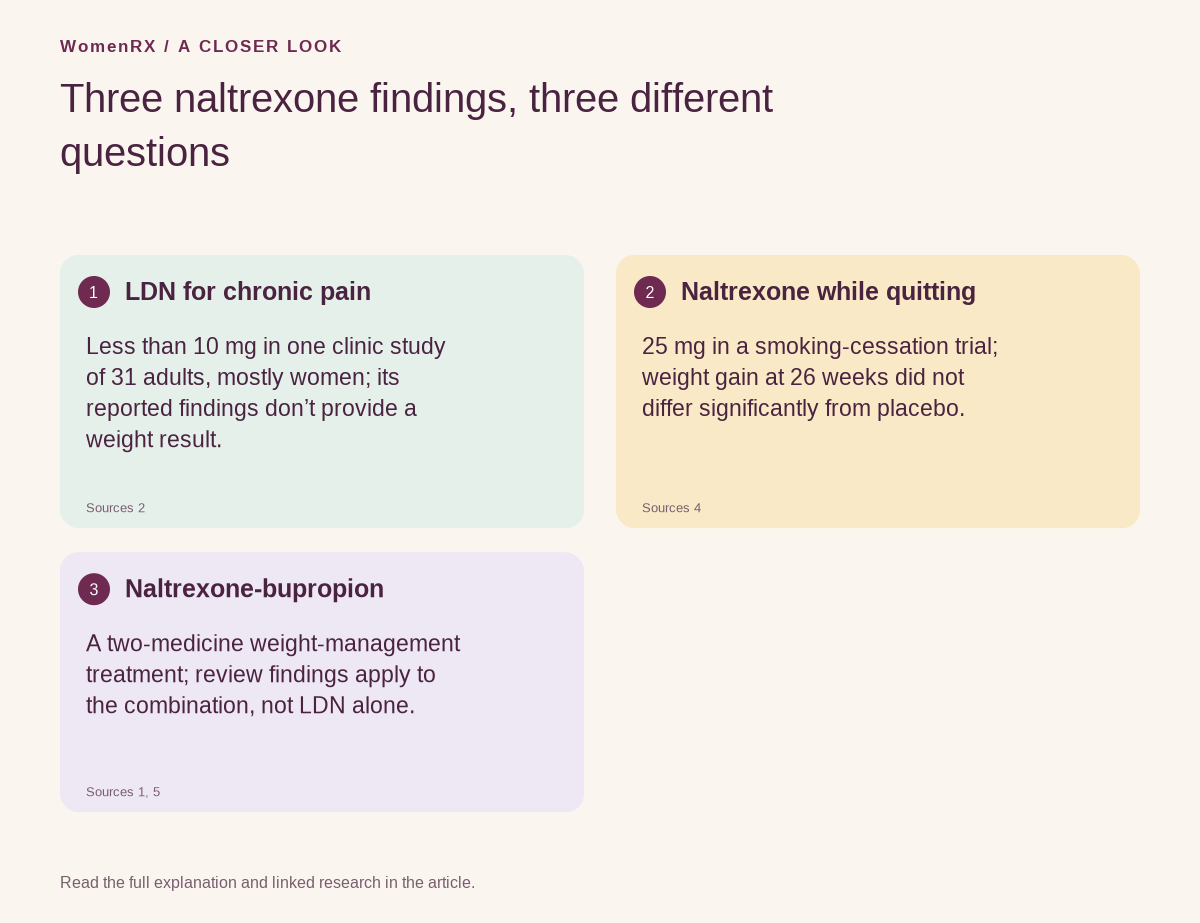
Three naltrexone findings, three different questions
LDN for chronic pain: Less than 10 mg in one clinic study of 31 adults, mostly women; its reported findings don’t provide a weight result.2
Naltrexone while quitting: 25 mg in a smoking-cessation trial; weight gain at 26 weeks did not differ significantly from placebo.4
Naltrexone-bupropion: A two-medicine weight-management treatment; review findings apply to the combination, not LDN alone.15
Read the figure as text
Compare dose or formulation, the population studied, and what the weight result can actually tell you.- LDN for chronic pain: Less than 10 mg in one clinic study of 31 adults, mostly women; its reported findings don’t provide a weight result.2
- Naltrexone while quitting: 25 mg in a smoking-cessation trial; weight gain at 26 weeks did not differ significantly from placebo.4
- Naltrexone-bupropion: A two-medicine weight-management treatment; review findings apply to the combination, not LDN alone.15
More questions, answered
Does naltrexone-bupropion prove that LDN causes weight loss?
No. The combination contains bupropion as well as naltrexone, and weight findings for that treatment can’t establish the effect of LDN alone. 1 5
Is the 25 mg smoking-cessation study evidence for LDN?
It’s a separate dose and situation. The trial tested 25 mg naltrexone during smoking cessation, and it did not find a statistically significant difference in weight gain at 26 weeks. 4
Sources you can check
- CONTRAVE EXTENDED-RELEASE (NALTREXONE HYDROCHLORIDE AND BUPROPION HYDROCHLORIDE) TABLET, EXTENDED RELEASE [NALPROPION PHARMACEUTICALS LLC] | US prescribing information and patient instructionsAccessed 2026-09-25Return to first citation
- Efficacy and Safety of Low Dose Naltrexone for Chronic Pain.N Irwin M, A Cooke D, Berland D, D Marshall V, A Smith M. · Journal of pain & palliative care pharmacotherapy · 2024Return to first citation
- Reduced Pro-Inflammatory Cytokines after Eight Weeks of Low-Dose Naltrexone for Fibromyalgia.Parkitny L, Younger J. · Biomedicines · 2017Return to first citation
- Low-dose naltrexone augmentation of nicotine replacement for smoking cessation with reduced weight gain: a randomized trial.Toll BA, White M, Wu R, Meandzija B, Jatlow P, Makuch R, O'Malley SS. · Drug and alcohol dependence · 2010Return to first citation
- Efficacy of Weight-Lowering Agents on Fat Distribution: A Systematic Review and Network Meta-Analysis of Randomized Controlled Trials.Qiao X, Wang W, Cao J, Guo L, Pan Q. · Obesity reviews : an official journal of the International Association for the Study of Obesity · 2026Return to first citation