Low-Dose Naltrexone Alternatives Depend on the Condition
For fibromyalgia, low-dose naltrexone has mixed evidence, while established options target particular symptoms; weight management is a different decision entirely.
There isn’t one universal alternative to low-dose naltrexone (LDN): the options depend on what you’re treating. For fibromyalgia, exercise and symptom-focused approaches such as CBT for insomnia have research support, and several medications are FDA-approved for the condition. A trial in women found no meaningful benefit from LDN over placebo. For weight management, the relevant evidence concerns a naltrexone-bupropion combination, not LDN alone. 4 6 1
Start with the condition, not the drug
LDN is naltrexone used at a lower dose than in standard naltrexone treatment. It’s discussed off label for different conditions, but evidence for one condition can’t establish benefit for another. The most useful comparison is therefore specific: What outcome are you hoping to improve, and what options have evidence for that outcome?
The clearest comparisons concern fibromyalgia and weight management. If you’re considering LDN for another diagnosis, the findings below shouldn’t be treated as evidence for that use.
If the goal is fibromyalgia symptom relief
The LDN evidence in fibromyalgia is mixed. A 2025 meta-analysis of seven randomized trials across chronic pain conditions found no significant overall difference in pain response between LDN and control groups. Its fibromyalgia subgroup favored LDN over placebo, but the review found no significant difference against active comparators. 5
A separate 12-month randomized, double-blind trial studied 98 women with fibromyalgia. At three months, the average pain score changed by −0.33 points with LDN and −0.64 with placebo on a 0-to-10 scale; the difference between groups was not statistically significant. Secondary outcomes showed minor, inconsistent changes. This trial does not prove that no individual can benefit, but it gives a more cautious result than the earlier small-trial evidence summarized in the meta-analysis. 6
There are also condition-specific options to discuss. The trial report identifies pregabalin, duloxetine, milnacipran, and sublingual cyclobenzaprine as FDA-approved for fibromyalgia in the United States. That doesn’t mean each is right for every person, or that these options have been individually ranked against LDN. The practical distinction is that these are established, approved options for fibromyalgia, while LDN remains an off-label approach with uncertain benefit. 6
Non-drug options can target different parts of the condition. In a randomized trial of 51 people with fibromyalgia who were all receiving duloxetine, adding a home-based postural exercise program for four weeks improved sleep quality, physical quality of life, and trunk mobility more than duloxetine alone. It did not show an added benefit for pain intensity. That’s a useful reminder to match an option to the outcome you care about, rather than assuming one treatment should improve every symptom. 3
If sleep is the main problem, a systematic review and meta-analysis covering 47 randomized trials and 11,094 participants found that cognitive behavioral therapy for insomnia (CBT-I) improved sleep quality. The review found no significant sleep benefit for duloxetine or milnacipran, and uncertainty remained around some medication findings. CBT-I is a sleep-focused option, not a substitute for a full fibromyalgia plan. 4
If the goal is weight management
For weight management, the relevant distinction is between LDN alone and a studied naltrexone-bupropion combination. A U.S. prescribing-information source describes trials of Contrave, a specific extended-release combination of naltrexone and bupropion, in adults with overweight or obesity. Participants also received diet and exercise counseling. Those combination trials do not establish that low-dose naltrexone by itself is a weight-management treatment. 1
Weight-management care can include nutrition and activity changes, counseling or support, weight-loss medicines, and, in some situations, procedures or surgery. Which options fit depends on health conditions and individual circumstances. The available information doesn’t support ranking particular weight-loss medicines against LDN, so ask about options intended and studied for weight management rather than assuming evidence for a combination applies to LDN alone. 2
Questions that make the comparison clearer
You might ask: “Which specific symptom or health outcome are we treating?” “What established options target that outcome?” “What evidence supports LDN for this diagnosis, and how does it compare with those options?” For fibromyalgia, it can help to separate pain, sleep, and daily function. For weight management, clarify whether a proposed treatment is LDN alone or a studied combination such as naltrexone-bupropion.
If pregnancy, breastfeeding, or trying to conceive is relevant, bring it into the medication discussion before deciding. The women-only LDN trial excluded participants who were pregnant, planning pregnancy during the study, or breastfeeding, so its results do not answer safety questions for those situations. 6
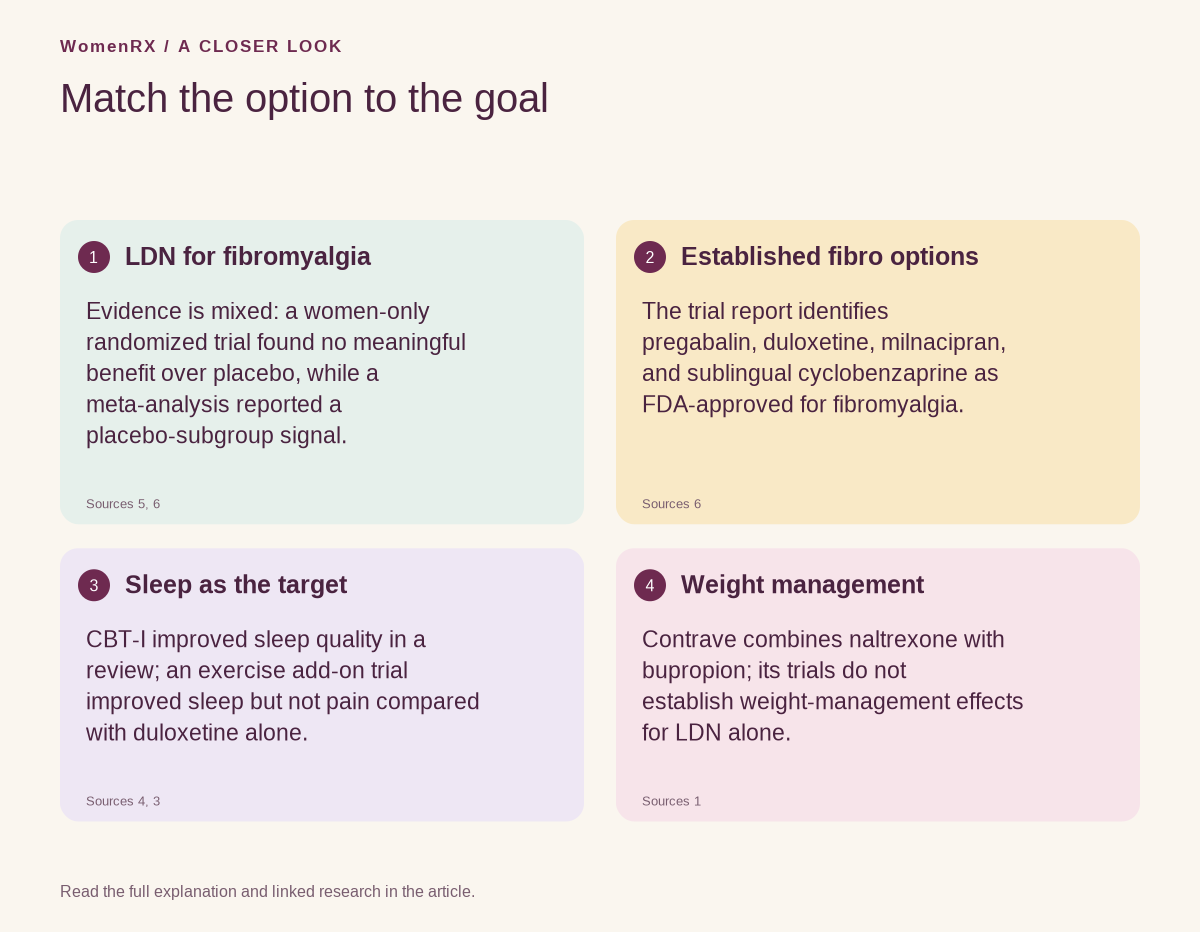
Match the option to the goal
LDN for fibromyalgia: Evidence is mixed: a women-only randomized trial found no meaningful benefit over placebo, while a meta-analysis reported a placebo-subgroup signal.56
Established fibro options: The trial report identifies pregabalin, duloxetine, milnacipran, and sublingual cyclobenzaprine as FDA-approved for fibromyalgia.6
Sleep as the target: CBT-I improved sleep quality in a review; an exercise add-on trial improved sleep but not pain compared with duloxetine alone.43
Weight management: Contrave combines naltrexone with bupropion; its trials do not establish weight-management effects for LDN alone.1
Read the figure as text
These examples show why LDN evidence and alternatives need to be compared by diagnosis and intended outcome, not treated as interchangeable.- LDN for fibromyalgia: Evidence is mixed: a women-only randomized trial found no meaningful benefit over placebo, while a meta-analysis reported a placebo-subgroup signal.56
- Established fibro options: The trial report identifies pregabalin, duloxetine, milnacipran, and sublingual cyclobenzaprine as FDA-approved for fibromyalgia.6
- Sleep as the target: CBT-I improved sleep quality in a review; an exercise add-on trial improved sleep but not pain compared with duloxetine alone.43
- Weight management: Contrave combines naltrexone with bupropion; its trials do not establish weight-management effects for LDN alone.1
More questions, answered
Is Contrave the same as low-dose naltrexone?
No. The prescribing information describes Contrave as an extended-release combination of naltrexone and bupropion. Evidence from trials of that combination, given alongside diet and exercise counseling, doesn’t show that LDN alone has the same effect. 1
Does the fibromyalgia LDN trial answer questions about pregnancy or breastfeeding?
No. The trial excluded women who were pregnant, planning pregnancy during the study, or breastfeeding. It therefore can’t establish how LDN affects those situations. 6
Sources you can check
- CONTRAVE EXTENDED-RELEASE (NALTREXONE HYDROCHLORIDE AND BUPROPION HYDROCHLORIDE) TABLET, EXTENDED RELEASE [NALPROPION PHARMACEUTICALS LLC] | US prescribing information and patient instructionsAccessed 2026-09-25Return to first citation
- Obesity: MedlinePlusAccessed 2026-09-25Return to first citation
- Home-based postural exercise as an adjunct to duloxetine improves sleep quality, physical quality of life, and trunk mobility in fibromyalgia: a randomized controlled trial.Demir C, Özçelep ÖF, Okumuş EC, Canlı M, Alkan H. · Rheumatology international · 2026Return to first citation
- Treatments for enhancing sleep quality in fibromyalgia: a systematic review and meta-analysis.Pathak A, Kelleher EM, Brennan I, Amarnani R, Wall A, Murphy R, Lee H, Fordham B, Irani A. · Rheumatology (Oxford, England) · 2025Return to first citation
- Low Dose Naltrexone In The Management Of Chronic Pain Syndrome: A Meta-Analysis Of Randomized Controlled Clinical Trials.Hegde NC, Mishra A, V D, Maiti R, Hota D, Srinivasan A. · Current pain and headache reports · 2025Return to first citation
- Efficacy of Low-Dose Naltrexone in Women With Fibromyalgia Syndrome: A 12-Month Randomised, Double-Blind, Placebo-Controlled Single-Centre Clinical Trial (INNOVA Study).Rodríguez-Freire C, Navarrete J, Rozadilla-Sacanell A, Sanabria-Mazo JP, Del Pino-Gaya B, Borràs X, Feliu-Soler A, Luciano JV. · European journal of pain (London, England) · 2026Return to first citation