Low-Dose Naltrexone: Uses, Evidence, and What’s Known
Low-dose naltrexone is an off-label approach with limited, condition-specific research, not a lower-dose version of a proven treatment for every chronic illness.
Standard-dose naltrexone is used for alcohol and opioid use disorders; low-dose naltrexone (LDN) means using much smaller amounts, usually off-label. LDN has been evaluated in small fibromyalgia studies, but the evidence is low certainty. Proposed immune and pain mechanisms remain unproven, and findings for one condition shouldn’t be assumed to apply to another. 1 4
Same medicine, different purpose
Naltrexone blocks opioid receptors. At standard doses, it’s used in treatment for alcohol and opioid use disorders. Low-dose naltrexone (LDN) uses a much smaller amount and is prescribed off-label for some conditions, especially chronic pain. A clinical review lists no approved indication for LDN. “Off-label” means a medicine is being used for a purpose that isn’t an approved use; it doesn’t, by itself, show that the treatment works. 4
The distinction is more than a number on a label. Standard-dose treatment is intended to block opioid effects over a sustained period. LDN is proposed to produce shorter-lived receptor blockade and to affect pain or immune signaling. Those proposed differences are not established explanations for clinical benefit, and researchers haven’t settled on one confirmed mechanism. 4
What the research shows by condition
Fibromyalgia: studied, but not settled
Fibromyalgia has been evaluated in small LDN studies. A 2023 systematic review found three efficacy studies: two small placebo-controlled trials published in peer-reviewed journals, and a third study reported as a conference abstract. The review concluded that there was low-strength evidence suggesting possible improvements in pain and quality of life, but the studies were small and had a high risk of bias. It also noted possible publication bias, which can make results look more favorable if positive findings are more likely to appear in print. 1
The studies don’t establish that LDN reliably helps people with fibromyalgia. The review rated the evidence very low overall, so the true effect could differ substantially from the results reported so far. A later retrospective chart review reported pain relief for some patients, but a chart review has no placebo comparison and can’t establish that LDN caused the improvement. 1 2
There’s a notable women’s-health detail: all three fibromyalgia efficacy studies in the systematic review included women only. That makes the findings directly relevant to women who took part, but it doesn’t tell us whether results differ by sex. The review called for more research among men and different ethnic groups. Also, one small study of inflammatory markers excluded people with known rheumatologic or autoimmune conditions, so its findings shouldn’t be treated as evidence for LDN in autoimmune disease. 1
Depression: a protocol, not proof of benefit
A published study protocol describes a planned placebo-controlled trial of LDN added to treatment for major depressive disorder. A protocol explains what researchers intend to test; it isn’t a report of results. On the evidence cited here, that study design can’t tell you whether LDN improves depression. 6
Cancer: case reports and reviews aren’t treatment proof
A case report described low-dose naltrexone used alongside vitamin D3 for tongue cancer. Because it was a single case and involved two treatments, it can’t show that LDN caused the reported outcome. A cancer review discusses possible explanations and potential uses, but a review’s claims of promise aren’t a substitute for reliable clinical evidence that a treatment benefits patients. 3 5
For endometriosis, autoimmune disease, and other conditions, don’t assume that a proposed anti-inflammatory mechanism or an effect reported in fibromyalgia applies. This evidence doesn’t establish LDN as an effective treatment for those conditions. That’s a limit on what can be concluded, not proof that no research exists.
What “immune mechanism” really means
LDN has been proposed to affect microglia, Toll-like receptor signaling, and other pathways involved in inflammation and pain processing. These are hypotheses about how the medicine might work, not proof that it changes those pathways in a way that treats a person’s condition. In the fibromyalgia review, small studies reported changes in inflammatory markers, but there were no brain-imaging studies showing how LDN affected brain structure or function. 1 4
That gap matters in everyday terms: a biological change on a lab test doesn’t automatically mean less pain, better sleep, or improved function. The clinical question is whether people feel and function better in well-designed comparisons, and that evidence remains limited for LDN.
A practical way to weigh a suggestion
If LDN has been suggested for you, ask what evidence supports its use for your specific diagnosis, and whether that evidence comes from controlled trials or from case reports and clinical observations. It’s also reasonable to ask what improvement would count as meaningful and how you’ll decide whether the treatment is helping. Those questions keep a promising theory separate from a demonstrated benefit.
One safety point deserves particular attention: naltrexone blocks opioid medicines, and many LDN studies excluded people taking opioids. If you use opioid pain medicine or might need it for a procedure or acute pain, raise that before starting LDN. 4
The bottom line is condition-specific. LDN has been studied in fibromyalgia, but the evidence is still weak; for other proposed uses, don’t let a shared mechanism or a compelling story stand in for clinical results.
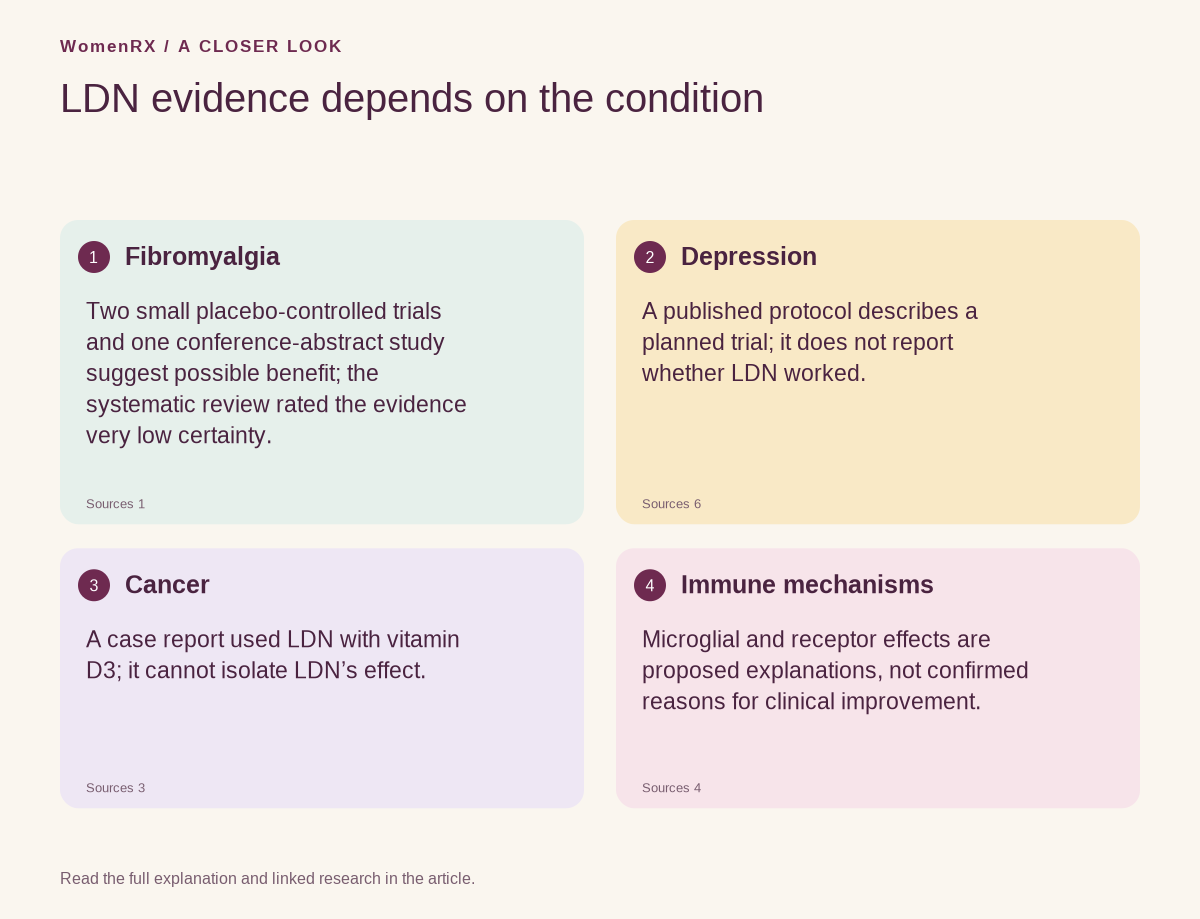
LDN evidence depends on the condition
Fibromyalgia: Two small placebo-controlled trials and one conference-abstract study suggest possible benefit; the systematic review rated the evidence very low certainty.1
Depression: A published protocol describes a planned trial; it does not report whether LDN worked.6
Cancer: A case report used LDN with vitamin D3; it cannot isolate LDN’s effect.3
Immune mechanisms: Microglial and receptor effects are proposed explanations, not confirmed reasons for clinical improvement.4
Read the figure as text
The research doesn’t support treating proposed mechanisms or early reports as equal to controlled clinical evidence.- Fibromyalgia: Two small placebo-controlled trials and one conference-abstract study suggest possible benefit; the systematic review rated the evidence very low certainty.1
- Depression: A published protocol describes a planned trial; it does not report whether LDN worked.6
- Cancer: A case report used LDN with vitamin D3; it cannot isolate LDN’s effect.3
- Immune mechanisms: Microglial and receptor effects are proposed explanations, not confirmed reasons for clinical improvement.4
More questions, answered
Can low-dose naltrexone be taken with opioid pain medicine?
Naltrexone blocks opioid effects, and LDN research has often excluded people taking opioids. If you use opioid pain medicine or may need it, discuss that interaction before starting LDN. 4
Sources you can check
- A systematic literature review on the clinical efficacy of low dose naltrexone and its effect on putative pathophysiological mechanisms among patients diagnosed with fibromyalgia.Partridge S, Quadt L, Bolton M, Eccles J, Thompson C, Colasanti A, Bremner S, Jones CI, Bruun KD, Van Marwijk H. · Heliyon · 2023Return to first citation
- Low dose naltrexone for fibromyalgia: case series demonstrating pain relief and other health benefits.Junek A, Anderson M. · Frontiers in pain research (Lausanne, Switzerland) · 2026Return to first citation
- Long-term remission of adenoid cystic tongue carcinoma with low dose naltrexone and vitamin D3--a case report.Khan A. · Oral health and dental management · 2014Return to first citation
- Low-Dose Naltrexone in Chronic Pain Management: Mechanisms, Evidence, and Clinical Implications.McKenzie A, Bittar T, Dombrower R, Raman D, Hussain H, Theeraphapphong N, McKenzie SM, Abd-Elsayed A. · Journal of personalized medicine · 2026Return to first citation
- Low Doses Naltrexone: The Potential Benefit Effects for its Use in Patients with Cancer.Couto RD, Fernandes BJD. · Current drug research reviews · 2021Return to first citation
- A randomized, double-blind, placebo-controlled, hybrid parallel-arm study of low-dose naltrexone as an adjunctive anti-inflammatory treatment for major depressive disorder.Plank JR, Glover SC, Moloney BD, Hoeh NR, Sundram F, Sumner RL, Muthukumaraswamy S, Lin JC. · Trials · 2022Return to first citation