Low-Dose Naltrexone: What Studies Measure, and When
There isn’t one proven response timeline: small studies in different conditions measured different outcomes over periods ranging from weeks to trial-phase comparisons.
Low-dose naltrexone studies don’t establish a universal time to feel better. In Crohn’s disease trials, researchers assessed outcomes after 8 weeks in children and 12 weeks in adults; fibromyalgia studies tracked pain and other symptoms, but their results don’t define a reliable onset for an individual. These are research assessment periods, not a personal treatment schedule. 2 3 5
Start with the condition and the outcome
“Response” can mean different things: less daily pain, a defined reduction in Crohn’s symptoms, or a change on a depression scale. Those measures aren’t interchangeable, and results from one condition can’t set expectations for another. The studies discussed are small and condition-specific, so they don’t establish a general low-dose naltrexone onset or success rate.
If you’re reviewing a trial of treatment, first name the main change you hope to see. For example, that might be fewer painful days, a change in a specific symptom score, or improvement on a measure your clinician is already using. Keep that measure consistent over time; otherwise, a fluctuating symptom or a good day can look like a treatment effect.
What the fibromyalgia studies measured
A small randomized crossover study followed 31 women with fibromyalgia and compared low-dose naltrexone with placebo. Participants reported pain daily. At the end of each treatment condition, pain had fallen by 28.8% from baseline during the naltrexone condition and by 18.0% during placebo. The study also reported better life satisfaction and mood during naltrexone, but not better fatigue or sleep. Its response definition required a significant pain reduction plus a significant reduction in fatigue or sleep problems; 32% met that definition during naltrexone and 11% during placebo. 5
Those figures describe one small crossover trial, not the chance that any individual will respond. A later systematic review found only three placebo-controlled fibromyalgia studies, with 117 adult participants in total. The studies were small and judged at high risk of bias, so the review rated the evidence as weak. It also noted that the studies included women, but did not establish results by reproductive life stage. 3
For timing, the useful point is that the trial measured daily pain across treatment conditions. It doesn’t show that a particular day or week is when a person should expect relief. A separate dose-response study enrolled women aged 18 to 60 and found wide variation in which symptoms changed; it was not a placebo-controlled test of when benefit begins. 4
Crohn’s disease used defined week-based endpoints
Crohn’s disease trials assessed different outcomes at set study endpoints. In the adult trial, 34 participants were evaluated after 12 weeks. Clinical remission occurred in 5 of 18 people assigned to low-dose naltrexone (30%) and 3 of 16 assigned to placebo (18%); this difference was not statistically significant. A clinical response, defined as a 70-point drop on the Crohn’s Disease Activity Index, occurred in 15 of 18 (83%) versus 6 of 16 (38%). 2
A pediatric study assessed 12 participants after 8 weeks, with safety and tolerability as its primary purpose. The review found the evidence overall too sparse to support firm conclusions about benefit or safety. These week counts tell you when the researchers measured outcomes, not when symptoms should improve or how long anyone should take treatment. 2
A planned depression study is not a result
A registered study protocol for low-dose naltrexone as an add-on treatment for major depressive disorder planned to measure depression symptoms at weeks 2, 4, 8, and 12, then continue assessments through week 24. That schedule shows how researchers planned to track change; a protocol alone does not show that treatment worked or reveal when a response occurred. 7
Make your review useful, not all-purpose
A practical review can stay focused on the condition being treated:
- Choose one or two meaningful outcomes before starting, such as daily pain or a condition-specific measure.
- Record them in the same way at regular intervals so you can compare like with like.
- At a planned follow-up, look at the pattern across the full interval, not just the best or worst day. Separate symptom change from changes in other treatments or routines where possible.
- Compare what happened with the outcome and timeframe that matter for your condition, not with a result from a different diagnosis.
This helps make a treatment review more concrete, but it doesn’t turn a study endpoint into a personal deadline. If you’re taking low-dose naltrexone for weight loss, the studies summarized here don’t test low-dose naltrexone alone as a weight-loss treatment. Evidence about naltrexone combined with bupropion concerns a different treatment and cannot establish what to expect from low-dose naltrexone by itself. 1 6
What the studies say about women
The fibromyalgia review’s studies were restricted to women, but that doesn’t mean they tell us how response differs across menstrual, perimenopausal, or postmenopausal stages. The review did not report those comparisons. The Crohn’s disease review and depression-study protocol also don’t provide reproductive-stage subgroup results in the reported information. So there’s no supported basis here for a separate timeline by life stage. 2 3 7
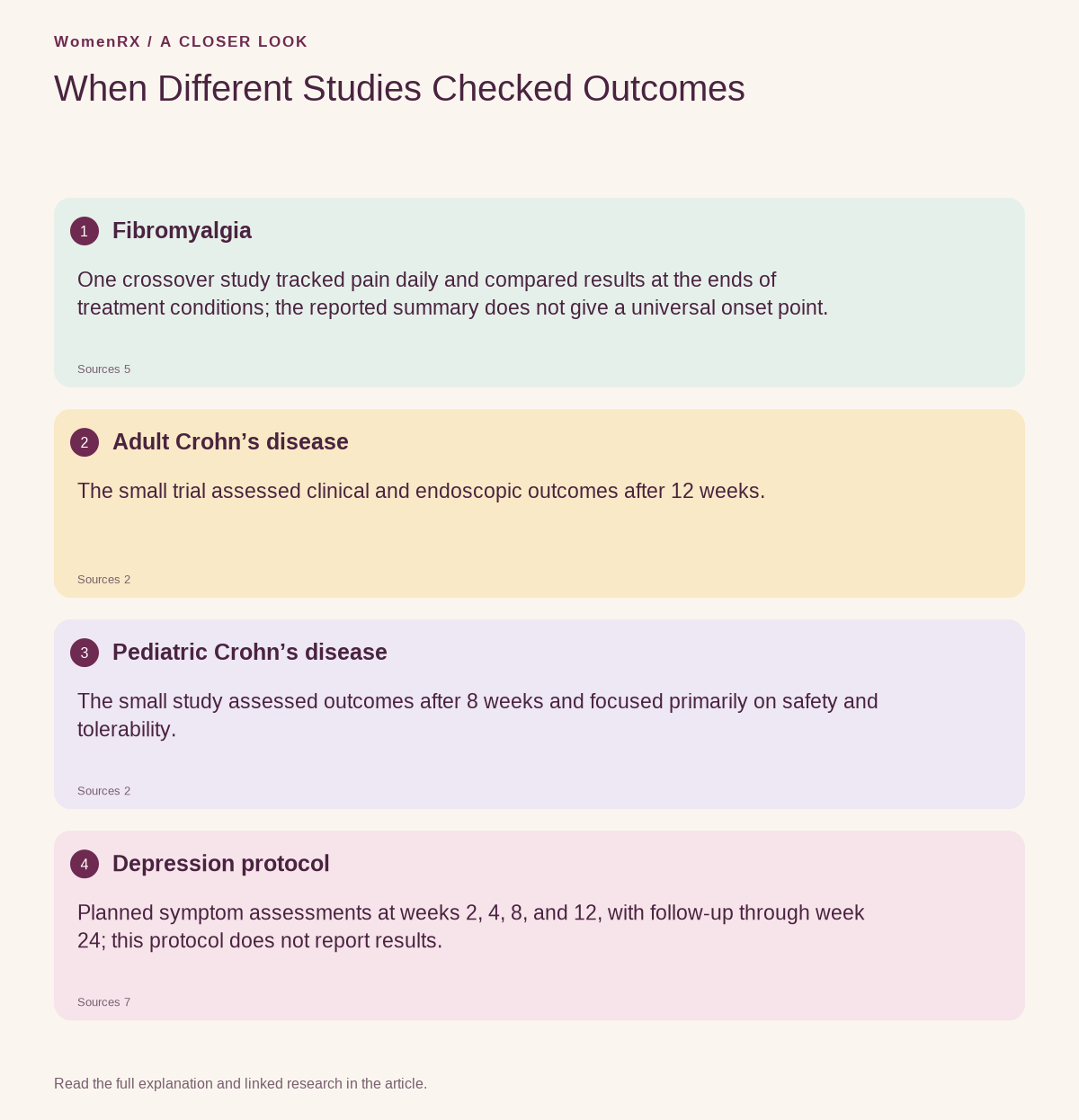
When Different Studies Checked Outcomes
Fibromyalgia: One crossover study tracked pain daily and compared results at the ends of treatment conditions; the reported summary does not give a universal onset point.5
Adult Crohn’s disease: The small trial assessed clinical and endoscopic outcomes after 12 weeks.2
Pediatric Crohn’s disease: The small study assessed outcomes after 8 weeks and focused primarily on safety and tolerability.2
Depression protocol: Planned symptom assessments at weeks 2, 4, 8, and 12, with follow-up through week 24; this protocol does not report results.7
Read the figure as text
These are study assessment points, not a recommended treatment schedule or a promise of when an individual will respond.- Fibromyalgia: One crossover study tracked pain daily and compared results at the ends of treatment conditions; the reported summary does not give a universal onset point.5
- Adult Crohn’s disease: The small trial assessed clinical and endoscopic outcomes after 12 weeks.2
- Pediatric Crohn’s disease: The small study assessed outcomes after 8 weeks and focused primarily on safety and tolerability.2
- Depression protocol: Planned symptom assessments at weeks 2, 4, 8, and 12, with follow-up through week 24; this protocol does not report results.7
More questions, answered
Does a study’s assessment week mean I should feel better by then?
No. It marks when researchers evaluated an outcome under that study’s conditions. It isn’t a proven onset date or an individual treatment deadline. 2 7
Do low-dose naltrexone studies show weight-loss results?
The condition-specific low-dose studies discussed here do not test low-dose naltrexone alone for weight loss. Findings about naltrexone combined with bupropion apply to that combination, not to low-dose naltrexone by itself. 1 6
Sources you can check
- CONTRAVE EXTENDED-RELEASE (NALTREXONE HYDROCHLORIDE AND BUPROPION HYDROCHLORIDE) TABLET, EXTENDED RELEASE [NALPROPION PHARMACEUTICALS LLC] | US prescribing information and patient instructionsAccessed 2026-09-25Return to first citation
- Low dose naltrexone for induction of remission in Crohn's disease.Parker CE, Nguyen TM, Segal D, MacDonald JK, Chande N. · The Cochrane database of systematic reviews · 2018Return to first citation
- A systematic literature review on the clinical efficacy of low dose naltrexone and its effect on putative pathophysiological mechanisms among patients diagnosed with fibromyalgia.Partridge S, Quadt L, Bolton M, Eccles J, Thompson C, Colasanti A, Bremner S, Jones CI, Bruun KD, Van Marwijk H. · Heliyon · 2023Return to first citation
- Low-Dose Naltrexone for the Treatment of Fibromyalgia: Investigation of Dose-Response Relationships.Bruun-Plesner K, Blichfeldt-Eckhardt MR, Vaegter HB, Lauridsen JT, Amris K, Toft P. · Pain medicine (Malden, Mass.) · 2020Return to first citation
- Low-dose naltrexone for the treatment of fibromyalgia: findings of a small, randomized, double-blind, placebo-controlled, counterbalanced, crossover trial assessing daily pain levels.Younger J, Noor N, McCue R, Mackey S. · Arthritis and rheumatism · 2013Return to first citation
- Comparative effects of drugs for adults with overweight or obesity: systematic review and network meta-analysis.Nong K, Shi Q, Xie X, Wang Y, Agarwal A, Guyatt GH, Zhang H, Gao Y, Khunti K, Le Roux CW, Widyahening IS, Fan Q, Liu T, Mao Y, Florez ID, Du H, Pan X, Zou X, Wang C, Sun X, Li J, H... · BMJ (Clinical research ed.) · 2026Return to first citation
- A randomized, double-blind, placebo-controlled, hybrid parallel-arm study of low-dose naltrexone as an adjunctive anti-inflammatory treatment for major depressive disorder.Plank JR, Glover SC, Moloney BD, Hoeh NR, Sundram F, Sumner RL, Muthukumaraswamy S, Lin JC. · Trials · 2022Return to first citation