Considering Low-Dose Naltrexone? Match Alternatives to Your Pain
The most useful alternative depends on whether you’re treating nerve pain, back pain, period cramps, or another cause of pelvic pain.
Start with the treatment goal, not a list of substitutes. For diabetic nerve pain, studied options include pregabalin, duloxetine, and amitriptyline; back pain and period pain call for different approaches. Pelvic pain may need treatment of an underlying cause. None of these options is established as an equivalent swap for low-dose naltrexone across conditions. 5 7 8 9
First, name the pain you want to treat
If you’re considering avoiding or stopping low-dose naltrexone (LDN), ask what it was meant to improve: burning or tingling nerve pain, back pain, cramps tied to your period, or something else? Those descriptions point to different treatment choices. A review focused on pain management in people with chronic kidney disease discusses LDN as an emerging option. It notes variable findings on effectiveness and safety in earlier studies, while saying LDN use in people with chronic kidney disease remains to be investigated. It does not establish how well LDN works across chronic-pain conditions. That isn’t a reason to dismiss your experience with it, but another pain treatment should not be assumed to do the same job. 6
If you take LDN and also use an opioid pain medicine, or might need one for a procedure, ask your prescriber how to manage both medicines. The opioid-blockade and overdose warning in Contrave’s product information applies to that naltrexone-containing combination product; this source does not establish the warning’s scope at LDN doses. 1
If the goal is relief from nerve pain
The diagnosis matters: evidence from people with painful diabetic neuropathy doesn’t automatically apply to every condition described as nerve pain.
In a randomized crossover trial of adults with painful diabetic neuropathy, researchers compared treatment pathways beginning with amitriptyline, duloxetine, or pregabalin and adding a second medicine if needed. No pathway clearly outperformed the others on pain at the end of each pathway. During weeks 6 to 16, combination therapy was associated with more pain reduction than remaining on one medicine. This was a comparison of treatments for diabetic nerve pain, not a trial of switching from LDN. 5
These are prescription options to compare by fit, not three interchangeable pills. Pregabalin is used for nerve pain, but sleepiness and dizziness can matter if you drive, work on your feet, or already struggle with fatigue. It can also increase hunger, and stopping it suddenly can cause withdrawal symptoms. 2 3 Amitriptyline and duloxetine were both studied in the diabetic-neuropathy trial; that trial found similar overall tolerability across its treatment pathways, but it doesn’t establish that either medicine will suit you personally. Ask which effects and other medicines would make one a better starting choice for you. 5
The distinction between nerve-pain diagnoses can change the decision. For example, a retrospective study of adults newly diagnosed with cervical radiculopathy found higher recorded risks of opioid-related adverse events and acute respiratory failure, along with greater use of some health services, among those prescribed gabapentin than among those prescribed nonsteroidal anti-inflammatory drugs. Because treatment wasn’t randomly assigned, it cannot show that gabapentin caused those differences or that the anti-inflammatory drugs relieved pain better. It does show why a result from diabetic neuropathy shouldn’t be treated as a recommendation for every pinched-nerve problem. 4
If the goal is relief from back pain
Back pain isn’t one diagnosis. Treatment depends on the kind of pain and its cause, and may involve hot or cold packs, exercise, medicines, injections, or, sometimes, surgery. For a recent episode, prolonged bed rest can make pain worse. Rather than asking for an LDN substitute by name, ask whether the next step is to keep moving as you’re able, address a suspected cause, or reassess persistent pain. New severe back pain, pain after an injury, or pain that isn’t improving deserves a medical assessment. 7
That choice has a practical trade-off: a heat pack may help you manage symptoms, but it won’t identify why pain persists; a procedure is a different proposition from an at-home measure. The right comparison depends on what’s causing your back pain. 7
If the pain follows your menstrual cycle
Cramps around the start of a period often come from the uterus tightening. Heat, gentle movement, and pain relievers such as ibuprofen are options for period pain. For more severe cramps, treatment may include an anti-inflammatory medicine or hormonal contraception that makes periods lighter. Hormonal contraception can ease cramps by making periods lighter, but it is a contraceptive choice rather than a noncontraceptive pain treatment. 9
Worsening or unusually severe cramps are a reason to look beyond symptom relief. Endometriosis, adenomyosis, fibroids, and infection are among the possible causes; treating a cause may change the plan. Seek prompt care if pelvic or period pain is severe or worse than usual and pain relief hasn’t helped. Arrange an assessment if periods become heavier or irregular, pain disrupts daily life, you bleed between periods, or you have pain with sex, urination, or bowel movements. 9
Pelvic pain that doesn’t simply track with periods needs an even wider view. It can involve reproductive organs, the urinary tract, bowel, muscles, or bone, and more than one cause can be present. There is no single treatment that serves as a meaningful LDN alternative for all of those possibilities. Describe where and when the pain happens and what else changes with it so the next treatment targets the likely cause. 8
Make the switch answer a specific question
A useful discussion starts with: “What diagnosis or symptom are we treating, and how will we tell whether the replacement is helping?” Then name the trade-off you most want to avoid, such as daytime sleepiness with a nerve-pain medicine or using contraception to treat period pain when you do not want contraception. If you’re planning a pregnancy or breastfeeding, tell the prescriber when comparing medication options. The cited diabetic-neuropathy pathway results do not identify a preferred option during pregnancy or breastfeeding. If your pain changes with your cycle, say that too. It may point toward a different cause and a different treatment than general chronic-pain advice would suggest. 2 5 8 9
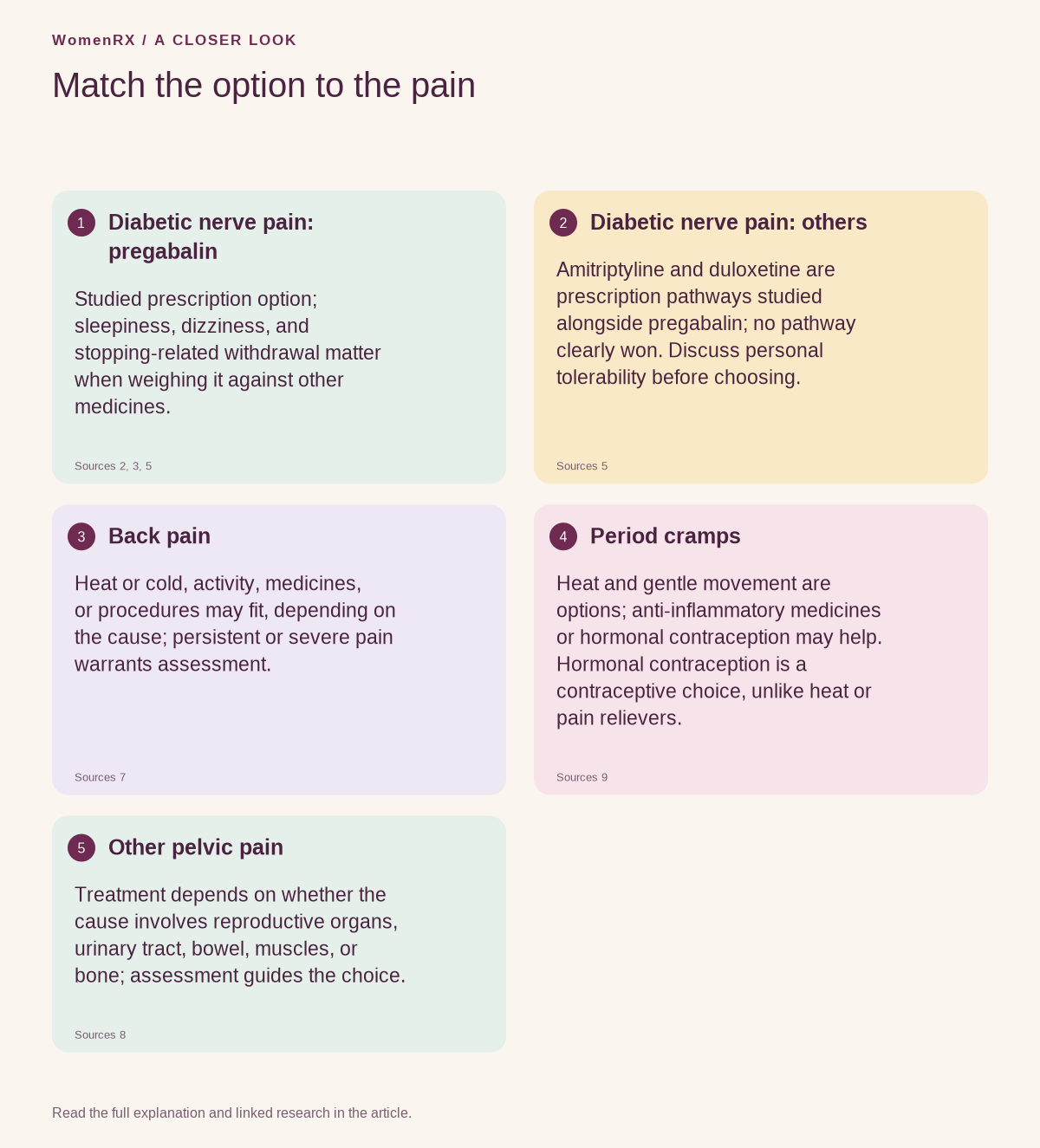
Match the option to the pain
Diabetic nerve pain: pregabalin: Studied prescription option; sleepiness, dizziness, and stopping-related withdrawal matter when weighing it against other medicines.235
Diabetic nerve pain: others: Amitriptyline and duloxetine are prescription pathways studied alongside pregabalin; no pathway clearly won. Discuss personal tolerability before choosing.5
Back pain: Heat or cold, activity, medicines, or procedures may fit, depending on the cause; persistent or severe pain warrants assessment.7
Period cramps: Heat and gentle movement are options; anti-inflammatory medicines or hormonal contraception may help. Hormonal contraception is a contraceptive choice, unlike heat or pain relievers.9
Other pelvic pain: Treatment depends on whether the cause involves reproductive organs, urinary tract, bowel, muscles, or bone; assessment guides the choice.8
Read the figure as text
These are different treatment decisions, not equivalent replacements for low-dose naltrexone.- Diabetic nerve pain: pregabalin: Studied prescription option; sleepiness, dizziness, and stopping-related withdrawal matter when weighing it against other medicines.235
- Diabetic nerve pain: others: Amitriptyline and duloxetine are prescription pathways studied alongside pregabalin; no pathway clearly won. Discuss personal tolerability before choosing.5
- Back pain: Heat or cold, activity, medicines, or procedures may fit, depending on the cause; persistent or severe pain warrants assessment.7
- Period cramps: Heat and gentle movement are options; anti-inflammatory medicines or hormonal contraception may help. Hormonal contraception is a contraceptive choice, unlike heat or pain relievers.9
- Other pelvic pain: Treatment depends on whether the cause involves reproductive organs, urinary tract, bowel, muscles, or bone; assessment guides the choice.8
Sources you can check
- CONTRAVE EXTENDED-RELEASE (NALTREXONE HYDROCHLORIDE AND BUPROPION HYDROCHLORIDE) TABLET, EXTENDED RELEASE [NALPROPION PHARMACEUTICALS LLC] | US prescribing information and patient instructionsAccessed 2026-09-25Return to first citation
- About pregabalin - NHSAccessed 2026-09-25Return to first citation
- Side effects of pregabalin - NHSAccessed 2026-09-25Return to first citation
- Comparative safety and health service utilization for gabapentin versus non-steroidal anti-inflammatory drugs for cervical radiculopathy: A retrospective cohort study of academic centers.Baumann AN, Trager RJ, McGlamery D, Yazdanpanah S, Conry KT, Preston G, Hoffmann JC. · Journal of clinical neuroscience : official journal of the Neurosurgical Society of Australasia · 2026Return to first citation
- Optimal pharmacotherapy pathway in adults with diabetic peripheral neuropathic pain: the OPTION-DM RCT.Tesfaye S, Sloan G, Petrie J, White D, Bradburn M, Young T, Rajbhandari S, Sharma S, Rayman G, Gouni R, Alam U, Julious SA, Cooper C, Loban A, Sutherland K, Glover R, Waterhouse S,... · Health technology assessment (Winchester, England) · 2022Return to first citation
- The Present and Future of Pain Management in Patients With Chronic Kidney Disease: A Narrative Review.Wilderman I, Sarzetto F, Wijetillake B, Verdun S. · Cureus · 2025Return to first citation
- Back PainAccessed 2026-09-25Return to first citation
- Pelvic Pain | Chronic Pelvic Pain | MedlinePlusAccessed 2026-09-25Return to first citation
- Period pain - NHSAccessed 2026-09-25Return to first citation