How to Read One-Year Semaglutide Weight-Loss Results
One-year averages depend on who was studied, which form of semaglutide they took, and whether treatment continued.
A large evidence review estimated that, at one year, subcutaneous semaglutide was associated with about 9.8% more weight loss than lifestyle modification alone; its estimate for oral semaglutide was 10.9%. These are group averages, not personal forecasts or a direct comparison of the two forms. The one-year figures presented here do not show results by dose. 5
Start with what the percentage compares
A one-year result is useful only when you know what it measures. A 2026 review of randomized trials estimated that subcutaneous semaglutide produced 9.8% more weight loss than lifestyle modification alone at one year. For oral semaglutide, the estimate was 10.9% more. The review combined evidence from many trials, with follow-up ranging from 12 to 172 weeks. Its estimates are comparisons with lifestyle modification, not promises that a particular person will lose that percentage. 5
Those two numbers also aren’t a head-to-head test of oral versus injectable semaglutide. The review reported results by route, but a pooled comparison across trials can’t tell you that one route will work better for you. Across the drugs it reviewed, subgroup analyses by dose found no credible differences in relative treatment effects. That is not a semaglutide-specific dose finding, and the one-year figures presented here do not show results by dose. So these figures can’t show what a particular dose might mean for an individual. 5
A percentage is not a fixed number of pounds: for example, 10% of a starting weight of 200 pounds is 20 pounds, while 10% of 300 pounds is 30 pounds.
Check the study population before comparing results
Semaglutide studies don’t all answer the same question. In the Wegovy prescribing information, a 68-week study enrolled adults with obesity, or overweight and a weight-related condition, and excluded people with type 2 diabetes. A separate 68-week study enrolled adults with type 2 diabetes and overweight or obesity. Women made up 74% of the first study and 51% of the second. Those differences matter: the outcomes from an obesity-focused study shouldn’t be treated as interchangeable with results in a diabetes population. 1
Real-world findings can look different again. In a retrospective study of U.S. veterans with diabetes and heart failure, average weight change one year after the first semaglutide prescription was a 4.7% loss among veterans without schizophrenia and a 3.1% loss among those with schizophrenia. The prescription date does not establish that participants took semaglutide throughout that year. This wasn’t a randomized trial or a comparison with lifestyle modification alone, and the participants had specific, significant health conditions. It helps illustrate how results in a particular care setting may differ from trial averages; it doesn’t set an expected result for people with diabetes generally. 3
A result after bariatric surgery is another distinct case. In a randomized trial of people with suboptimal weight loss after surgery, 68 weeks of semaglutide was associated with an estimated mean 18.0% weight loss, compared with a 0.4% gain with placebo. The trial included 70 participants, most of them women. Those findings concern a small, selected group after surgery, not a typical one-year outcome for everyone considering semaglutide. 2
One year on treatment isn’t the same as one year after starting
A study’s follow-up period and treatment period can differ. In a small, open-label study of people with schizophrenia who didn’t have diabetes, participants received semaglutide for 24 weeks and were followed for 76 weeks total. The reported average loss was 9.8% at 24 weeks and 5.1% from baseline at the end of follow-up. The researchers said the benefit had attenuated after semaglutide was stopped. This study offers a reason to pay attention to whether treatment continued, but its small, specific population doesn’t show what happens to everyone after discontinuation. 4
Missing follow-up can change what a reported average represents. If a result includes only people who completed a study, it describes those with observed outcomes. If people who leave differ in their weight changes from people who stay, that average could shift in either direction. An “intention-to-treat” label is useful to look for, but check how many randomized participants appear in the reported analysis and how missing outcomes were handled. For example, the post-surgery trial randomized 70 people and reported an intention-to-treat analysis of 63; that count alone doesn’t show how the other outcomes were handled. 2
The small study after semaglutide discontinuation also illustrates why completion details matter: 17 of 26 participants completed the intervention, and 15 of those 17 completed the full follow-up. The reported 24-week weight result was an intention-to-treat estimate. The completion figures do not establish how missing outcomes affected the later result. 4
When reading any result, look for the end point: Was the weight measured after about a year of taking the medication, or at a one-year follow-up that included time off treatment? Those are different questions.
What the numbers can tell you as a woman
Some of the relevant trials included many women, but a study’s overall average is not a women-specific estimate. The trial summaries above report the proportion of women enrolled, not a separate one-year result by sex. They therefore don’t establish that women should expect a reliably different response. 1 2
These weight-loss averages also don’t answer questions about treatment around pregnancy planning or reproductive transitions. If those circumstances matter to your decision, they’re a separate conversation from interpreting a one-year study average.
A quick way to assess a one-year claim
Before comparing a headline number with your own progress, check whether the study involved people with diabetes, whether the result was for oral or subcutaneous semaglutide, and how long participants actually took treatment. Look for the dose studied, but remember that the one-year figures presented here do not show results by dose. Check how many participants had follow-up data, whether the analysis included everyone randomized, and how missing outcomes were handled. Finally, check what the percentage is compared with. A result versus placebo or lifestyle modification is not the same as the total weight change from a person’s starting point.
For your own progress, the study average is context, not a pass-or-fail target. Your starting weight, health conditions, treatment course, and whether you’re still taking the medication all affect what a comparison can mean. A useful question is: “Is this result from people like me, on the same treatment route and over the same period?”
Five checks for a one-year result
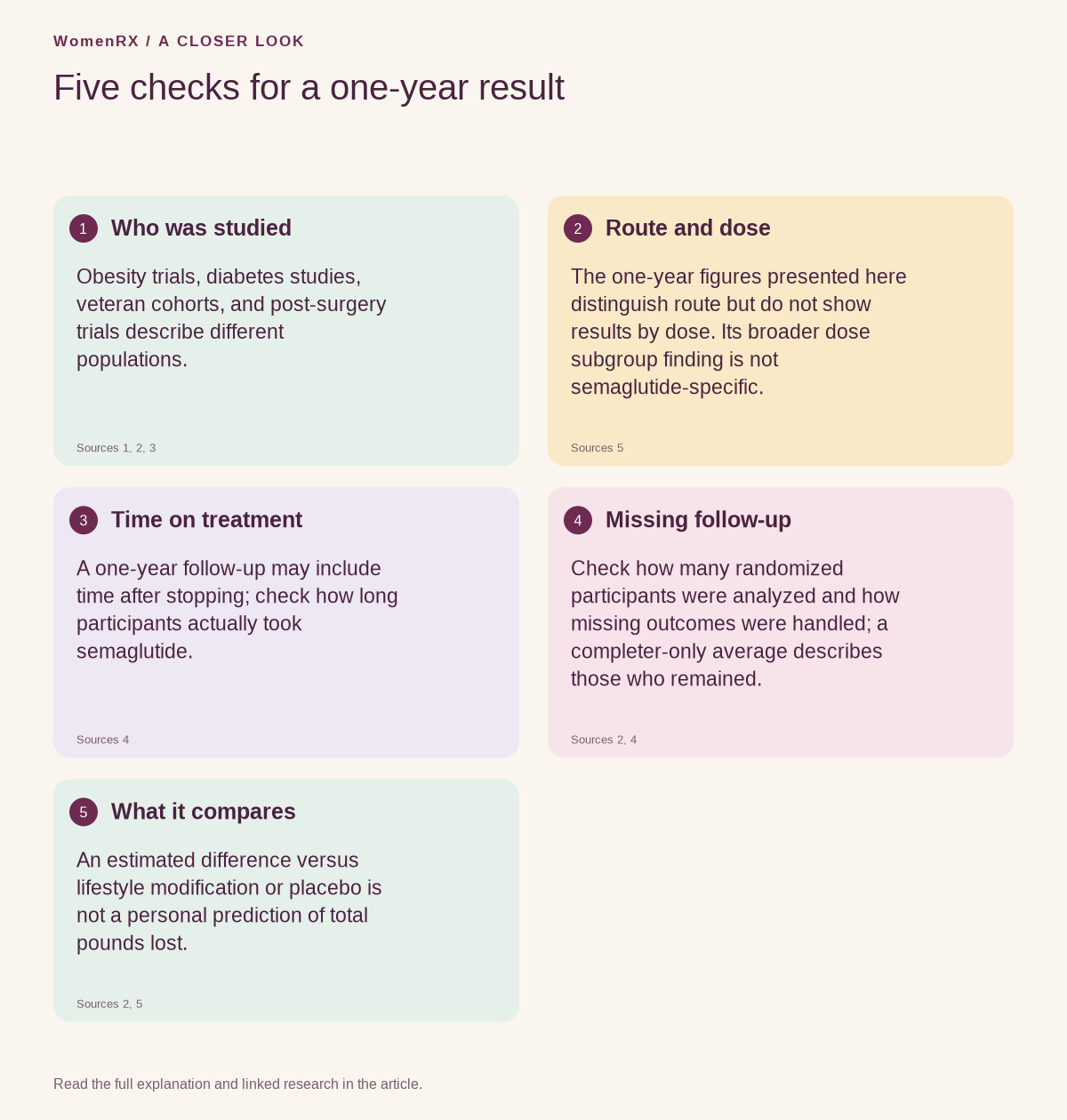
Who was studied: Obesity trials, diabetes studies, veteran cohorts, and post-surgery trials describe different populations.123
Route and dose: The one-year figures presented here distinguish route but do not show results by dose. Its broader dose subgroup finding is not semaglutide-specific.5
Time on treatment: A one-year follow-up may include time after stopping; check how long participants actually took semaglutide.4
Missing follow-up: Check how many randomized participants were analyzed and how missing outcomes were handled; a completer-only average describes those who remained.24
What it compares: An estimated difference versus lifestyle modification or placebo is not a personal prediction of total pounds lost.25
Read the figure as text
A weight-loss percentage is easier to interpret when you know the population, treatment details, follow-up, and comparison group.- Who was studied: Obesity trials, diabetes studies, veteran cohorts, and post-surgery trials describe different populations.123
- Route and dose: The one-year figures presented here distinguish route but do not show results by dose. Its broader dose subgroup finding is not semaglutide-specific.5
- Time on treatment: A one-year follow-up may include time after stopping; check how long participants actually took semaglutide.4
- Missing follow-up: Check how many randomized participants were analyzed and how missing outcomes were handled; a completer-only average describes those who remained.24
- What it compares: An estimated difference versus lifestyle modification or placebo is not a personal prediction of total pounds lost.25
More questions, answered
Does a one-year average tell me how many pounds I’ll lose?
No. A percentage translates to different numbers of pounds at different starting weights, and a trial average describes a group rather than predicting one person’s outcome. For example, 10% of 200 pounds is 20 pounds; 10% of 300 pounds is 30 pounds.
Can I compare an obesity-study result with a diabetes-study result?
Not as if they were the same kind of evidence. The study populations and designs differ, and one-year observational results in people with diabetes and other health conditions aren’t directly comparable with randomized trial estimates against lifestyle modification. 1 3 5
Sources you can check
- WEGOVY (SEMAGLUTIDE) INJECTION, SOLUTION WEGOVY (SEMAGLUTIDE) TABLET [NOVO NORDISK PHARMACEUTICAL INDUSTRIES, LP] | US prescribing information and patient instructionsAccessed 2026-09-25Return to first citation
- Semaglutide versus placebo in individuals with poor weight loss after bariatric surgery: a double-blinded, randomized, placebo-controlled trial.Stanley C, Mallik R, Hamid N, Jassil FC, Reuven V, Ruwona T, Dicken SJ, Qamar S, Norton B, Kingett H, Pucci A, Magee C, Boniface D, Batterham RL, Devalia K, Mok J, Elkalaawy M, Loy... · Nature medicine · 2026Return to first citation
- Weight Loss in Veterans with Schizophrenia and Multimorbidity Prescribed Semaglutide: Results From a National Retrospective Cohort Study.Browne J, Wu WC, Jiang L, Bayer TA, Kunicki ZJ, Thompson M, Bozzay ML, De Vito AN, Howe MD, Singh M, Primack JM, McGeary JE, Maharaj R, Kelso CM, Philip NS, Greenberg BD, Rudolph J... · Schizophrenia bulletin · 2026Return to first citation
- Weight loss and gut microbial changes associated with semaglutide among people living with schizophrenia receiving clozapine or olanzapine: An open-label 24-week semaglutide intervention and 76-week trial.Lappin JM, Bolton P, Smith G, Chua XY, Grattan S, Samaras K, Day R, Popovic G, O'Donnell M, Buten S, Hansen J, Teasdale S, Wong T, El-Omar E. · Schizophrenia research · 2026Return to first citation
- Comparative effects of drugs for adults with overweight or obesity: systematic review and network meta-analysis.Nong K, Shi Q, Xie X, Wang Y, Agarwal A, Guyatt GH, Zhang H, Gao Y, Khunti K, Le Roux CW, Widyahening IS, Fan Q, Liu T, Mao Y, Florez ID, Du H, Pan X, Zou X, Wang C, Sun X, Li J, H... · BMJ (Clinical research ed.) · 2026Return to first citation