Semaglutide Results: Trial Evidence vs. Testimonials
A trial average can show what happened in a defined group, while a personal story can’t tell you how likely the same result is for you.
The strongest way to judge a semaglutide result is to compare like with like: the product and dose, treatment length, whether participants had diabetes, and what happened to everyone enrolled. In nine randomized trials of adults with overweight or obesity without diabetes, semaglutide reduced body weight by an average 12.04 percentage points more than placebo. That group average is useful context, not a forecast for an individual. 3
Start with the kind of evidence
A testimonial tells you that one person says they had a particular experience. It usually can’t tell you how typical that experience is, what would have happened without treatment, or how many people tried the same approach without posting about it. That makes testimonials useful for understanding what someone noticed, but weak evidence for predicting your own result.
A randomized trial offers a different kind of answer. Participants are assigned to treatment or comparison groups, so researchers can estimate how outcomes differ between those groups. For example, a meta-analysis of nine randomized trials included 6,239 adults with overweight or obesity who did not have diabetes. Semaglutide reduced percentage body weight by an average 12.04 percentage points more than placebo. This is a pooled group comparison, not the amount every participant lost or a separate estimate for women. 3
Check whether the comparison fits you
Before comparing a story or headline with trial results, look for four details:
- Who was studied? Weight-loss studies in people without diabetes don’t automatically predict results for people taking semaglutide for type 2 diabetes. In a different setting, the US SEPRA trial randomized adults with type 2 diabetes and inadequate glucose control to semaglutide or another treatment chosen by their physician. Its main question included blood sugar control, not just weight. 1
- Which formulation and regimen? Injectable and oral semaglutide have been studied in different populations and study designs. For example, the pooled weight estimate above came from trials of subcutaneous semaglutide, while PIONEER REAL followed adults with type 2 diabetes using oral semaglutide in routine care. Their numbers aren’t a direct head-to-head comparison. 23
- How long was treatment followed? A result after several months is not the same as a result after years. The PIONEER REAL analysis measured outcomes from baseline to week 38; SEPRA reported outcomes at years one and two. 12
- Who is included in the result? Ask whether the figure describes everyone assigned to treatment, only people who completed the study, or only those still taking it. In PIONEER REAL, 1,615 people started oral semaglutide; 1,483 completed the study, and 1,222 of those completers were still on treatment at the end. Those counts provide retention context. Check the outcome-analysis denominator separately before comparing its week-38 weight estimate with another result. 2
If a post leaves out these details, the result may still be someone’s genuine experience. It just can’t be compared fairly with a trial average.
Read the number, not just the headline
“Lost 20 pounds” sounds specific, but without starting weight and timeframe it’s hard to interpret. A percentage change gives some context, while the comparison group helps show how much change was associated with treatment beyond the placebo group. Even then, a study average does not reveal the full range of individual outcomes.
The 12.04-point estimate is a difference versus placebo in a pooled analysis, not a promise that any one person will lose that percentage. Check a trial’s dose and follow-up before matching its result to a particular testimonial. Keep the comparison at the level the evidence supports: a result across a group, under study conditions, in adults without diabetes. 3
Routine-care findings can add a different perspective, but they answer a different question. In PIONEER REAL, seven prospective, non-interventional studies pooled data on adults with type 2 diabetes taking oral semaglutide. By week 38, estimated average weight change was minus 5.0%, alongside improved treatment satisfaction. Because participants weren’t randomized to semaglutide or a comparison treatment in this analysis, it describes outcomes during routine use rather than isolating the drug’s effect in the way a randomized comparison can. 2
Patient-reported results are not the same as weight results
A story may focus on appetite, daily routines, satisfaction, or how someone feels. Those experiences matter, but they are different outcomes from pounds lost or blood sugar changes. Trials can measure patient-reported outcomes with questionnaires, yet one person’s account isn’t equivalent to a standardized group result.
SEPRA was a two-year, open-label, randomized pragmatic trial in adults with type 2 diabetes. Some patient-reported outcomes improved more with semaglutide than with alternative treatment, but the study’s population and treatment question don’t make it a direct prediction for someone seeking weight management without diabetes. 1
What the evidence says about women
A result reported for a whole study group may not tell you whether outcomes differed by sex, age, or reproductive stage. The pooled weight-loss estimate for adults without diabetes is an overall result, not a separate result for women. The PIONEER REAL analysis examined outcomes by age and other characteristics, but its reported subgroup findings do not establish what to expect during pregnancy, postpartum, perimenopause, or after menopause. 23
So when a testimonial comes from someone whose circumstances resemble yours, treat that as a point of personal relevance, not proof that your response will match. Look for the study population, treatment details, timeframe, comparison group, and whether the outcome is a measured result or a personal impression. Those details help put a striking story in perspective without dismissing it.
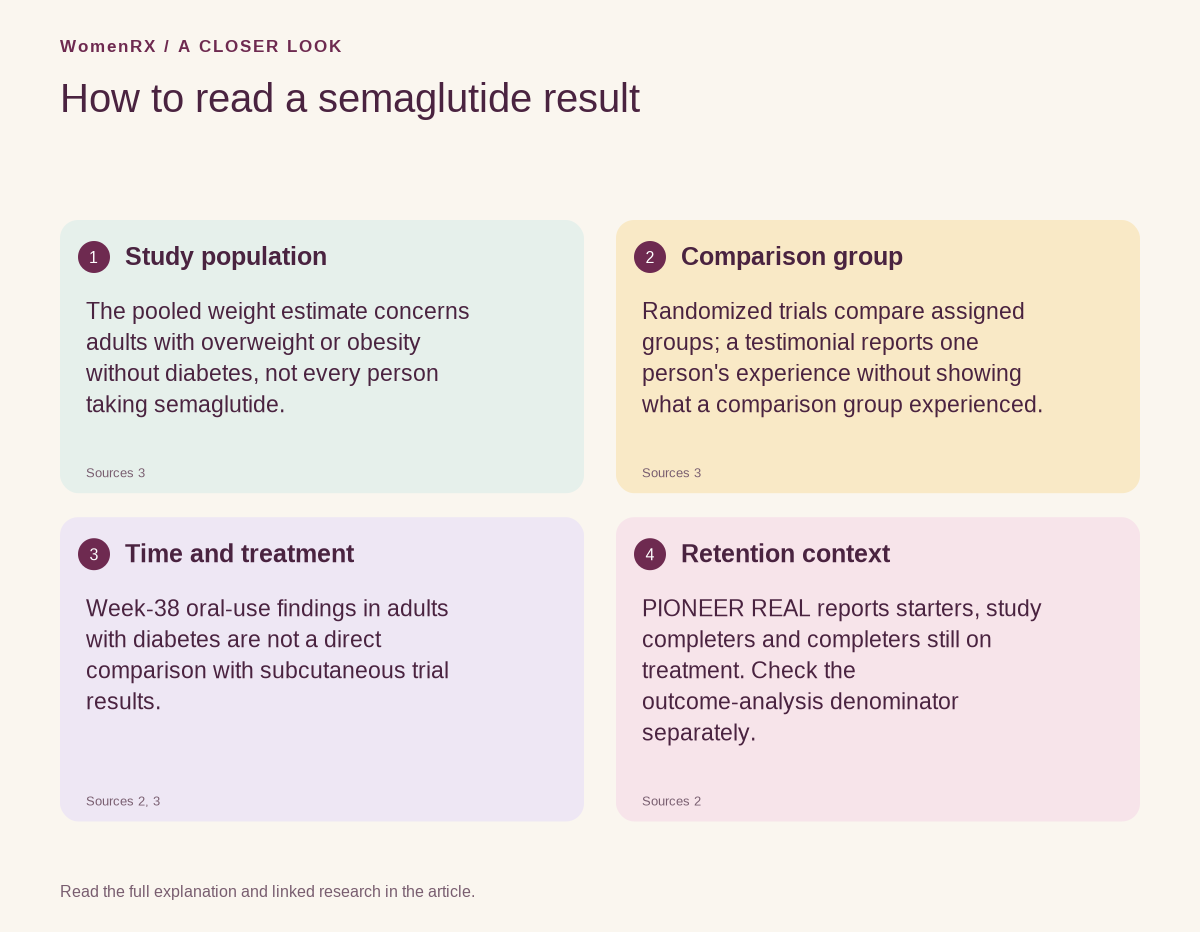
How to read a semaglutide result
Study population: The pooled weight estimate concerns adults with overweight or obesity without diabetes, not every person taking semaglutide.3
Comparison group: Randomized trials compare assigned groups; a testimonial reports one person's experience without showing what a comparison group experienced.3
Time and treatment: Week-38 oral-use findings in adults with diabetes are not a direct comparison with subcutaneous trial results.23
Retention context: PIONEER REAL reports starters, study completers and completers still on treatment. Check the outcome-analysis denominator separately.2
Read the figure as text
A quick comparison of what a trial average can establish and what a personal story leaves unanswered.- Study population: The pooled weight estimate concerns adults with overweight or obesity without diabetes, not every person taking semaglutide.3
- Comparison group: Randomized trials compare assigned groups; a testimonial reports one person's experience without showing what a comparison group experienced.3
- Time and treatment: Week-38 oral-use findings in adults with diabetes are not a direct comparison with subcutaneous trial results.23
- Retention context: PIONEER REAL reports starters, study completers and completers still on treatment. Check the outcome-analysis denominator separately.2
More questions, answered
Can a testimonial show what semaglutide will do for me?
No. It can describe one person’s reported experience, but without a comparison group or a denominator showing how many people had similar or different outcomes, it can’t estimate your likelihood of getting the same result.
Are results for oral and injectable semaglutide interchangeable?
No. This evidence comes from different formulations, populations, and study designs. For example, the pooled weight estimate came from subcutaneous semaglutide trials in adults without diabetes, while PIONEER REAL studied oral semaglutide in adults with type 2 diabetes. 23
Sources you can check
- Long-term comparative effectiveness of once-weekly semaglutide versus alternative treatments in a real-world US adult population with type 2 diabetes: a randomized pragmatic clinical trial.Buse JB, Nordahl Christensen H, Harty BJ, Cziraky MJ, Willey VJ, Skibsted S. · BMJ open diabetes research & care · 2025Return to first citation
- Oral Semaglutide Use in Type 2 Diabetes: A Pooled Analysis of Clinical and Patient-Reported Outcomes from Seven PIONEER REAL Prospective Real-World Studies.Rudofsky G, Amadid H, Braae UC, Catrina SB, Kick A, Mandavya K, Roslind K, Saravanan P, van Houtum W, Jain AB. · Diabetes therapy : research, treatment and education of diabetes and related disorders · 2025Return to first citation
- Effects of subcutaneous semaglutide on weight loss and inflammatory markers in adults with overweight or obesity without diabetes: a systematic review and meta-analysis.Milluzzo A, Oteri V, Manuella L, Pulvirenti A, Frittitta L. · International journal of obesity (2005) · 2026Return to first citation