Semaglutide Microdosing: What the Evidence Actually Shows
Studied lower doses aren’t the same as self-adjusted microdosing, and the difference matters for both results and measurement.
A lower dose taken as a planned step toward a target isn’t the same as staying at that dose or choosing and measuring one yourself. A trial tested a specified semaglutide dose against placebo, not different dose-increase schedules. 3 In a seven-person case series combining clinician-supervised low-dose semaglutide with a ketogenic diet, mean weight loss was 21.9 kg over six months, but the study couldn’t isolate the drug’s effect. A larger observational study found greater weight loss among people who reached higher doses, not proof that self-adjusted microdosing works, reduces side effects, or saves money. 46
“Microdosing” isn’t one tested weight-loss plan
People use microdosing to mean different things: taking a lower dose during a planned increase, staying at a lower dose, or changing the amount based on how they feel. In dose escalation, a lower dose is a planned step toward a target. Staying at that step is a different approach, not one tested simply because a treatment plan includes lower doses along the way. A randomized trial in adults with obesity-related heart failure and type 2 diabetes tested once-weekly semaglutide 2.4 mg against placebo. It did not compare a planned increase with staying at a lower dose or adjusting an amount yourself. 3
The key distinction is between a dose used within a defined treatment plan and an amount chosen or measured on your own. A small study of individualized treatment can raise a question worth researching; it can’t, by itself, establish a reliable approach for other people.
What the small low-dose reports can tell us
One case series followed seven adults, six of them women, in a clinician-supervised program combining a ketogenic diet with semaglutide doses of up to 1.0 mg per week. Over six months, mean weight loss was 21.9 kg. But the participants had no comparison group, and the study combined medication with a substantial dietary intervention. Its findings therefore can’t show whether the semaglutide dose, the diet, or other factors accounted for that loss. It also didn’t compare low dosing with a planned higher-dose schedule or establish that a lower dose caused fewer side effects. 4
Another report described low-dose semaglutide in adults with HIV and fatty liver disease. It assessed liver-related outcomes, not a microdosing strategy for weight loss; its liver-related analysis included participants who had already lost more than 2.27 kg. That is a different question and setting, not evidence that a self-selected low dose is effective for weight management. 5
Taken together, these reports are early, limited observations. They don’t tell you what dose would work for you, whether a smaller amount would be easier to tolerate, or whether it would produce a similar weight effect to a studied regimen.
Dose and outcome can be related, but that’s not proof of a DIY strategy
In a 48-week observational study of 191 adults with severe obesity starting semaglutide treatment, mean weight loss was 11.8% overall. It ranged from 3.9% among people who discontinued treatment to 15.3% among those who reached 2.4 mg per week. Participants were not randomly assigned to different doses. People who tolerate and continue treatment may differ from those who stop or take less, so this pattern can’t prove that dose alone caused the difference. It also doesn’t show that a lower, self-adjusted dose is a dependable substitute. 6
That distinction matters when weighing claims that “less is just as effective.” A dose-response observation in routine care is not the same as a trial directly comparing a planned low-dose strategy with another schedule while tracking both weight outcomes and side effects.
Product and measurement are part of the question
Before comparing two people’s doses, you need to know which product each used and how the amount was determined. Product information describes Wegovy injection and other semaglutide products as oral tablets; an amount specified for one form is not an instruction for measuring another. 12
A prescribed or research dose is a defined amount within a treatment plan. Choosing a smaller number yourself is different from knowing how much of the product you actually measured or received. The case series describes clinician-supervised treatment, not self-measurement or a comparison of products. Its results therefore can’t verify a self-measured amount or establish that a dosing tip for a different product gives an equivalent dose. 4
Cost is a separate claim. The reported results from the case series, liver-focused report, and observational cohort concern health outcomes or treatment persistence, not a comparison of out-of-pocket spending under different dosing plans. Those results can’t tell you whether self-adjusting would save money. 456
If side effects, affordability, or access are leading you to consider changing the amount or product, bring that specific concern to the clinician who prescribed it or to a pharmacist. Ask what options fit your prescription and the product you actually have, rather than relying on a conversion or schedule from an online anecdote.
Is there a special microdose approach for women?
No women-specific low-dose approach is established by these findings. The seven-person case series included six women, but its reported results don’t show that women respond differently or benefit from a particular dose. The presence of women in a small study is not the same as evidence for a sex-specific regimen. 4
The reported results also don’t separate responses by reproductive stage, such as pregnancy, postpartum, perimenopause, or postmenopause. They can’t support a distinct microdose approach for any of those stages. 456
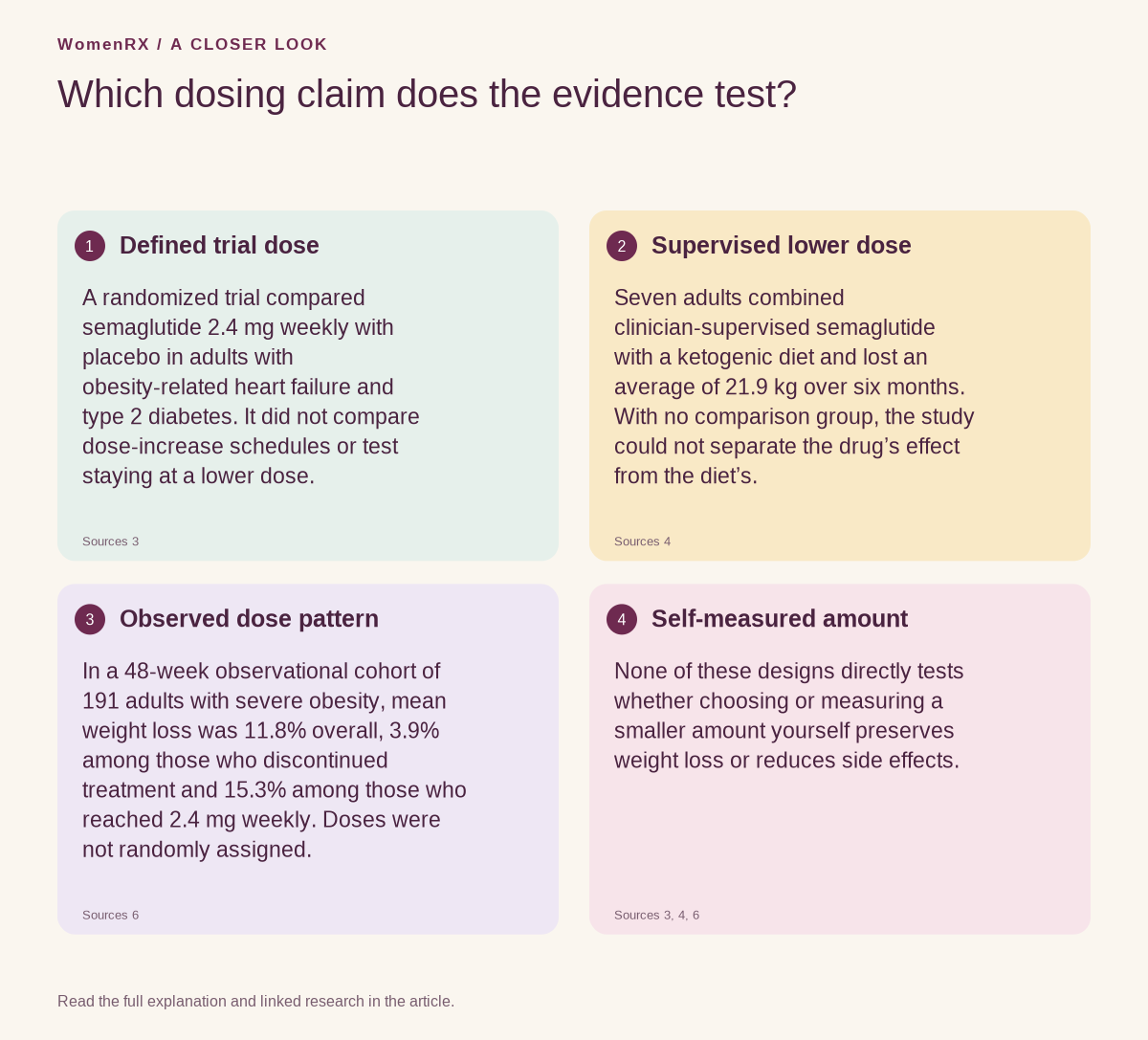
Which dosing claim does the evidence test?
Defined trial dose: A randomized trial compared semaglutide 2.4 mg weekly with placebo in adults with obesity-related heart failure and type 2 diabetes. It did not compare dose-increase schedules or test staying at a lower dose.3
Supervised lower dose: Seven adults combined clinician-supervised semaglutide with a ketogenic diet and lost an average of 21.9 kg over six months. With no comparison group, the study could not separate the drug’s effect from the diet’s.4
Observed dose pattern: In a 48-week observational cohort of 191 adults with severe obesity, mean weight loss was 11.8% overall, 3.9% among those who discontinued treatment and 15.3% among those who reached 2.4 mg weekly. Doses were not randomly assigned.6
Self-measured amount: None of these designs directly tests whether choosing or measuring a smaller amount yourself preserves weight loss or reduces side effects.346
Read the figure as text
A defined research dose, clinician-supervised lower-dose use, and a self-measured amount are different questions.- Defined trial dose: A randomized trial compared semaglutide 2.4 mg weekly with placebo in adults with obesity-related heart failure and type 2 diabetes. It did not compare dose-increase schedules or test staying at a lower dose.3
- Supervised lower dose: Seven adults combined clinician-supervised semaglutide with a ketogenic diet and lost an average of 21.9 kg over six months. With no comparison group, the study could not separate the drug’s effect from the diet’s.4
- Observed dose pattern: In a 48-week observational cohort of 191 adults with severe obesity, mean weight loss was 11.8% overall, 3.9% among those who discontinued treatment and 15.3% among those who reached 2.4 mg weekly. Doses were not randomly assigned.6
- Self-measured amount: None of these designs directly tests whether choosing or measuring a smaller amount yourself preserves weight loss or reduces side effects.346
More questions, answered
Does taking less semaglutide mean fewer side effects?
The low-dose reports described here don’t compare side effects across randomly assigned semaglutide doses, so they can’t establish that microdosing prevents or reduces them. 45
Sources you can check
- WEGOVY (SEMAGLUTIDE) INJECTION, SOLUTION WEGOVY (SEMAGLUTIDE) TABLET [NOVO NORDISK PHARMACEUTICAL INDUSTRIES, LP] | US prescribing information and patient instructionsAccessed 2026-09-25Return to first citation
- OZEMPIC (ORAL SEMAGLUTIDE) TABLET RYBELSUS (ORAL SEMAGLUTIDE) TABLET [NOVO NORDISK PHARMACEUTICAL INDUSTRIES, LP] | US prescribing information and patient instructionsAccessed 2026-09-25Return to first citation
- Semaglutide in obesity-related heart failure with preserved ejection fraction and type 2 diabetes across baseline HbA1c levels (STEP-HFpEF DM): a prespecified analysis of heart failure and metabolic outcomes from a randomised, placebo-controlled trial.Davies MJ, van der Meer P, Verma S, Patel S, Chinnakondepalli KM, Borlaug BA, Butler J, Kitzman DW, Shah SJ, Harring S, Salsali A, Rasmussen S, von Lewinski D, Abhayaratna W, Petri... · The lancet. Diabetes & endocrinology · 2025Return to first citation
- Personalized Combination of a Ketogenic Diet and Low-Dose Semaglutide for Cardiometabolic Health: A Retrospective Case Series.Parker G, Morris MD, Heggie JR, Cooper-Leavitt EF, Clark CJ, Reynolds AP, Smith HA, Wendel CP, Jensen WJ, Morris TJ, Reynolds PR, Bikman BT. · Journal of personalized medicine · 2026Return to first citation
- Semaglutide improves MASLD and MASH in people with HIV: The SLIM LIVER study.Lake JE, Kitch DW, Kantor A, Mayo R, Belaunzaran-Zamudio P, Fichtenbaum CJ, Brown TT, Corey KE, Sattler F, Erlandson KM. · HIV medicine · 2026Return to first citation
- Digital Engagement and Predictors of Semaglutide Persistence and Weight Loss in Severe Obesity: 48-Week Observational Study.Tournayre S, Bonnet JB, Anitcheou J, Faivre M, Boegner C, Jalek A, Jullien D, Le Rouzic C, Attalin V, Myzia J, Kemba Y, Sultan A, Avignon A. · Journal of medical Internet research · 2026Return to first citation