Tirzepatide Microdosing: What Lower Doses Can’t Tell Us Yet
Studied tirzepatide doses and fixed-dose devices don’t establish that tiny, self-adjusted doses will work better or feel easier.
“Microdosing” can mean starting below the prescribed dose or adding small doses between increases, but neither approach can be judged from trials of standard dose groups. Mounjaro’s recommended starting dose is 2.5 mg once weekly, while a review of weight-loss trials evaluated 5, 10, and 15 mg groups. Those findings don’t show whether an improvised smaller dose is effective or safer.26
A smaller dose isn’t automatically a gentler plan
It’s reasonable to wonder whether taking less tirzepatide might make nausea or other side effects easier to manage. The catch is that “microdosing” isn’t one clearly defined regimen. Someone might mean starting below the prescribed starting dose, taking a fraction of a device’s dose, or adding a tiny injection between weekly doses. Evidence for one of those approaches wouldn’t automatically answer questions about the others.
Mounjaro’s US prescribing information names 2.5 mg once weekly as its recommended starting dose. The Zepbound and Mounjaro device information describes fixed weekly doses, with presentations labeled from 2.5 mg through 15 mg. These are product directions and device descriptions, not evidence that every smaller amount someone could measure has been tested.12
What dose-response studies actually compare
A systematic review of ten tirzepatide weight-loss trials compared groups receiving 5, 10, or 15 mg with placebo. Across those studied groups, higher doses produced greater weight loss; discontinuations due to side effects increased at higher doses. The trials included people with obesity or type 2 diabetes and varied substantially in duration and population. That pattern gives a real tradeoff to discuss, but it can’t predict the benefit or tolerability of a dose below the prescribed start, a fractional pen dose, or an extra dose between scheduled injections.6
There’s another distinction worth keeping: a starting dose is not the same question as a longer-term dose studied for an outcome. Mounjaro’s 2.5 mg starting instruction tells you where its recommended regimen begins. It doesn’t mean the 5, 10, and 15 mg weight-loss results can be scaled down to calculate what a still-smaller starting amount would do.26
For example, if your concern is feeling unwell when a dose increases, the useful question for your prescriber isn’t simply “Can I microdose?” It’s “Which part of the plan are we trying to change: my starting dose, the timing of an increase, or the dose I’ll remain on?” Those choices ask different evidence questions. A trial comparing established dose groups doesn’t settle them all.
Why the device matters as much as the number
A dose written in milligrams isn’t an instruction for dividing what’s in a pen. Zepbound’s single-dose pens are labeled for one weekly use, and its KwikPen contains four fixed weekly doses. Mounjaro’s device information likewise describes fixed-dose presentations. Both prescribing-information excerpts call for training specific to the presentation a person receives; for vials, they specify a syringe appropriate for administering the dose.12
That matters if an online suggestion asks you to count clicks, withdraw part of a pen’s contents, or measure a tiny volume yourself. The device directions cited here don’t establish those methods as ways to deliver a smaller dose. A measurement or preparation mistake could also mean you take a different amount than you intended. Before changing how you use a device, ask your prescriber or pharmacist to identify your exact presentation and explain how its prescribed dose is meant to be administered.12
Two questions that matter specifically for women
Does the dose evidence differ by sex? Not enough can be concluded from these results. The weight-loss review included trials with varying proportions of men, including one with only men, but the reported dose-response results don’t give a separate answer for women. A 40-week tirzepatide trial in adults with type 2 diabetes receiving basal insulin reported that 38% of its efficacy-analysis participants were female; its abstract did not report dose outcomes separately for women. Neither result establishes a women-specific microdosing benefit or tolerability advantage.56
Would a tiny dose change pregnancy or contraception considerations? Don’t assume so. Zepbound and Mounjaro prescribing information says tirzepatide may reduce the effectiveness of oral hormonal contraceptives because it delays stomach emptying. Both recommend switching to a non-oral method or adding a barrier method for 4 weeks after starting and 4 weeks after each dose increase; they say non-oral hormonal contraceptives should not be affected by this mechanism. That guidance isn’t replaced by an informal claim that a small dose is too small to matter.12
If you’re planning a pregnancy, raise that before settling on a tirzepatide plan. Human pregnancy-safety evidence remains limited, and decisions about medicines before or during pregnancy need to account for the condition being treated as well as possible exposure. Don’t use a proposed microdose as a substitute for that discussion.34
The practical bottom line: tell your prescriber what “microdosing” means in the plan you’ve seen, what problem you hope it will solve, and which device you have. That makes it possible to discuss the actual tradeoff without treating an improvised dose as a studied regimen.
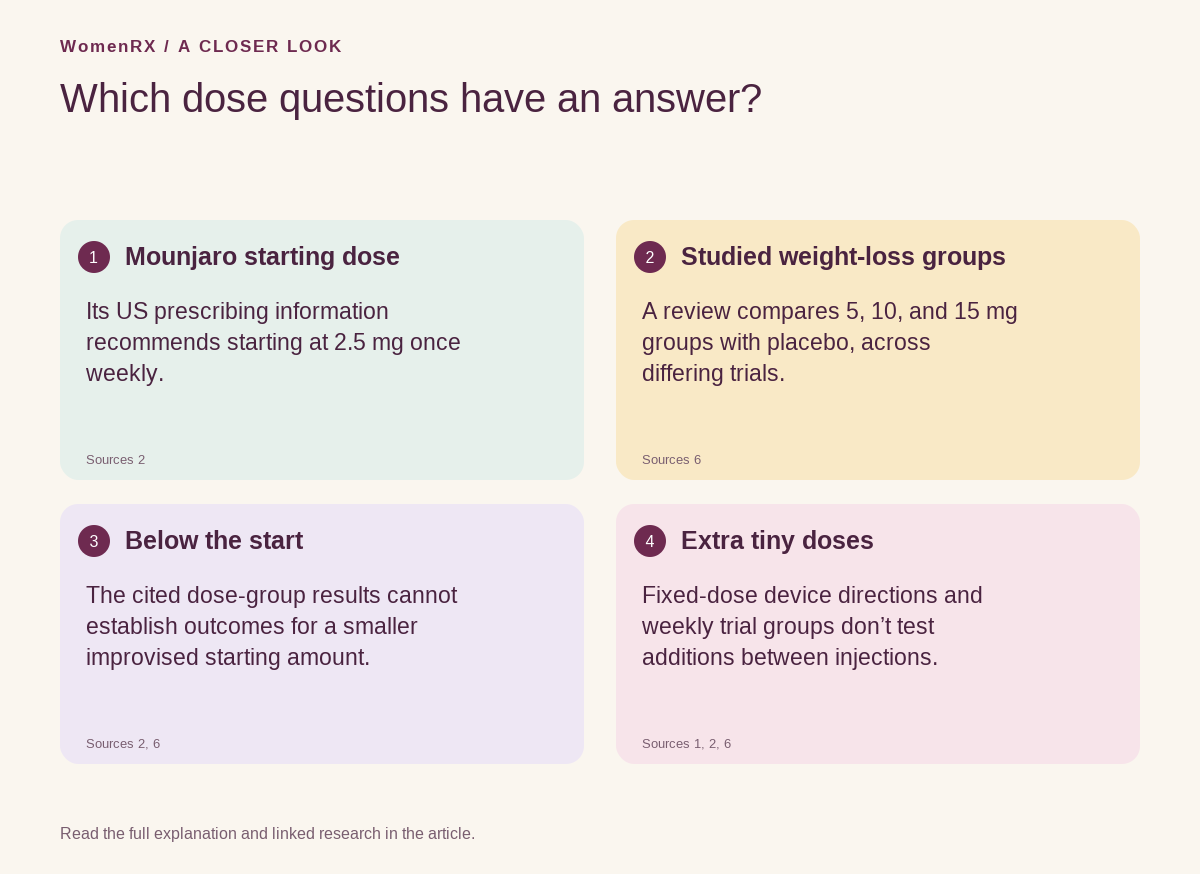
Which dose questions have an answer?
Mounjaro starting dose: Its US prescribing information recommends starting at 2.5 mg once weekly.2
Studied weight-loss groups: A review compares 5, 10, and 15 mg groups with placebo, across differing trials.6
Below the start: The cited dose-group results cannot establish outcomes for a smaller improvised starting amount.26
Extra tiny doses: Fixed-dose device directions and weekly trial groups don’t test additions between injections.126
Read the figure as text
A starting instruction, a studied outcome dose, and an improvised dose answer different questions.- Mounjaro starting dose: Its US prescribing information recommends starting at 2.5 mg once weekly.2
- Studied weight-loss groups: A review compares 5, 10, and 15 mg groups with placebo, across differing trials.6
- Below the start: The cited dose-group results cannot establish outcomes for a smaller improvised starting amount.26
- Extra tiny doses: Fixed-dose device directions and weekly trial groups don’t test additions between injections.126
More questions, answered
Does a lower studied dose cause fewer side effects?
In a review comparing studied 5, 10, and 15 mg groups, discontinuations due to side effects increased at higher doses. That doesn’t establish that doses below the prescribed start, or extra small doses between injections, are safer.6
Sources you can check
- ZEPBOUND (TIRZEPATIDE) INJECTION, SOLUTION ZEPBOUND (TIRZEPATIDE) INJECTION, SOLUTION ZEPBOUND KWIKPEN (TIRZEPATIDE) INJECTION, SOLUTION [ELI LILLY AND COMPANY] | US prescribing information and patient instructionsAccessed 2026-09-25Return to first citation
- MOUNJARO (TIRZEPATIDE) INJECTION, SOLUTION MOUNJARO KWIKPEN (TIRZEPATIDE) INJECTION, SOLUTION [ELI LILLY AND COMPANY] | US prescribing information and patient instructionsAccessed 2026-09-25Return to first citation
- Pregnancy and Medicines | MedlinePlusAccessed 2026-09-25Return to first citation
- GLP-1 receptor agonists and preconception planning: bridging the gap between obesity treatment and reproductive safety, a narrative review.Saad Alfaiz A. · Annals of medicine and surgery (2012) · 2025Return to first citation
- Efficacy and safety of tirzepatide added to basal insulin in patients with type 2 diabetes in China (SURPASS-CN-INS): a double-blind, multicentre, randomised, placebo-controlled, phase 3 trial.Guo L, Dong X, Ma J, Liu M, Lu Y, Wang H, Li Q, Li L, Deng Y, Xu J. · The lancet. Diabetes & endocrinology · 2025Return to first citation
- Efficacy and safety of tirzepatide for weight loss in patients with obesity or type 2 diabetes: a systematic review and meta-analysis.Tian Q, Song Y, Deng Y, Lin S. · Frontiers in endocrinology · 2025Return to first citation