What’s the Maximum Mounjaro Dose?
For US adults, Mounjaro’s maximum is 15 mg once weekly, but the right dose isn’t necessarily the highest one.
In the US, the maximum Mounjaro dose is 15 mg once weekly for adults and 10 mg once weekly for pediatric patients. Mounjaro is the tirzepatide product used for type 2 diabetes; Zepbound is the US tirzepatide product used for weight management and also has a 15 mg weekly maximum. These are upper limits, not doses everyone needs to reach.231
First, check which product you have
Mounjaro and Zepbound contain the same medicine, tirzepatide, but their US product names point to different treatment purposes. Mounjaro is used for type 2 diabetes, while Zepbound is the tirzepatide product for weight management. The US Mounjaro maximum is 15 mg once weekly for adults and 10 mg once weekly for pediatric patients. The US Zepbound maximum is 15 mg once weekly for its indications.231
If you’re reading about Mounjaro from another country, check the country on the page before comparing it with your prescription. For example, UK public health guidance describes Mounjaro as a treatment for both type 2 diabetes and obesity. That doesn’t make a US Zepbound label the dosing instructions for a UK Mounjaro pen. Use the product information issued where your medicine was prescribed for that comparison.41
Why a lower dose may be the right dose
The US Mounjaro starting dose is 2.5 mg once weekly, well below its adult maximum. In a large type 2 diabetes trial described in the Mounjaro prescribing information, participants started at 2.5 mg weekly. Their doses rose by 2.5 mg every four weeks, up to 15 mg weekly or the maximum they tolerated. Increasing the dose in steps let tolerability limit how far participants went, rather than making 15 mg the required destination. Those four-week increases describe the trial, not a complete dosing schedule to copy for your own prescription.2
That distinction matters when you see “maximum dose” online. It tells you the labeled upper boundary, not whether your blood sugar needs another change or whether a higher dose suits you. A 10 mg prescription, for example, isn’t incomplete simply because 15 mg exists. For Zepbound, a weight-management trial likewise used a maximum tolerated dose of either 10 mg or 15 mg weekly, rather than requiring everyone to finish at 15 mg.21
Tirzepatide can reduce appetite and help you feel fuller for longer. Don’t use another person’s dose, or a trial’s dose-escalation schedule, as a reason to change your own.42
A missed injection is a different question
If you’re checking your dose because you missed an injection, the US Mounjaro and Zepbound instructions give the same rule: take the missed dose as soon as possible within four days of when it was due. If more than four days have passed, skip it and take the next dose on your regular day. A missed dose isn’t a reason to take extra medicine or move to a higher strength.21
Pregnancy plans and breastfeeding change the conversation
If you’re planning a pregnancy, the question is whether to use tirzepatide, rather than whether to move to a different strength.4 UK public health guidance says tirzepatide isn’t used during pregnancy because there isn’t enough information to establish safety for the baby. If you’re trying to conceive or think you may be pregnant, bring that up with your prescriber before making a change to treatment.24
Breastfeeding calls for its own discussion. The US Mounjaro prescribing information reports that tirzepatide was undetectable or present at low concentrations in breast milk in a single-dose study, but it says there are no data on effects in breastfed infants or on milk production. That finding cannot, by itself, tell you whether continued treatment is right for you and your baby.2
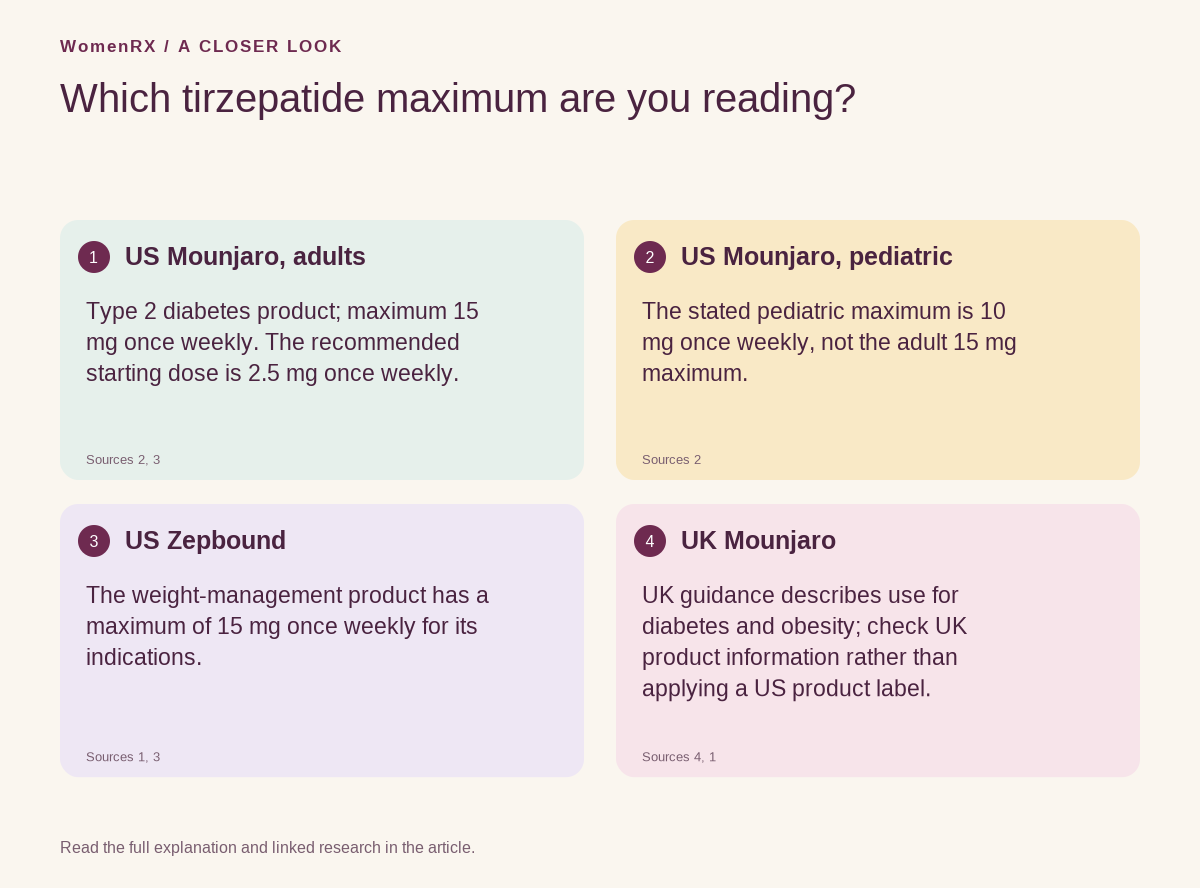
Which tirzepatide maximum are you reading?
US Mounjaro, adults: Type 2 diabetes product; maximum 15 mg once weekly. The recommended starting dose is 2.5 mg once weekly.23
US Mounjaro, pediatric: The stated pediatric maximum is 10 mg once weekly, not the adult 15 mg maximum.2
US Zepbound: The weight-management product has a maximum of 15 mg once weekly for its indications.13
UK Mounjaro: UK guidance describes use for diabetes and obesity; check UK product information rather than applying a US product label.41
Read the figure as text
Match the product, country, and patient group before treating a maximum dose as relevant to your prescription.- US Mounjaro, adults: Type 2 diabetes product; maximum 15 mg once weekly. The recommended starting dose is 2.5 mg once weekly.23
- US Mounjaro, pediatric: The stated pediatric maximum is 10 mg once weekly, not the adult 15 mg maximum.2
- US Zepbound: The weight-management product has a maximum of 15 mg once weekly for its indications.13
- UK Mounjaro: UK guidance describes use for diabetes and obesity; check UK product information rather than applying a US product label.41
Sources you can check
- ZEPBOUND (TIRZEPATIDE) INJECTION, SOLUTION ZEPBOUND (TIRZEPATIDE) INJECTION, SOLUTION ZEPBOUND KWIKPEN (TIRZEPATIDE) INJECTION, SOLUTION [ELI LILLY AND COMPANY] | US prescribing information and patient instructionsAccessed 2026-09-25Return to first citation
- MOUNJARO (TIRZEPATIDE) INJECTION, SOLUTION MOUNJARO KWIKPEN (TIRZEPATIDE) INJECTION, SOLUTION [ELI LILLY AND COMPANY] | US prescribing information and patient instructionsAccessed 2026-09-25Return to first citation
- Real-World Weight Loss Observed With Semaglutide and Tirzepatide in Patients with Overweight or Obesity and Without Type 2 Diabetes (SHAPE).Ng CD, Divino V, Wang J, Toliver JC, Buss M. · Advances in therapy · 2025Return to first citation
- Tirzepatide: a medicine to manage type 2 diabetes and treat obesity - NHSAccessed 2026-09-25Return to first citation