Maximum Tirzepatide Dose: Mounjaro Versus Zepbound
Both U.S. products list a 15 mg weekly adult maximum, but increases happen in steps and the ceiling may not be your prescribed dose.
The U.S. adult maximum is 15 mg injected once weekly for either Mounjaro or Zepbound. Mounjaro lists a 10 mg weekly maximum for pediatric patients. 1 2 Both start at 2.5 mg weekly. Zepbound increases to 5 mg after four weeks; either product can then be increased in 2.5 mg steps after at least four weeks at the current dose, according to its product-specific directions. 1 2
The adult maximum is the same for both brands
In U.S. prescribing information, the maximum dose for adults is 15 mg injected once weekly for both Mounjaro and Zepbound. Mounjaro lists a maximum of 10 mg weekly for pediatric patients. The brands have different labeled uses: Mounjaro is indicated for type 2 diabetes, while Zepbound is indicated for chronic weight management. Check the brand and directions on your prescription rather than treating “tirzepatide” as one interchangeable dosing schedule. These are U.S. product labels, not a guide to products or access rules in other countries. 1 2 6
A maximum is a ceiling, not a dose everyone needs to reach. The dose prescribed for you depends on the product, treatment response and tolerability, not simply the largest number on the label. 1 2
How the labeled steps lead toward the maximum
Zepbound: The labeled starting dose is 2.5 mg once weekly for four weeks. It then increases to 5 mg once weekly. After at least four weeks at the current dose, it may be increased by another 2.5 mg: from 5 to 7.5 mg, then potentially to 10, 12.5 and 15 mg once weekly. The 2.5 mg dose is for treatment initiation, not maintenance. The label says to consider response and tolerability when selecting a maintenance dose and to consider a lower maintenance dose if one isn’t tolerated. Its maximum is 15 mg weekly for all labeled indications. 1
Mounjaro: The labeled starting dose is also 2.5 mg once weekly. If additional blood-sugar control is needed, the dose may increase by 2.5 mg after at least four weeks at the current dose. That means a possible sequence of 2.5, 5, 7.5, 10, 12.5 and, for adults, 15 mg once weekly. The adult maximum is 15 mg; the pediatric maximum is 10 mg. Unlike Zepbound’s instruction to move from its four-week starting dose to 5 mg, Mounjaro’s cited increase rule is conditional on needing more blood-sugar control. 2
For either brand, the four-week interval is a minimum time at a dose before a further increase, not a requirement to increase every four weeks. The stepwise approach is intended to reduce gastrointestinal adverse reactions. 1 2
A trial’s dosing plan isn’t a substitute for the directions on your prescription. For example, a Mounjaro cardiovascular-outcomes trial started at 2.5 mg and increased by 2.5 mg every four weeks, up to 15 mg or the maximum tolerated dose. That describes the trial regimen, not a requirement for every person to reach 15 mg. 2
What these dose details say about women
The product maximums aren’t sex-specific. 1 2 A U.S. retrospective study of adults with overweight or obesity and without type 2 diabetes included mostly women, but its reported results do not establish whether women and men respond differently at particular tirzepatide doses. It also assessed tirzepatide at the ingredient level rather than separating Mounjaro from Zepbound for its main comparison. That makes it useful context for real-world use, not a replacement for either product’s dosing instructions. 6
Pregnancy planning and breastfeeding deserve a separate check
The dose ceiling doesn’t answer whether tirzepatide is appropriate when planning a pregnancy. A 2025 review reports animal findings that raise concern and says human pregnancy data for tirzepatide are lacking. Reviews suggest different times to stop before conception: a 2026 review says eight weeks, while the 2025 review suggests 25 to 35 days. If you’re planning a pregnancy, discuss when to stop the product prescribed to you rather than using its maximum dose to judge reproductive safety. 4 5 7
If you use an oral contraceptive, dose changes matter for another reason. A 2026 review summarizes manufacturer guidance to use backup contraception for four weeks after starting tirzepatide or increasing the dose because delayed stomach emptying may affect oral contraceptive reliability. 3
For breastfeeding, a review advises avoiding GLP-1 medicines including tirzepatide while noting limited human evidence. Taking less than the maximum does not establish a safe breastfeeding dose. 7
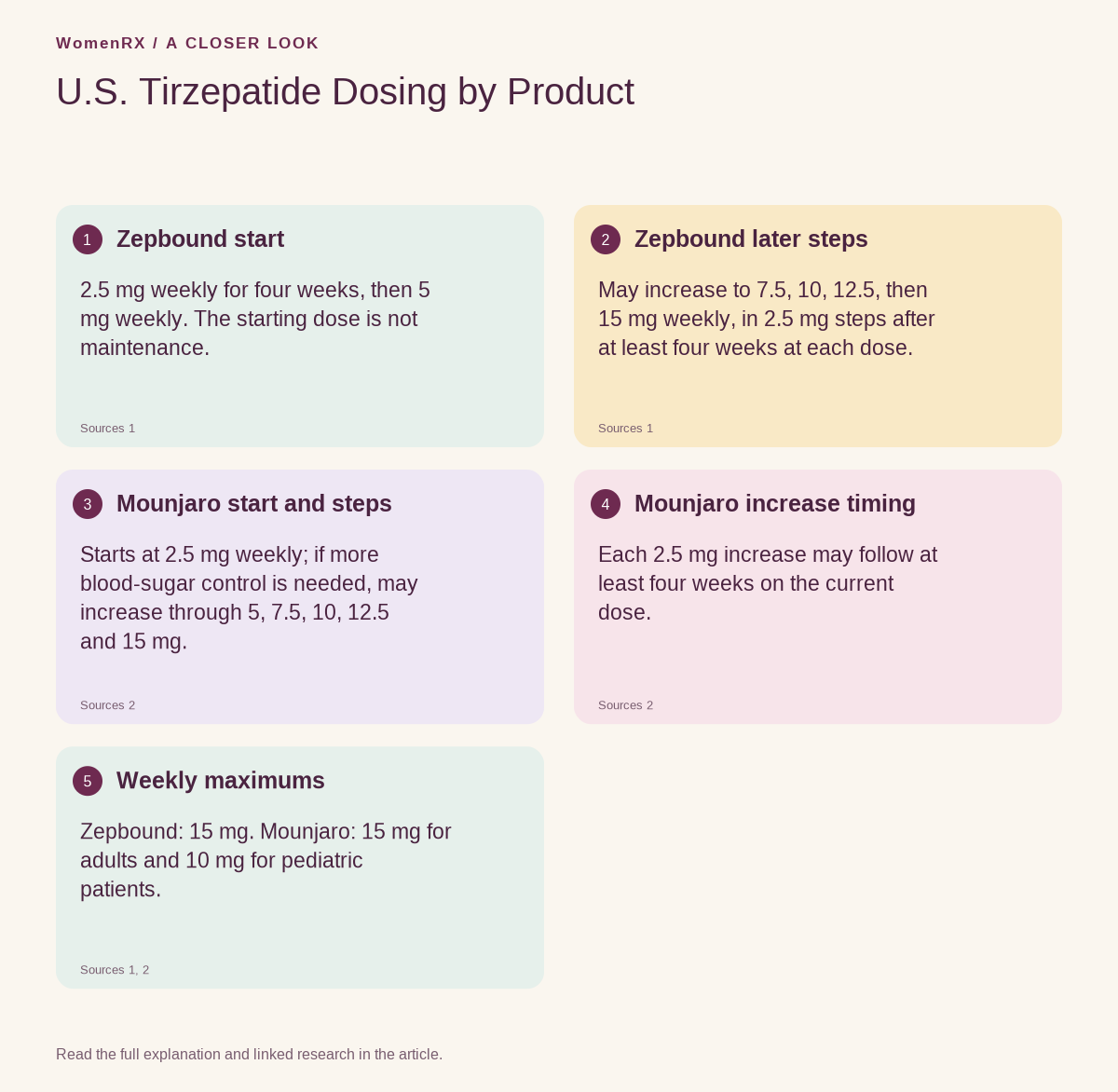
U.S. Tirzepatide Dosing by Product
Zepbound start: 2.5 mg weekly for four weeks, then 5 mg weekly. The starting dose is not maintenance.1
Zepbound later steps: May increase to 7.5, 10, 12.5, then 15 mg weekly, in 2.5 mg steps after at least four weeks at each dose.1
Mounjaro start and steps: Starts at 2.5 mg weekly; if more blood-sugar control is needed, may increase through 5, 7.5, 10, 12.5 and 15 mg.2
Mounjaro increase timing: Each 2.5 mg increase may follow at least four weeks on the current dose.2
Weekly maximums: Zepbound: 15 mg. Mounjaro: 15 mg for adults and 10 mg for pediatric patients.12
Read the figure as text
The possible strengths form a stepwise path, but later increases are not automatic.- Zepbound start: 2.5 mg weekly for four weeks, then 5 mg weekly. The starting dose is not maintenance.1
- Zepbound later steps: May increase to 7.5, 10, 12.5, then 15 mg weekly, in 2.5 mg steps after at least four weeks at each dose.1
- Mounjaro start and steps: Starts at 2.5 mg weekly; if more blood-sugar control is needed, may increase through 5, 7.5, 10, 12.5 and 15 mg.2
- Mounjaro increase timing: Each 2.5 mg increase may follow at least four weeks on the current dose.2
- Weekly maximums: Zepbound: 15 mg. Mounjaro: 15 mg for adults and 10 mg for pediatric patients.12
More questions, answered
Is 2.5 mg a Zepbound maintenance dose?
No. Zepbound’s U.S. information describes 2.5 mg weekly for the first four weeks as a treatment-initiation dose, not a maintenance dose. It then directs an increase to 5 mg weekly. 1
Do I have to increase Mounjaro every four weeks?
No. Its U.S. dosing language says an increase may be made in 2.5 mg steps after at least four weeks on the current dose if additional blood-sugar control is needed. 2
Sources you can check
- ZEPBOUND (TIRZEPATIDE) INJECTION, SOLUTION ZEPBOUND (TIRZEPATIDE) INJECTION, SOLUTION ZEPBOUND KWIKPEN (TIRZEPATIDE) INJECTION, SOLUTION [ELI LILLY AND COMPANY] | US prescribing information and patient instructionsAccessed 2026-09-25Return to first citation
- MOUNJARO (TIRZEPATIDE) INJECTION, SOLUTION MOUNJARO KWIKPEN (TIRZEPATIDE) INJECTION, SOLUTION [ELI LILLY AND COMPANY] | US prescribing information and patient instructionsAccessed 2026-09-25Return to first citation
- What obgyns need to know about GLP-1 receptor agonists.Chauhan I. · Current opinion in obstetrics & gynecology · 2026Return to first citation
- The effects of glucagon-like peptide-1 receptor agonists on fertility, contraception, and pregnancy: clinical perspectives.Dilbaz B, Ateş Ç. · The European journal of contraception & reproductive health care : the official journal of the European Society of Contraception · 2026Return to first citation
- GLP-1 receptor agonists and preconception planning: bridging the gap between obesity treatment and reproductive safety, a narrative review.Saad Alfaiz A. · Annals of medicine and surgery (2012) · 2025Return to first citation
- Real-World Weight Loss Observed With Semaglutide and Tirzepatide in Patients with Overweight or Obesity and Without Type 2 Diabetes (SHAPE).Ng CD, Divino V, Wang J, Toliver JC, Buss M. · Advances in therapy · 2025Return to first citation
- GLP-1 Receptor Agonists and Fertility: What Is Known So Far?Becker AS, Castilhos JP, Shugair SAS, Colombo T, Hentschke M-. · JBRA assisted reproduction · 2026Return to first citation