The Maximum Zepbound Dose and How You Reach It
Zepbound starts at a low dose, and 15 mg is a ceiling, not a goal everyone needs to reach.
The maximum labeled Zepbound dose is 15 mg injected once weekly. Treatment starts at 2.5 mg weekly for four weeks, then moves to 5 mg. If a higher dose is appropriate, increases are made in 2.5 mg steps after at least four weeks at the current dose. Response and side effects help determine where to stay.1
The starting dose isn’t the dose you stay on
Zepbound starts at 2.5 mg injected once weekly for four weeks. That dose is for starting treatment, not for long-term maintenance. The next labeled dose is 5 mg once weekly. After that, a dose may increase by 2.5 mg, but only after at least four weeks at the current dose. Following the steps upward gives the body time to adjust and is intended to reduce gastrointestinal side effects.1
For weight reduction and long-term maintenance, the recommended maintenance doses are 5 mg, 10 mg, or 15 mg once weekly. That means 7.5 mg and 12.5 mg can be steps on the way up without being listed as recommended maintenance doses for weight reduction. The maximum, 15 mg once weekly, is an upper limit, not a dose everyone is expected to reach.1
Why a clinician might hold at a dose
The decision to increase isn’t based on the calendar alone. Zepbound’s prescribing information says to consider both treatment response and tolerability when choosing a maintenance dose, and to consider a lower maintenance dose if someone doesn’t tolerate one.1 For example, if 5 mg is working well but nausea is making meals difficult, the question isn’t simply whether four weeks have passed. It’s whether moving up makes sense given the benefit and the side effects.
That tradeoff is real. In an analysis of the SURMOUNT-1 through SURMOUNT-4 trials, which enrolled adults with obesity or overweight, with or without type 2 diabetes, gastrointestinal problems such as nausea, vomiting, and diarrhea occurred most often during dose escalation. Weight reduction was similar among tirzepatide-treated participants who reported nausea, other nausea-vomiting-diarrhea symptoms, or none of those symptoms. Feeling sick isn’t a sign that the medicine is working better.3
A separate exploratory analysis of SURMOUNT-1 and SURMOUNT-2 found that participants with less weight loss early in treatment could still have meaningful weight reduction by week 72. An early result alone, therefore, doesn’t tell you that you need to rush toward 15 mg. Those trials used set escalation schedules; the analysis didn’t test whether faster escalation improves outcomes.2
What changes if you’re pregnant or breastfeeding?
Being a woman doesn’t create a different Zepbound dose ceiling. Pregnancy, breastfeeding, and contraception do raise separate questions that matter before the next dose increase.1
Zepbound’s prescribing information says to discontinue it when pregnancy is recognized. Weight loss offers no benefit during pregnancy and may cause fetal harm; human pregnancy data are insufficient to determine the drug’s risks, while animal studies raised concerns.1
If you use an oral hormonal contraceptive, Zepbound can reduce its effectiveness because it delays stomach emptying. The Zepbound guidance advises switching to a non-oral contraceptive method or adding a barrier method for four weeks after starting Zepbound and for four weeks after each dose increase. It says non-oral hormonal contraceptives should not be affected by this interaction.1 This is worth planning for whenever an increase is being considered, not just at the first injection.
For breastfeeding, a small study found undetectable or low amounts of tirzepatide in milk after a single 5 mg dose in 11 lactating adults. That doesn’t answer what happens with ongoing treatment: there are no available data on effects in breastfed infants or on milk production. The decision needs to weigh the benefits of breastfeeding alongside the mother’s need for treatment and the remaining uncertainty.1
The useful way to read the schedule is as a set of options: start low, allow at least four weeks before any increase, and choose a maintenance dose based on how treatment is going. The highest labeled dose is one option, not the definition of success.1
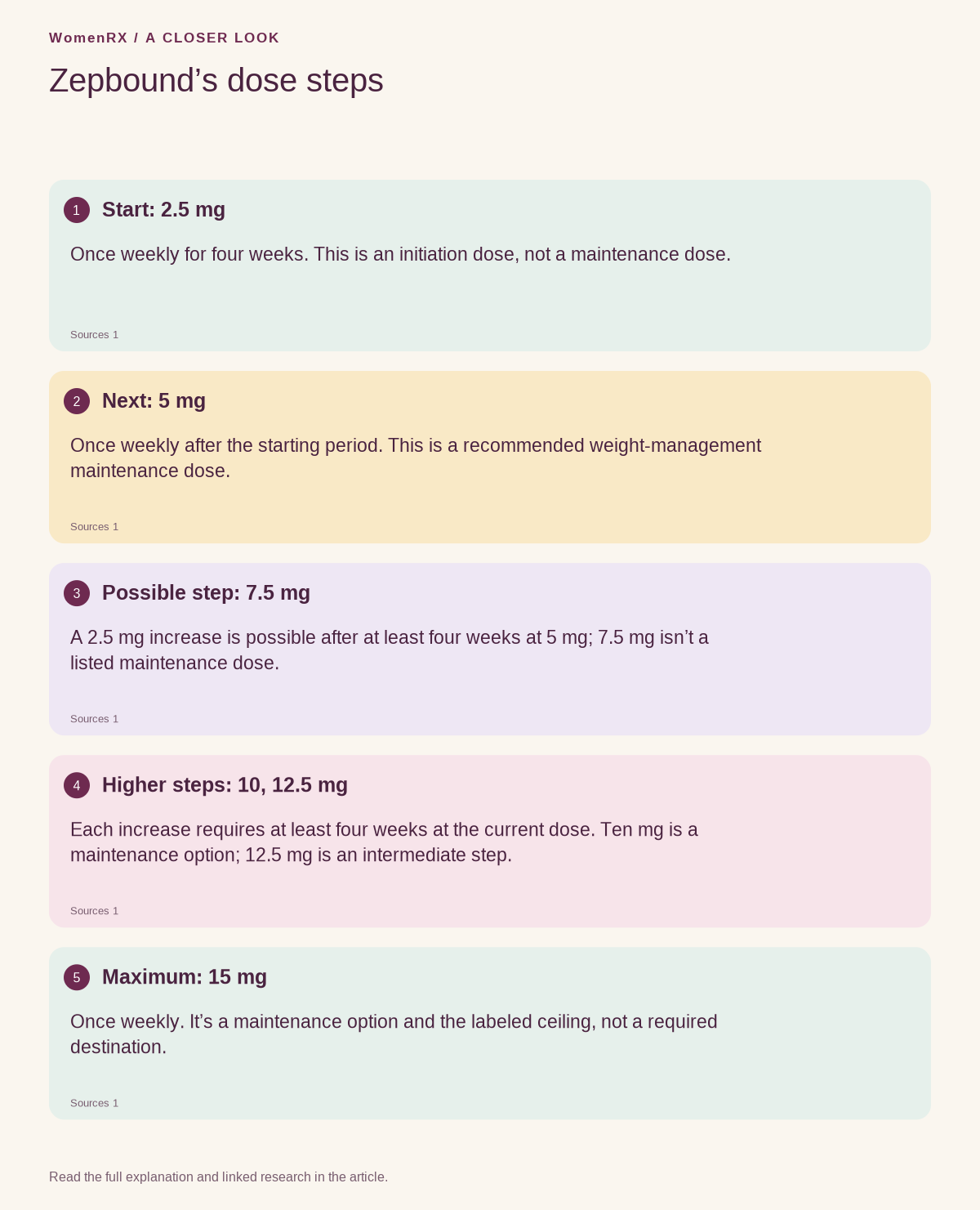
Zepbound’s dose steps
Start: 2.5 mg: Once weekly for four weeks. This is an initiation dose, not a maintenance dose.1
Next: 5 mg: Once weekly after the starting period. This is a recommended weight-management maintenance dose.1
Possible step: 7.5 mg: A 2.5 mg increase is possible after at least four weeks at 5 mg; 7.5 mg isn’t a listed maintenance dose.1
Higher steps: 10, 12.5 mg: Each increase requires at least four weeks at the current dose. Ten mg is a maintenance option; 12.5 mg is an intermediate step.1
Maximum: 15 mg: Once weekly. It’s a maintenance option and the labeled ceiling, not a required destination.1
Read the figure as text
The labeled weight-management path separates the starting dose, possible steps upward, maintenance choices, and maximum.- Start: 2.5 mg: Once weekly for four weeks. This is an initiation dose, not a maintenance dose.1
- Next: 5 mg: Once weekly after the starting period. This is a recommended weight-management maintenance dose.1
- Possible step: 7.5 mg: A 2.5 mg increase is possible after at least four weeks at 5 mg; 7.5 mg isn’t a listed maintenance dose.1
- Higher steps: 10, 12.5 mg: Each increase requires at least four weeks at the current dose. Ten mg is a maintenance option; 12.5 mg is an intermediate step.1
- Maximum: 15 mg: Once weekly. It’s a maintenance option and the labeled ceiling, not a required destination.1
Sources you can check
- ZEPBOUND (TIRZEPATIDE) INJECTION, SOLUTION ZEPBOUND (TIRZEPATIDE) INJECTION, SOLUTION ZEPBOUND KWIKPEN (TIRZEPATIDE) INJECTION, SOLUTION [ELI LILLY AND COMPANY] | US prescribing information and patient instructionsAccessed 2026-09-25Return to first citation
- Tirzepatide Efficacy and Tolerability According to Early Weight Response: A Post Hoc Analysis of the SURMOUNT-1 and SURMOUNT-2 Trials.Kokkinos A, Thethi T, Lee CJ, Neff LM, Stefanski A, Cao D, Rodriguez A, Bartee A. · Diabetes, obesity & metabolism · 2026Return to first citation
- Gastrointestinal tolerability and weight reduction associated with tirzepatide in adults with obesity or overweight with and without type 2 diabetes in the SURMOUNT-1 to -4 trials.Rubino DM, Pedersen SD, Connery L, Cao D, Chigutsa F, Stefanski A, Fraseur Brumm J, Griffin R, Gerber C. · Diabetes, obesity & metabolism · 2025Return to first citation