What Wegovy Studies Show About Weight Loss
Trial averages can help set expectations, but they don’t predict exactly what you’ll lose or how long you’ll stay on treatment.
In studies of semaglutide 2.4 mg for weight management, average weight loss differed by population and study duration: reviews of the STEP trials report roughly 10% to 17% in participants without diabetes and around 10% in those with type 2 diabetes. These are group averages, not promises. A STEP trial review also reports weight regain after treatment withdrawal, so results during treatment don’t tell you what happens after stopping. 3
What the headline number means
When you see a Wegovy weight-loss result, look for three things: who was studied, how long the study lasted, and what the number is being compared with. A trial average describes the group, not the result each person got. It isn’t a forecast of what one person will experience.
A review of the STEP trials reports average weight reductions of about 10% to 17% among participants without diabetes, and around 10% among participants with type 2 diabetes. It also reports about 15% maintained over two years in STEP 5. These figures cover different trial populations and time periods, so they aren’t interchangeable predictions for one person. 3
A separate meta-analysis pooled nine randomized trials involving 6,239 adults with overweight or obesity who did not have diabetes. Across those studies, semaglutide was associated with 12.04 percentage points greater weight reduction than placebo. That is a comparison between study groups, not a claim that every participant lost 12% of their starting weight. 2
Why personal stories can look so different
A personal review tells you what happened to one person, often without the details needed to compare their experience with yours. For example, two accounts might describe different results because one person had diabetes and the other didn’t, or because they’re reporting at different points in treatment. The STEP review’s different average results across diabetes groups show why population matters. 3
The time window matters, too. An outcome measured near the end of a trial answers a different question from one measured after a longer period. The Wegovy prescribing information describes key injection-trial weight outcomes measured through Week 68; the STEP review also summarizes a two-year result. A number without its study duration leaves out important context. 1 3
Tolerability can shape the experience as well. The STEP review describes gastrointestinal effects as the most common side effects, generally manageable and nonsevere. That summary does not tell you how an individual will feel, or whether side effects will affect her ability to continue. Online testimonials can capture those personal details, but they can’t establish how common any one experience is. 3
Staying on treatment changes what “results” mean
Weight loss while taking semaglutide isn’t the same as weight loss that remains after stopping. The STEP review reports weight regain after treatment withdrawal. That’s a reason to distinguish an on-treatment result from a result after treatment ends, not a prediction that every person will regain the same amount. The review does not give a specific regain figure to apply to an individual. 3
This distinction is easy to miss in before-and-after posts: a photo may show a real change, but not how long it took, whether the person was still taking treatment, or what happened afterward. Trial results and personal stories can both be informative, but they answer different questions.
What the evidence says about women
Women were included in some Wegovy studies; for example, the prescribing information reports that 76% of participants in one oral semaglutide trial were female. But that was a tablet study, and the overall injection-trial averages above are not women-only estimates. The pooled meta-analysis reports results for adults overall, not a separate women’s estimate. These results therefore don’t establish whether weight loss or side effects differ by sex. 1 2
If you’re weighing a personal result against a trial average, first match the population and time period as closely as you can. Then treat the average as a reference point, not a target you’ve failed if your experience differs.
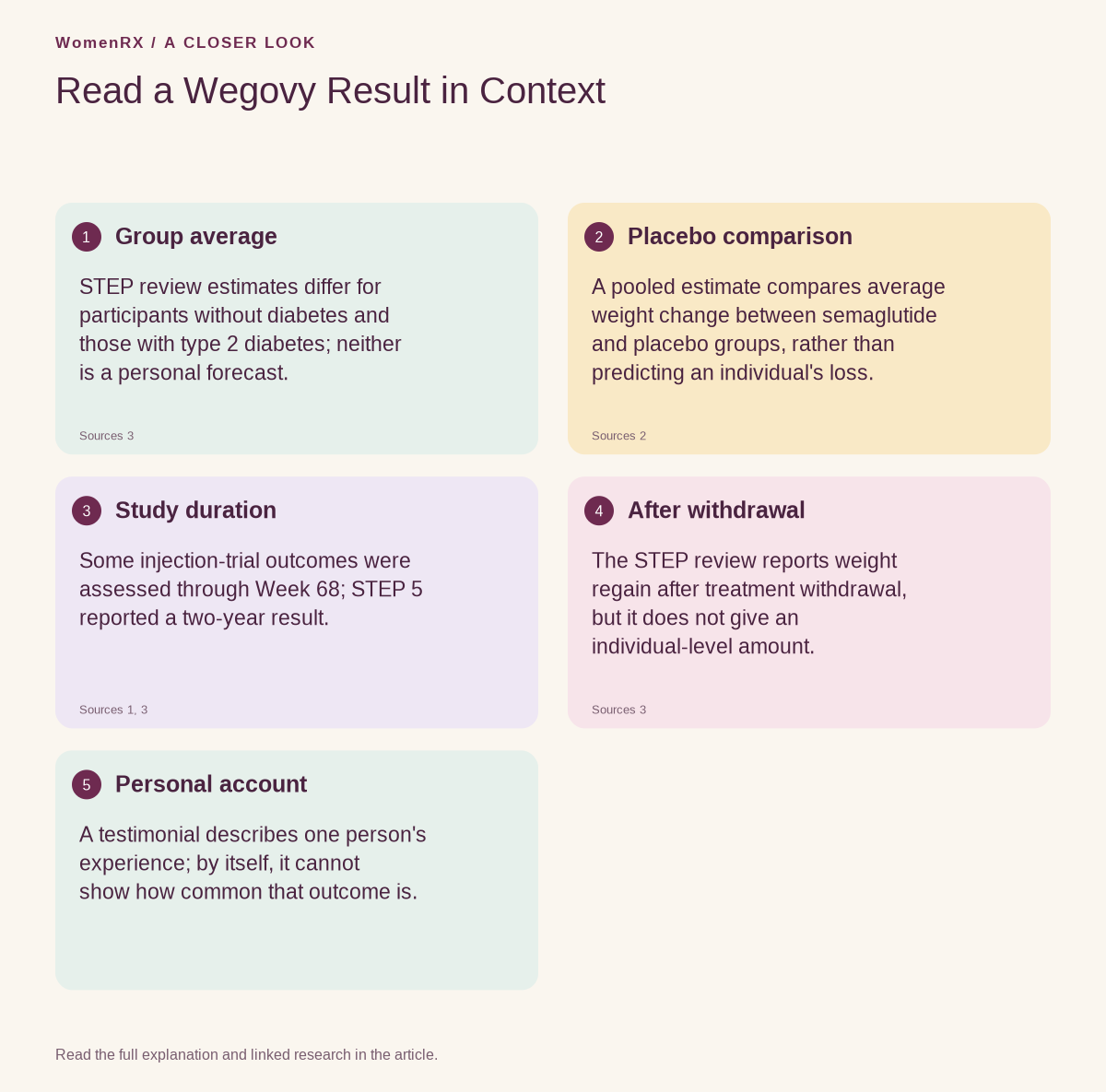
Read a Wegovy Result in Context
Group average: STEP review estimates differ for participants without diabetes and those with type 2 diabetes; neither is a personal forecast.3
Placebo comparison: A pooled estimate compares average weight change between semaglutide and placebo groups, rather than predicting an individual's loss.2
Study duration: Some injection-trial outcomes were assessed through Week 68; STEP 5 reported a two-year result.13
After withdrawal: The STEP review reports weight regain after treatment withdrawal, but it does not give an individual-level amount.3
Personal account: A testimonial describes one person's experience; by itself, it cannot show how common that outcome is.
Read the figure as text
These distinctions show what a study average can tell you, and what it leaves unanswered about an individual experience.- Group average: STEP review estimates differ for participants without diabetes and those with type 2 diabetes; neither is a personal forecast.3
- Placebo comparison: A pooled estimate compares average weight change between semaglutide and placebo groups, rather than predicting an individual's loss.2
- Study duration: Some injection-trial outcomes were assessed through Week 68; STEP 5 reported a two-year result.13
- After withdrawal: The STEP review reports weight regain after treatment withdrawal, but it does not give an individual-level amount.3
- Personal account: A testimonial describes one person's experience; by itself, it cannot show how common that outcome is.
More questions, answered
Does a trial average mean I should expect the same result?
No. An average summarizes a group; it doesn’t predict an individual result. The STEP review reports different averages for participants with and without type 2 diabetes, which is one reason to read the study population alongside the headline figure. 3
Do studies show what happens after stopping Wegovy?
A review of the STEP trials reports weight regain after treatment withdrawal, but it doesn't provide a specific amount to expect. It’s useful to separate results while taking treatment from outcomes after stopping. 3
Sources you can check
- WEGOVY (SEMAGLUTIDE) INJECTION, SOLUTION WEGOVY (SEMAGLUTIDE) TABLET [NOVO NORDISK PHARMACEUTICAL INDUSTRIES, LP] | US prescribing information and patient instructionsAccessed 2026-09-25Return to first citation
- Effects of subcutaneous semaglutide on weight loss and inflammatory markers in adults with overweight or obesity without diabetes: a systematic review and meta-analysis.Milluzzo A, Oteri V, Manuella L, Pulvirenti A, Frittitta L. · International journal of obesity (2005) · 2026Return to first citation
- Semaglutide in obesity and type 2 diabetes: A review of clinical trial evidence from 1 to 5 semaglutide treatment effect in people with obesity program.Khanna A, Kumar V, Gola S. · Indian journal of pharmacology · 2026Return to first citation