What Weight Loss on Wegovy Can Realistically Look Like
Trial averages offer context, but your result depends on the study, time on treatment, and whether you can continue it.
In STEP trials summarized in a review, average weight reductions were about 10% to 17% in studies without type 2 diabetes and about 10% in the study involving people with diabetes. These are group averages over trial periods, not a forecast or minimum for one person. Treatment duration, tolerability, and the study population all matter. 3
What a trial average can tell you
Wegovy’s trial results are best read as a range of outcomes seen in groups, not a promise about what you’ll lose. A review of the STEP program reports average reductions of about 10% to 17% in trials involving people without type 2 diabetes, and about 10% in the trial involving people with diabetes. The trials examined different situations, so the figures aren’t interchangeable predictions. 3
A separate meta-analysis of nine placebo-controlled trials in 6,239 adults with overweight or obesity and without diabetes found that semaglutide reduced body weight by an average of 12.04 percentage points more than placebo. That number is a difference between groups, not a prediction that each person taking semaglutide will lose 12% of their starting weight. 2
Percentages can help you picture a result without assuming it will happen. For example, 10% of a starting weight of 200 pounds is 20 pounds. That’s only an illustration of the calculation, not an estimate of what you personally will lose.
Time on treatment changes the comparison
The trial averages reflect change measured over months, and in some cases longer. For example, the STEP review describes about 15% weight loss maintained over two years in STEP 5. That result answers a different question from what you might see early in treatment. 3
Dose escalation also affects how to interpret some results. In one Wegovy injection trial described in the US prescribing information, people who stopped during dose escalation or did not reach 2.4 mg weekly weren’t eligible for the randomized treatment period. The label cautions that those results may not represent everyone starting treatment. That limitation applies to that specific trial, not automatically to every semaglutide study. 1
Tolerability can affect whether someone continues. In adult weight-reduction trials, gastrointestinal side effects led to permanent treatment discontinuation in 4.3% of people receiving Wegovy injection and 0.7% receiving placebo. This doesn’t tell you whether you’ll have side effects, but it helps explain why a trial result may not describe every person’s treatment experience. 1
Diabetes and study design matter
The STEP review reports a lower average in the trial involving people with type 2 diabetes than in trials without diabetes. That comparison is useful context, but it doesn’t predict an individual result, and it shouldn’t be treated as a direct comparison between otherwise identical people. The trials involved different populations and study conditions. 3
Behavioral support and other parts of a trial’s design can also shape the result. The STEP review describes different interventions across studies, including behavioral support. So when you see a number, check which group it came from and how long the study measured weight change, rather than treating one headline result as the expected outcome for everyone. 3
What the results say about women and menopause
The STEP review presents results by diabetes status, but doesn’t give separate weight-loss averages for women or results specifically for people in perimenopause or after menopause. That means these figures can’t tell you whether being a woman or being near menopause changes your response to Wegovy. They’re overall trial findings, not a menopause-specific estimate. 3
Weight loss after stopping is a separate question
Weight change while taking semaglutide and weight change after stopping aren’t the same outcome. The STEP review describes notable weight regain after treatment withdrawal in STEP 4, but doesn’t give an amount or an individual timeline in its summary. It’s a reason to consider treatment duration when interpreting results, not a way to forecast what will happen to you. 3
A more useful comparison than a single promised number is: which population was studied, over what period, and did the study include people who couldn’t continue through dose escalation? Those details help put an average in context while leaving room for individual variation.
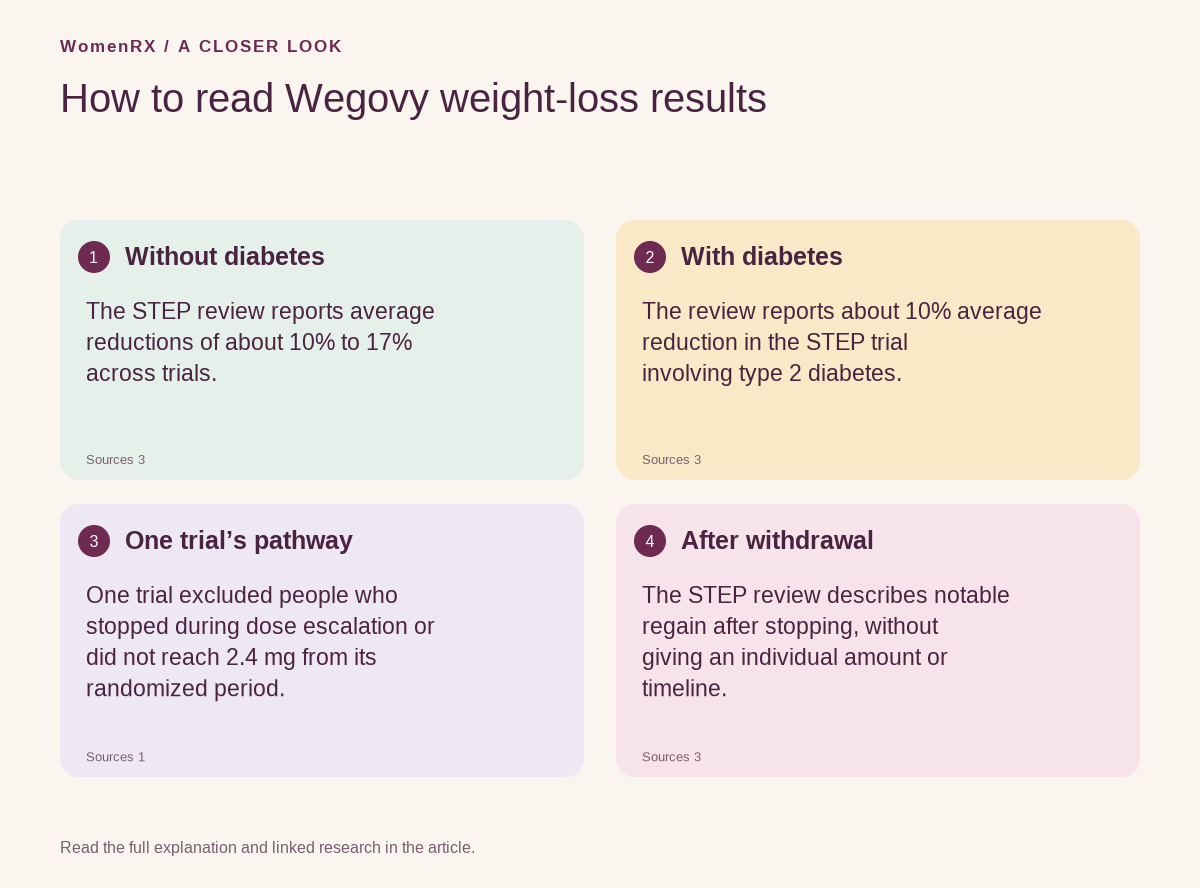
How to read Wegovy weight-loss results
Without diabetes: The STEP review reports average reductions of about 10% to 17% across trials.3
With diabetes: The review reports about 10% average reduction in the STEP trial involving type 2 diabetes.3
One trial’s pathway: One trial excluded people who stopped during dose escalation or did not reach 2.4 mg from its randomized period.1
After withdrawal: The STEP review describes notable regain after stopping, without giving an individual amount or timeline.3
Read the figure as text
These findings describe groups under specific study conditions. Each one answers a different question and should not be read as a personal forecast.- Without diabetes: The STEP review reports average reductions of about 10% to 17% across trials.3
- With diabetes: The review reports about 10% average reduction in the STEP trial involving type 2 diabetes.3
- One trial’s pathway: One trial excluded people who stopped during dose escalation or did not reach 2.4 mg from its randomized period.1
- After withdrawal: The STEP review describes notable regain after stopping, without giving an individual amount or timeline.3
More questions, answered
Does the average mean everyone loses at least that much?
No. An average describes the group as a whole; it isn’t a minimum or guarantee for each participant. 3
Is there a menopause-specific Wegovy weight-loss estimate?
The STEP review’s reported results don’t provide a separate estimate for perimenopausal or postmenopausal people. 3
Sources you can check
- WEGOVY (SEMAGLUTIDE) INJECTION, SOLUTION WEGOVY (SEMAGLUTIDE) TABLET [NOVO NORDISK PHARMACEUTICAL INDUSTRIES, LP] | US prescribing information and patient instructionsAccessed 2026-09-25Return to first citation
- Effects of subcutaneous semaglutide on weight loss and inflammatory markers in adults with overweight or obesity without diabetes: a systematic review and meta-analysis.Milluzzo A, Oteri V, Manuella L, Pulvirenti A, Frittitta L. · International journal of obesity (2005) · 2026Return to first citation
- Semaglutide in obesity and type 2 diabetes: A review of clinical trial evidence from 1 to 5 semaglutide treatment effect in people with obesity program.Khanna A, Kumar V, Gola S. · Indian journal of pharmacology · 2026Return to first citation