Semaglutide Before and After: Read the Changes, Not Just the Photos
A useful before-and-after comparison needs a time point, treatment context, and more than a number on the scale.
Semaglutide changes are best interpreted as a trend, not a dramatic photo or one weigh-in. Ask how long someone was followed, whether treatment was continuing, and which outcomes were measured. Weight can’t distinguish fat from muscle or water, so waist size, body composition, strength, and relevant health markers may add context. These findings don’t establish separate expectations by sex or reproductive stage. 1 2 4
A photo can show how someone looked at two moments. It can’t show how typical the change is, what else changed, or whether semaglutide caused it. To make sense of a result, look for the time frame, the treatment conditions, and the measures behind the headline.
Start with the study’s clock
A result after a few months and one after a year answer different questions. In several adult weight-management trials described in U.S. prescribing information, participants were followed to week 68. Some studies included a dose-escalation period followed by maintenance treatment; the exact study designs varied. Those results belong to that timeframe and treatment context, not to a guaranteed personal timeline. 1
When you see a post, ask: How long after starting treatment was the “after” image taken? Was the person still taking the medicine? Was the comparison made under similar conditions? If those details aren’t given, the image is a personal snapshot, not a reliable forecast.
A lower weight doesn’t tell you what changed
Body weight includes fat, muscle, bone, and water. The scale can track a change in total weight, but it can’t identify which parts of the body account for it. BMI has a similar limitation: it doesn’t distinguish fat from muscle or bone. 2
That distinction matters when reading semaglutide research. In a small, single-center retrospective study of adults with obesity and without diabetes, researchers assessed body composition using bioelectrical impedance, alongside weight, waist circumference, and handgrip strength. Over 12 months, the semaglutide group had reductions in weight, waist size, fat mass, and measures of lean tissue. Absolute handgrip strength was preserved in both the semaglutide and lifestyle groups. Because this was an observational study, it shows what was associated with treatment in that setting, not what every person should expect. 4
A different 12-month observational study followed 70 people with obesity and type 1 diabetes. It included people using GLP-1 medicines alone as well as people using a dual-action medicine, and it used DEXA to measure body composition. Fat and lean mass both decreased in the overall group. Those mixed treatments and that specific population make the findings useful context, not a semaglutide-only prediction for women without type 1 diabetes. 3
Choose measures that answer the health question
A useful comparison can include more than weight: for example, waist circumference, body composition, strength, or a health marker relevant to the person’s medical history. These measures describe different things, so they shouldn’t be treated as interchangeable. In the 12-month observational study of adults without diabetes, waist, body composition, and grip strength were assessed alongside weight. 4
Some markers apply only to particular health situations. For example, HbA1c was measured in the study of people with type 1 diabetes, but its findings shouldn’t be assumed to describe people who don’t have diabetes or to predict an individual result. 3
Even a more detailed measurement needs context. The two body-composition studies above used different assessment methods, and one focused on people with type 1 diabetes while the other excluded people with diabetes. A number from one study can’t automatically be compared with a number from the other. 3 4
A four-question check for before-and-after claims
When you encounter a dramatic result, look for four details:
- When was the “after” measured? A result needs a clear follow-up time.
- Was treatment ongoing? The treatment context is part of the result.
- What changed besides weight? Check whether waist, body composition, strength, or relevant health markers were measured.
- Who was studied? A result from a specific group may not apply to a different health situation.
If a post gives only a photo and a number, you don’t have enough information to judge whether the result is typical or what kind of change it represents.
What the evidence says about women
These findings don’t establish separate expected weight or body-composition trajectories for women. One observational study adjusted analyses for sex but did not report separate results by sex; the other study descriptions also don’t provide outcomes by menstrual or menopause stage. That means it would be misleading to promise a different timeline for cycling, perimenopausal, or postmenopausal women based on these findings. 3 4
The most grounded way to read a semaglutide before-and-after story is to treat it as one person’s result until you know its timeframe, treatment context, and measured outcomes. The scale may be part of the picture, but it isn’t the whole picture.
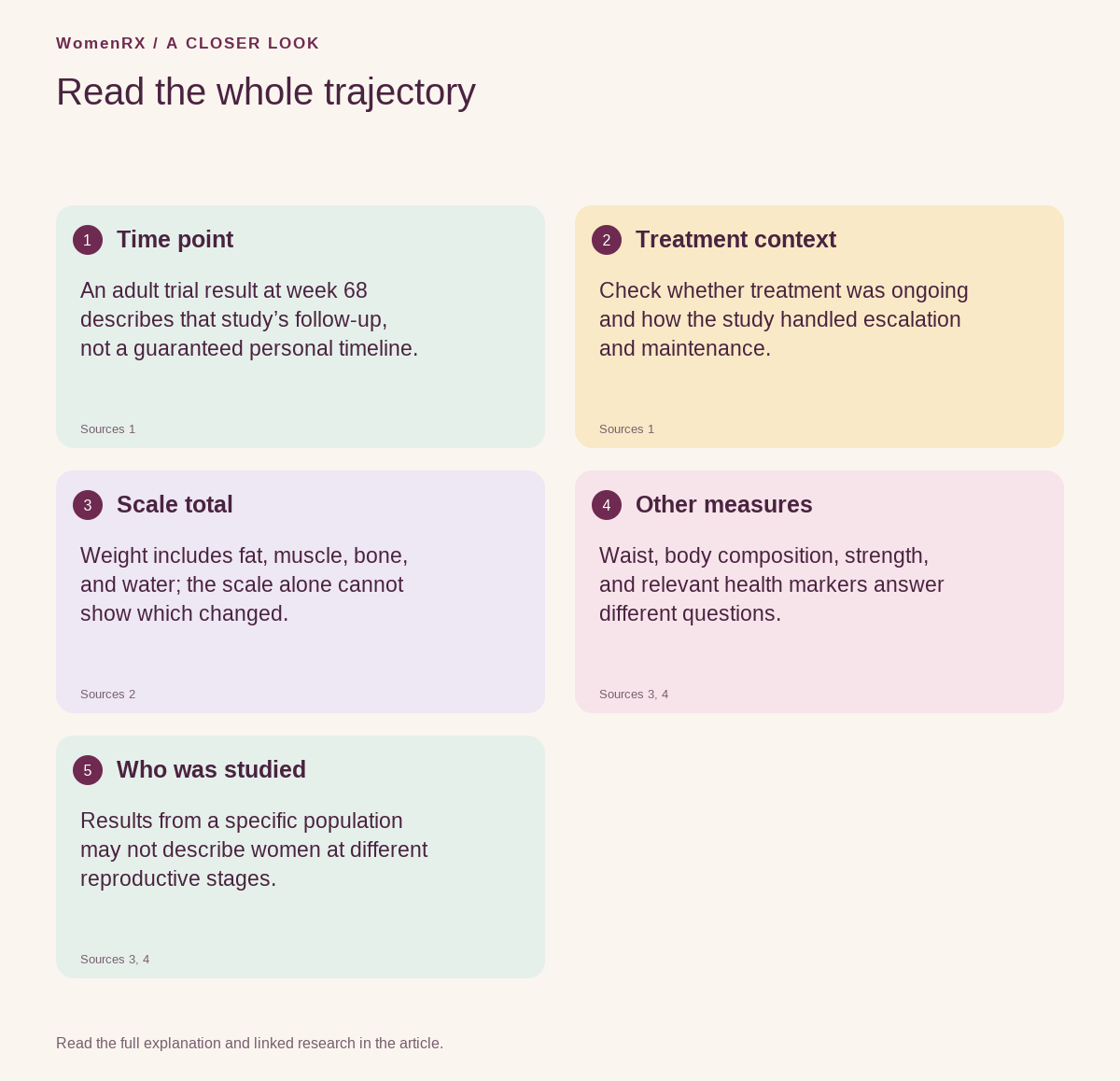
Read the whole trajectory
Time point: An adult trial result at week 68 describes that study’s follow-up, not a guaranteed personal timeline.1
Treatment context: Check whether treatment was ongoing and how the study handled escalation and maintenance.1
Scale total: Weight includes fat, muscle, bone, and water; the scale alone cannot show which changed.2
Other measures: Waist, body composition, strength, and relevant health markers answer different questions.34
Who was studied: Results from a specific population may not describe women at different reproductive stages.34
Read the figure as text
Before treating a before-and-after as a useful comparison, check its timeframe, treatment context, and the outcomes actually measured.- Time point: An adult trial result at week 68 describes that study’s follow-up, not a guaranteed personal timeline.1
- Treatment context: Check whether treatment was ongoing and how the study handled escalation and maintenance.1
- Scale total: Weight includes fat, muscle, bone, and water; the scale alone cannot show which changed.2
- Other measures: Waist, body composition, strength, and relevant health markers answer different questions.34
- Who was studied: Results from a specific population may not describe women at different reproductive stages.34
Sources you can check
- WEGOVY (SEMAGLUTIDE) INJECTION, SOLUTION WEGOVY (SEMAGLUTIDE) TABLET [NOVO NORDISK PHARMACEUTICAL INDUSTRIES, LP] | US prescribing information and patient instructionsAccessed 2026-09-25Return to first citation
- Body Weight: MedlinePlusAccessed 2026-09-25Return to first citation
- Weight Loss-Dependent Changes in Body Composition and Bone Health in People With Obesity and Type 1 Diabetes Treated With Liraglutide, Semaglutide, or Tirzepatide.Al Ozairi E, Irshad M, Alkandri J, Mashankar A, Gray SR, le Roux CW. · Diabetes/metabolism research and reviews · 2026Return to first citation
- Longitudinal Changes in Body Composition, Adaptive Thermogenesis and Muscle Strength in Patients with Obesity Treated with Semaglutide.Filippi-Arriaga F, Comas M, Prats A, Juan A, Vidal E, Costa P, Flores V, Oliver-Vila C, Fidilio E, Ciudin A. · Obesity facts · 2026Return to first citation