Wegovy Before-and-After Photos: What to Check
A photo can show a change in appearance, but it can’t tell you how much weight someone lost, what else changed, or whether their experience is typical.
Treat a Wegovy before-and-after post as one person’s story, not a forecast. Look for how long they took semaglutide, what dose they reached, their starting context, other treatments, and whether they stayed on treatment through follow-up. Real-world studies show weight loss varies, and some include only people who continued treatment, so ask who is missing from the picture. 3 4
Start with what the image can’t show
A side-by-side photo may look compelling, but it doesn’t tell you the person’s weight change, how long it took, or what else happened during that time. Body weight includes muscle, bone, fat, and water, and a number on the scale doesn’t tell the whole story either. 1
That makes photos useful as personal accounts, not as a way to predict your own result. Before you compare yourself with someone online, see whether their post gives enough context to interpret the change.
Use five checks before you compare
1. How long were they taking it? A post without a timeline leaves out a major part of the story. In one real-world study, researchers assessed outcomes after at least 12 months of weekly semaglutide use. Another followed an obesity cohort at different points across the first year. Those results can’t be compared fairly with a photo that gives no timeframe. 3 4
2. What product and dose are they talking about? “Semaglutide” doesn’t always mean the same treatment context. For example, a study of people with type 2 diabetes compared injectable Ozempic with dulaglutide, while a separate obesity study looked at semaglutide in people without diabetes. Don’t treat a result from one group or treatment context as a guaranteed Wegovy outcome for another. 2 4
A post that says only “I’m on semaglutide” may not give enough detail to know what it represents. If the dose reached is missing, that’s another piece of context you can’t use to compare outcomes. Don’t assume that a person’s dose or treatment course matches yours.
3. What was their starting context? Ask whether the post says anything about starting weight, health conditions, or other weight-management treatments. In a real-world obesity clinic study, 163 of 294 people prescribed semaglutide continued it for at least 12 months. Among those 163, mean weight loss was 8.1% of starting weight, with wide variation (standard deviation 8.3%). The result describes those who remained on treatment, not everyone who was prescribed it. 3
4. Were other treatments or changes involved? If the person also used another medication, had a procedure, or made other changes, the photo can’t show which change contributed what. One real-world obesity study reported that some participants switched from prior liraglutide treatment, and that a substantial number stopped semaglutide during the first year. That makes treatment history and follow-up worth checking, rather than assuming the image isolates one cause. 4
5. What happened after the photo? A post usually captures a moment, not whether the person maintained the change or continued treatment. In the obesity cohort above, 103 of 211 people who started semaglutide discontinued within the first year. That doesn’t mean the same will happen to you; it does show why a photo from someone still posting results may not represent everyone’s experience. 4
Read the numbers behind a testimonial carefully
Percent weight change is often more useful than a photo for understanding a study result, but it still needs context: the population, the time point, and who was counted. For instance, in one real-world study of adults with overweight or obesity who did not have diabetes, 248 people were included and 77.5% were women. The researchers reported no significant differences in weight outcomes by sex or starting BMI category. That finding is reassuring as a group comparison, but it doesn’t predict an individual woman’s result or tell us how outcomes differ at specific life stages. 4
A different study followed people with obesity in a single multidisciplinary clinic. Its 12-month average came from the 163 people who continued treatment that long, and the large spread around the average signals that experiences differed. Neither study makes a social-media photo a reliable forecast. They give a better frame for asking who was studied and who is represented in the result. 3 4
Keep life stage in the comparison
Pregnancy, postpartum recovery, and menopause can be part of the context around a person’s weight history. If a post leaves out whether the photos span one of these life stages, you can’t make a like-for-like comparison with that person’s story. And appearance alone can’t establish that Wegovy caused a change, or separate the medication’s role from other changes over the same period.
The most useful takeaway isn’t whether your progress matches someone else’s image. It’s whether the post gives enough information to understand what happened, for whom, and over what period. If it doesn’t, let it remain an anecdote rather than a benchmark.
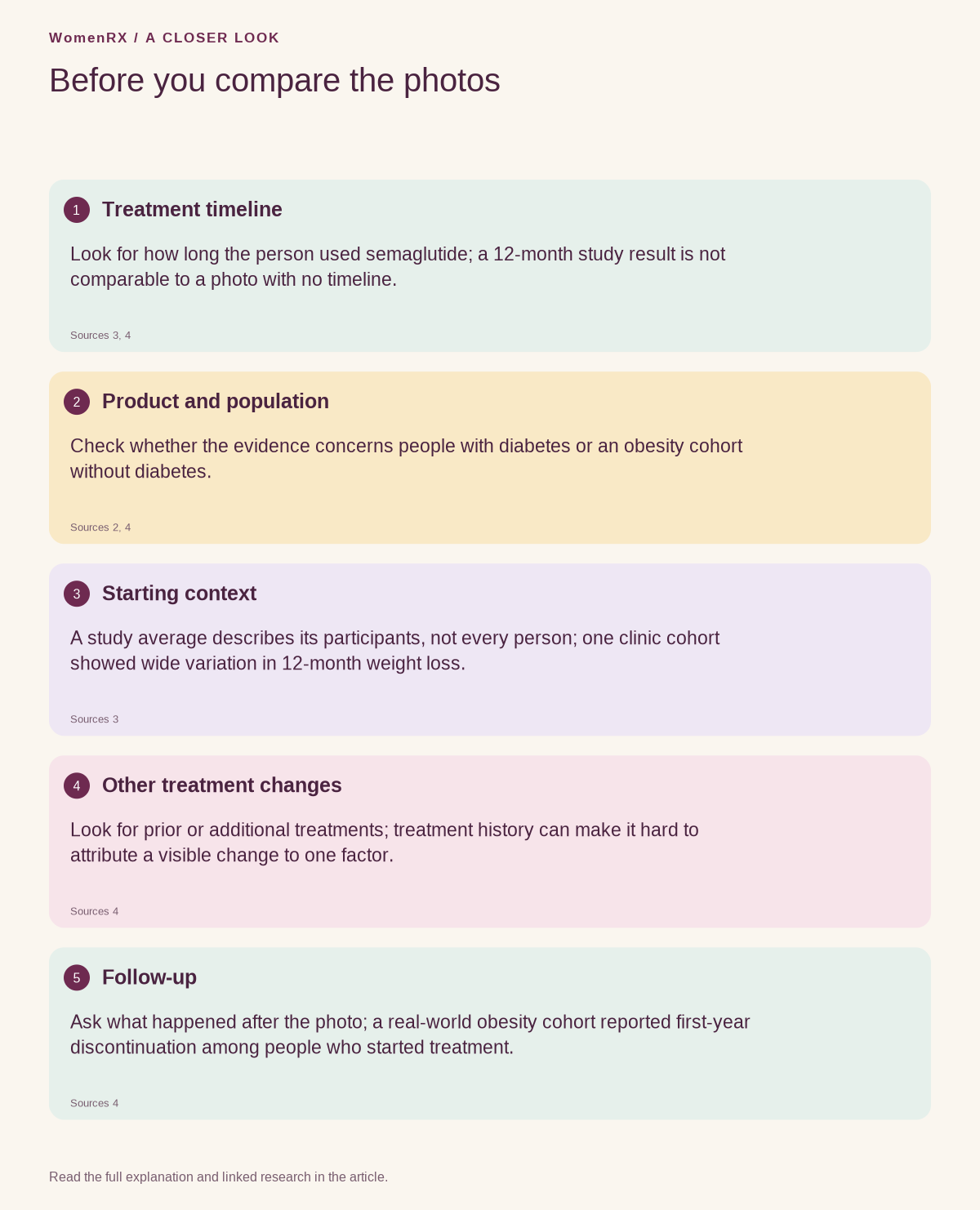
Before you compare the photos
Treatment timeline: Look for how long the person used semaglutide; a 12-month study result is not comparable to a photo with no timeline.34
Product and population: Check whether the evidence concerns people with diabetes or an obesity cohort without diabetes.24
Starting context: A study average describes its participants, not every person; one clinic cohort showed wide variation in 12-month weight loss.3
Other treatment changes: Look for prior or additional treatments; treatment history can make it hard to attribute a visible change to one factor.4
Follow-up: Ask what happened after the photo; a real-world obesity cohort reported first-year discontinuation among people who started treatment.4
Read the figure as text
Check whether a before-and-after story includes enough context to interpret the change rather than treat it as a forecast.- Treatment timeline: Look for how long the person used semaglutide; a 12-month study result is not comparable to a photo with no timeline.34
- Product and population: Check whether the evidence concerns people with diabetes or an obesity cohort without diabetes.24
- Starting context: A study average describes its participants, not every person; one clinic cohort showed wide variation in 12-month weight loss.3
- Other treatment changes: Look for prior or additional treatments; treatment history can make it hard to attribute a visible change to one factor.4
- Follow-up: Ask what happened after the photo; a real-world obesity cohort reported first-year discontinuation among people who started treatment.4
More questions, answered
Is a real-world semaglutide result the same as a Wegovy result?
Not automatically. Real-world studies may include different groups and treatment contexts. For example, one study examined people with type 2 diabetes using injectable semaglutide, while another studied people with overweight or obesity without diabetes. Check the population and treatment details before comparing a result with a Wegovy post. 2 4
Does the average in a study tell me what I’ll lose?
No. An average describes a group, not an individual. In one obesity-clinic study, the average among people who continued semaglutide for at least 12 months came with substantial variation. Your circumstances may differ from the people included. 3
Sources you can check
- Body Weight: MedlinePlusAccessed 2026-09-25Return to first citation
- Real-world weight loss with injectable semaglutide vs dulaglutide for diabetes.Spitery A, Lobkovich A, Thomas E. · The American journal of managed care · 2026Return to first citation
- Diabetic Status, Advanced Age, and Hispanic Ethnicity Predict Poorer Weight Loss in Patients With Obesity Receiving Semaglutide.Cornet NC, Buckholz AP, Yeung M, Kumar S, Rogers L, Magahis PT, Sharaiha RZ, Krisko TI, Fortune BE, Newberry CA. · Endocrine practice : official journal of the American College of Endocrinology and the American Association of Clinical Endocrinologists · 2026Return to first citation
- Real-world semaglutide in obesity cohort: effectiveness, safety and persistence across sex, BMI, and prior GLP-1RA treatment.Milani I, Parrotta ME, Chinucci M, Franzò E, Gintoli E, Franco F, Sbraccia P, Guglielmi V, Capoccia D. · Frontiers in endocrinology · 2026Return to first citation