Wegovy Reviews: What Patient Stories Can Tell You
Reviews can help you name questions about daily life on Wegovy, but they can’t show how common an experience is or predict your own.
A Wegovy review is one person’s account, not a reliable estimate of typical weight loss, side effects, or quality-of-life changes. For a clearer picture, check what outcome was measured, how long people were followed, and whether results were compared with placebo. In research, semaglutide improved some patient-reported measures on average, but the average change in physical function was modest. 3

Online reviews can make treatment feel more tangible: a person may describe what changed in her appetite, routine, or sense of well-being. Those details can help you decide what you want to ask about. But a story, even a vivid and sincere one, can’t tell you how often an experience happens or whether Wegovy caused it.
A useful way to read reviews is to treat them as prompts, then look for research that measures the same outcome in a defined group over a stated period.
Start with the claim, not the star rating
Pull out the specific claim. Is the reviewer describing weight change, a digestive symptom, energy, mood, physical function, or the ease of fitting treatment into daily life? Those are different outcomes, and a study measuring one may not answer another.
Then ask what would make the claim informative: How long was the person taking semaglutide? Was there a comparison group? Was the outcome measured in a consistent way, or recalled later? A review usually doesn’t provide the denominator you’d need to estimate frequency, such as how many people had the same experience among everyone who started treatment. People who choose to post may not represent people who don’t post, so a collection of reviews shouldn’t be read as a typical-results report.
What patient-reported research adds
A systematic review and meta-analysis of four randomized STEP trials, including 4,182 adults with overweight or obesity, found that semaglutide improved average physical-function scores on the SF-36v2 compared with placebo. The mean difference was 1.71 points, with a 95% confidence interval of 1.07 to 2.35. That was below the review’s cited 3.7-point threshold for a meaningful change within an individual. In other words, an average improvement in a trial does not mean every participant noticed a meaningful difference. 3
The same review included quality-of-life results from two trials with 2,768 participants. Effects on the weight-related quality-of-life measure were below published thresholds for meaningful change, and the review described effects as smaller among participants with type 2 diabetes than among those without it. These findings can help set expectations, but they don’t predict an individual’s experience. 3
Patient reports can also be measured in ways that are narrower than a general online review. For example, a 15-week randomized crossover study in adults with type 1 diabetes used questionnaires and interviews to examine semaglutide alongside automated insulin delivery. It included 23 questionnaire completers and 24 interview participants. The questionnaire difference reported was increased gastrointestinal symptom frequency and severity with semaglutide; the study population and treatment context are not the same as a general Wegovy weight-management population. 2
That distinction matters: a study can offer a more structured comparison than testimonials, yet still answer only a specific question in a specific group.
Check the time frame and the comparison
A review that says “it worked” may not tell you whether the change lasted, when it happened, or what else changed during that period. Look for the follow-up duration and the comparison. Randomized trials can estimate average differences between treatment and placebo within the studied population; a single review cannot make that comparison. Longer follow-up also answers a different question from a brief account.
Side-effect stories need the same care. The US prescribing information warns that nausea, vomiting, or diarrhea can contribute to dehydration and kidney problems, and advises attention to symptoms that don’t go away. That establishes a safety concern to take seriously; it doesn’t tell you how likely a particular reviewer’s experience is. 1
If a post mentions severe or persistent stomach problems, it may be a useful prompt to ask what symptoms need attention and what to do if they occur. Don’t use the number of posts you find to estimate your personal risk.
Look for women’s data, not just women’s stories
A review written by a woman is not, by itself, evidence that women respond differently. The patient-reported meta-analysis above pooled adult trial results, but the findings summarized here don’t provide sex-specific estimates. They therefore can’t establish whether women’s average quality-of-life or physical-function changes differ from men’s. 3
Pregnancy and menopause are also distinct contexts, not interchangeable labels for “women’s experience.” The findings discussed here don’t provide separate patient-reported results for pregnancy or menopause, so a testimonial from one of those contexts can raise a question but cannot establish a different treatment effect.
A quick way to use a review
When a story catches your attention, write down the concrete question behind it: “How often does this happen?”, “Was this measured in a trial?”, or “Does the evidence apply to someone with my health context?” Then check whether the research matches the outcome, population, and follow-up you care about. Reviews can help you decide what to ask; structured studies are better suited to estimating averages and comparing outcomes.
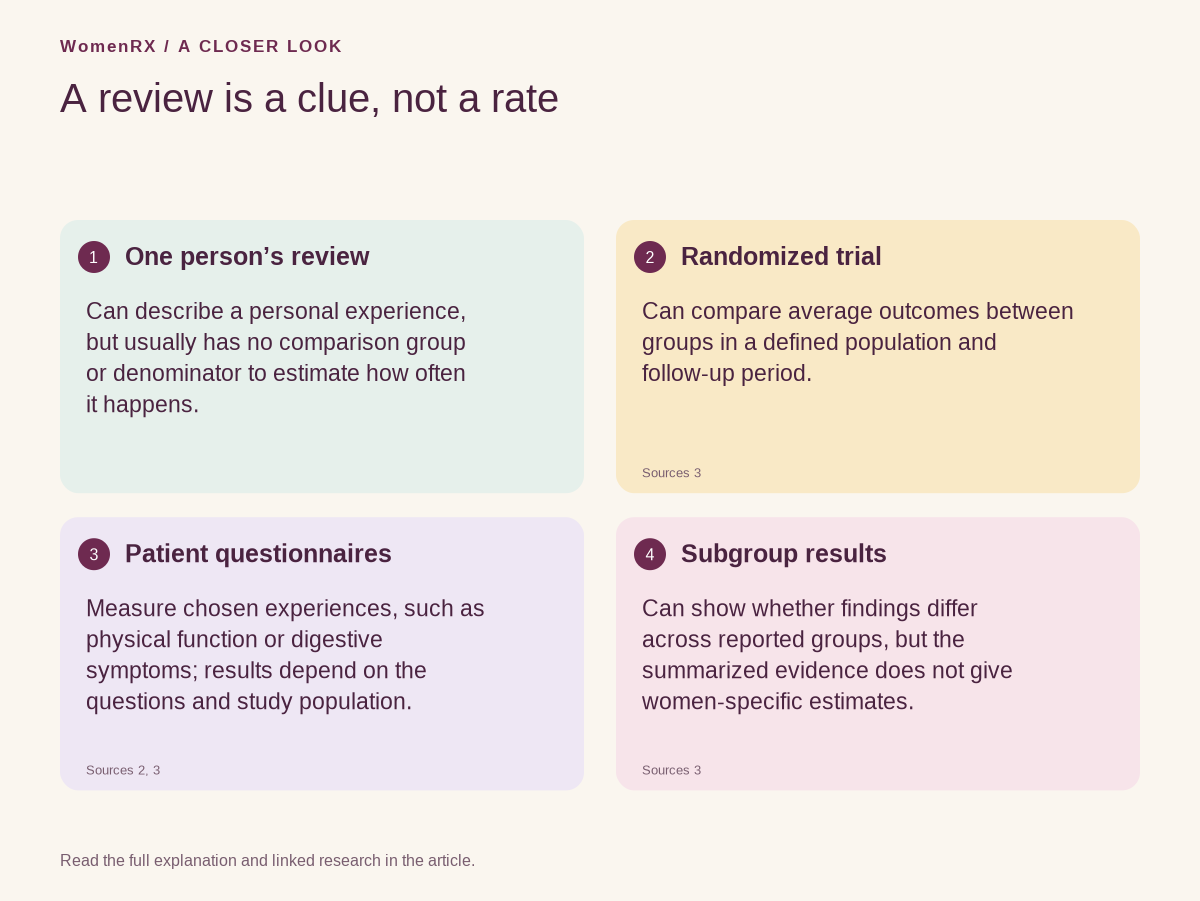
A review is a clue, not a rate
One person’s review: Can describe a personal experience, but usually has no comparison group or denominator to estimate how often it happens.
Randomized trial: Can compare average outcomes between groups in a defined population and follow-up period.3
Patient questionnaires: Measure chosen experiences, such as physical function or digestive symptoms; results depend on the questions and study population.23
Subgroup results: Can show whether findings differ across reported groups, but the summarized evidence does not give women-specific estimates.3
Read the figure as text
These evidence types answer different questions, from what one person experienced to how an average outcome compares under study conditions.- One person’s review: Can describe a personal experience, but usually has no comparison group or denominator to estimate how often it happens.
- Randomized trial: Can compare average outcomes between groups in a defined population and follow-up period.3
- Patient questionnaires: Measure chosen experiences, such as physical function or digestive symptoms; results depend on the questions and study population.23
- Subgroup results: Can show whether findings differ across reported groups, but the summarized evidence does not give women-specific estimates.3
Sources you can check
- WEGOVY (SEMAGLUTIDE) INJECTION, SOLUTION WEGOVY (SEMAGLUTIDE) TABLET [NOVO NORDISK PHARMACEUTICAL INDUSTRIES, LP] | US prescribing information and patient instructionsAccessed 2026-09-25Return to first citation
- Semaglutide Use With Automated Insulin Delivery in Adults With Type 1 Diabetes: Qualitative Analyses and Patient-reported Outcomes From a Randomized Controlled Trial.Pasqua MR, Doumat J, Tsoukas MA, Haidar A. · Canadian journal of diabetes · 2026Return to first citation
- The Effect of Semaglutide on Quality of Life in Adults With Overweight or Obesity: A Brief Systematic Review and Meta-Analysis.Eisa N, Khoury M. · Diabetes, obesity & metabolism · 2026Return to first citation