Hormonal IUD Reviews: What Stories Can Tell You
A personal review can help you picture one person’s experience, but it can’t tell you how likely that experience is to be yours.
Use hormonal IUD reviews to find questions worth asking about insertion, bleeding, and follow-up, not to predict your outcome. The device, reason for use, and timing matter: a study of immediate postpartum insertions, for example, describes a different situation from routine contraception. Clinical studies can estimate outcomes in defined groups, but they don’t make one person’s story a forecast for you. 3

Treat a review as a story, not a rate
A review can be useful for details a study may not capture well: what someone found uncomfortable, what they wished they’d known, or how an unexpected change affected daily life. But one person’s account has no comparison group and doesn’t tell you how common that experience is. A string of reviews is still not a reliable estimate of how often an outcome happens unless you know who was asked, how they were selected, and how outcomes were recorded.
Try asking: What does this story help me ask about? rather than Will this happen to me? For example, if a review mentions a difficult insertion, it may prompt you to ask what comfort measures or support are available. It doesn’t establish the typical insertion experience or predict your pain.
Check whether the story matches your situation
Before comparing experiences, look for four pieces of context:
- Which device? Hormonal IUDs are not all the same product. For example, Mirena’s US prescribing information describes a 52 mg levonorgestrel device, while Kyleena’s describes a 19.5 mg device. That difference identifies the product; it does not, by itself, show which will suit you better or predict your experience. 12
- Why was it used? Someone choosing an IUD for contraception may judge success differently from someone using it for heavy bleeding or after endometriosis surgery. Those are different goals, and evidence about one goal should not stand in for another. 56
- When was it inserted? Immediate insertion after childbirth is a distinct setting from insertion later. In a retrospective Australian cohort of immediate postpartum insertions, outcomes differed between insertion at cesarean birth and after vaginal birth. Those results describe that cohort, not all IUD users or all postpartum care. 3
- What outcome and follow-up are being described? “Satisfied,” “still using it,” and “would choose it again” are not interchangeable. A brief follow-up and a longer one can answer different questions.
Age, parity, bleeding history, and postpartum timing may be relevant context to discuss, but a review usually can’t show that one of those factors caused someone’s experience or predict what it means for you.
What clinical evidence adds
A study can define who took part, what device or situation it examined, and how an outcome was measured. That makes it more useful than an anecdote for understanding a group, though a result still may not apply to people outside that group.
For example, a 2025 randomized trial at one Belgian hospital compared virtual-reality distraction with standard care during levonorgestrel IUD insertion. It found no evidence of a difference in reported overall experience or pain between the groups. That is a result about this particular comparison, not a universal estimate of insertion pain or proof that every comfort approach works or fails. 4
A different study followed 143 people who had immediate postpartum hormonal IUD insertion at one Australian maternity service. At 12 months, continuation was 54.4% after cesarean insertion and 39.1% after vaginal-birth insertion; reported expulsion was 10.1% and 34.1%, respectively. These figures belong to that retrospective cohort and its postpartum setting. They should not be used as general rates for people getting an IUD at another time. 3
The reason for use matters, too. A small retrospective study of 27 women treated for abnormal uterine bleeding reported high satisfaction, but its size, setting, and specific treatment population make it a poor benchmark for someone choosing an IUD for contraception. 6 For endometriosis after surgery, a Cochrane review found only four trials with 157 women and rated the evidence on satisfaction very low certainty. That uncertainty is a reason not to treat confident-sounding stories as a settled answer about that use. 5
Turn a story into a useful question
If a review catches your attention, try translating it into a question that fits your own decision:
- Insertion: What should I expect at the appointment, and what options are available if I’m worried about discomfort?
- Bleeding: What changes might matter for the reason I’m considering the IUD, and what follow-up would make sense if bleeding concerns me?
- Fit: Which specific device and purpose is the person describing, and does that match the option being discussed with me?
- Follow-up: How long after insertion was the review written, and is the person describing satisfaction, continued use, or a particular symptom?
The most useful review is not necessarily the happiest or most alarming one. It’s the one that helps you name a concern clearly. Then you can ask about that concern in the context of the specific device, your reason for considering it, and the timing of insertion.
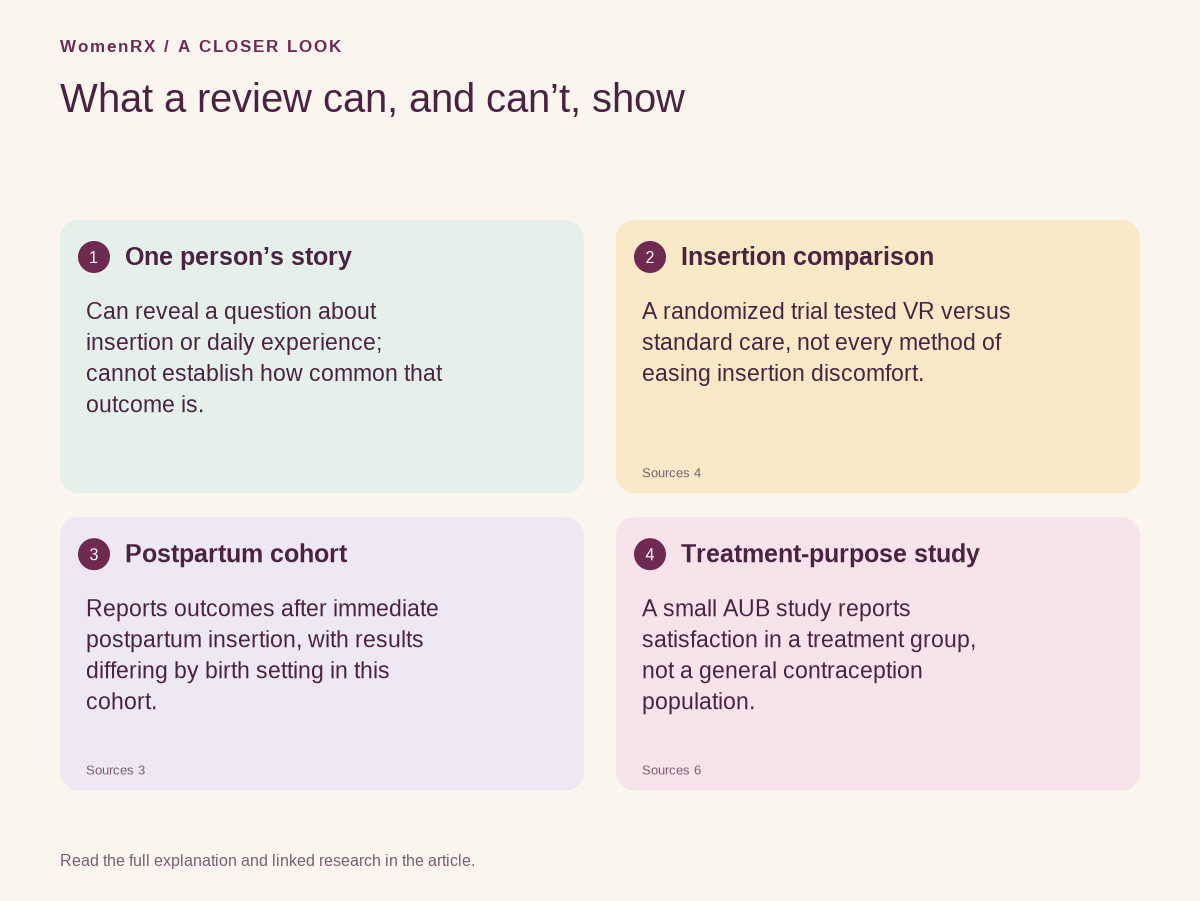
What a review can, and can’t, show
One person’s story: Can reveal a question about insertion or daily experience; cannot establish how common that outcome is.
Insertion comparison: A randomized trial tested VR versus standard care, not every method of easing insertion discomfort.4
Postpartum cohort: Reports outcomes after immediate postpartum insertion, with results differing by birth setting in this cohort.3
Treatment-purpose study: A small AUB study reports satisfaction in a treatment group, not a general contraception population.6
Read the figure as text
Use a story to identify a concern; use a study of a clearly described group to understand a measured outcome.- One person’s story: Can reveal a question about insertion or daily experience; cannot establish how common that outcome is.
- Insertion comparison: A randomized trial tested VR versus standard care, not every method of easing insertion discomfort.4
- Postpartum cohort: Reports outcomes after immediate postpartum insertion, with results differing by birth setting in this cohort.3
- Treatment-purpose study: A small AUB study reports satisfaction in a treatment group, not a general contraception population.6
More questions, answered
Does a high satisfaction rate mean I’ll be satisfied too?
No. A satisfaction result describes the people in that study, with their reasons for use, setting, follow-up, and definition of satisfaction. For example, a small study of women treated for abnormal uterine bleeding is not a prediction for someone choosing an IUD for contraception. 6
Can I compare postpartum IUD reviews with other insertion stories?
Only with care. Immediate postpartum insertion is a distinct setting, and one retrospective cohort reported outcomes separately for insertion after cesarean and vaginal birth. Those findings don’t establish what to expect with insertion later or in a different group. 3
Sources you can check
- MIRENA (LEVONORGESTREL) INTRAUTERINE DEVICE [BAYER HEALTHCARE PHARMACEUTICALS INC.] | US prescribing information and patient instructionsAccessed 2026-09-25Return to first citation
- KYLEENA (LEVONORGESTREL) INTRAUTERINE DEVICE [BAYER HEALTHCARE PHARMACEUTICALS INC.] | US prescribing information and patient instructionsAccessed 2026-09-25Return to first citation
- Patient acceptability, continuation and complication rates with immediate postpartum levonorgestrel intrauterine device insertion at caesarean section and vaginal birth.Wojcik N, Watkins L, Nugent R. · The Australian & New Zealand journal of obstetrics & gynaecology · 2022Return to first citation
- Virtual reality simulation in reducing discomfort and pain during intrauterine device insertion: a randomized controlled trial.Dumont S, Page AS, Dewilde K, Ceusters J, Van Calster B, Froyman W, Timmerman D. · Contraception · 2025Return to first citation
- Levonorgestrel-releasing intrauterine device (LNG-IUD) for symptomatic endometriosis following surgery.Gibbons T, Georgiou EX, Cheong YC, Wise MR. · The Cochrane database of systematic reviews · 2021Return to first citation
- A Study of the Effect of the Levonorgestrel Intrauterine System on the Management of Abnormal Uterine Bleeding.Patil SS, Jadhav V, Pathak N. · Cureus · 2025Return to first citation