When a Hormonal IUD May Not Be Right for You
Pregnancy, certain infections, and some cancers can rule out placement, while other health concerns call for a closer look rather than an automatic no.
A levonorgestrel IUD should not be placed during known or suspected pregnancy, current pelvic inflammatory disease, or current purulent cervicitis, chlamydia, or gonorrhea. Mirena and Kyleena also rule out untreated acute cervicitis or vaginitis, and their labels contraindicate placement after postpartum endometritis or an infected abortion in the past three months. Current breast cancer rules out placement under CDC guidance, and the Mirena and Kyleena labels also contraindicate use after breast cancer. For past breast cancer with no evidence of disease for five years, CDC classifies a levonorgestrel IUD as category 3 rather than category 4. Unexplained uterine bleeding or a uterine cavity incompatible with placement can also rule out placement. Migraine, blood-pressure changes, and recent childbirth call for individual assessment instead. 126
A hormonal IUD releases levonorgestrel in the uterus. Deciding whether one fits your health history involves two different questions: Is there a reason not to place it now? And is there a concern worth weighing before you choose? The distinction matters. A treatable infection may delay placement; a condition that makes placement unsuitable may point you toward another contraceptive option. Mirena and Kyleena have product-specific instructions, while the CDC’s U.S. Medical Eligibility Criteria provides a broader framework for comparing methods. 126
Reasons to pause or choose another method
Pregnancy comes first. Neither Mirena nor Kyleena should be placed during a known or suspected pregnancy, and neither is intended for emergency contraception after sex. Placement can be considered when the clinician can be reasonably certain you are not pregnant. If recent sex or an uncertain period makes that difficult to establish, raise it before the appointment. 127
An active infection can change the plan. Current pelvic inflammatory disease (PID) rules out new IUD placement. So do current purulent cervicitis, chlamydia, or gonorrhea under CDC guidance. STI screening, however, can often happen at the placement visit without delaying it when there is no known infection. The Mirena and Kyleena labels also say not to place the device while acute cervicitis or vaginitis, including bacterial vaginosis, remains untreated. Tell the clinician about new lower-belly pain, unusual discharge, fever, or a known STI exposure so the right issue can be assessed first. A hormonal IUD does not protect against STIs. 12467
The uterus and bleeding history matter. A fibroid does not automatically rule out an IUD. The concern is a fibroid or other uterine difference that distorts the cavity enough to interfere with placement. Unexplained uterine bleeding also needs evaluation before a new Mirena or Kyleena is placed; heavy periods alone are not the same thing as unexplained bleeding. For example, if bleeding has newly started between periods or after menopause, identifying its cause matters before treating it as an expected period pattern. Known or suspected cancer of the uterus or cervix is another reason not to start with IUD placement. 1236
Some health histories point away from levonorgestrel. The Mirena and Kyleena labels rule out use with current or past breast cancer or another progestin-sensitive cancer, as well as acute liver disease or a liver tumor. CDC guidance classifies current breast cancer as category 4 for a levonorgestrel IUD, but past breast cancer with no evidence of disease for five years as category 3. That distinction does not change the Mirena or Kyleena labels; discuss the diagnosis and disease-free interval when considering options. 6 The labels also list allergy to a device component, certain conditions that increase susceptibility to pelvic infection, and an existing IUD that has not been removed. If one of these applies, the discussion is about the specific diagnosis and an appropriate alternative, not whether you have ever had children. 12
Precautions are not all prohibitions
A history of migraine or exceptionally severe headache, a marked rise in blood pressure, clotting problems or anticoagulant use, and severe arterial disease such as a prior stroke or heart attack call for careful assessment in the Mirena and Kyleena labels. They are listed as precautions, not grouped with the labels’ outright contraindications. Bring the details that make a difference, such as whether a migraine includes visual symptoms or whether you take an anticoagulant. 12
Past PID is one place where guidance needs a closer reading. The Mirena and Kyleena labels contraindicate use after PID unless there has been a subsequent intrauterine pregnancy. The CDC classifies past PID without a subsequent pregnancy differently from current PID: the former calls for weighing benefits and risks, while new placement with current PID is not recommended. If you have had PID, ask how your history and the specific device label affect your options rather than treating either a past infection or a past pregnancy as a shortcut to an answer. 126
Likewise, CDC guidance does not treat never having given birth as a reason, by itself, to rule out a levonorgestrel IUD. The Mirena patient information explicitly says it can be used whether or not you have given birth. The relevant question is whether placement is suitable for your body and health history now. 16
Pregnancy and postpartum are different decisions
Being currently pregnant rules out placement. Being postpartum does not. CDC guidance allows levonorgestrel IUD placement immediately after delivery or at a later postpartum visit when pregnancy can be excluded, but placement during postpartum sepsis is not recommended. Separately, the Mirena and Kyleena labels contraindicate placement if you have had postpartum endometritis or an infected abortion in the past three months. 12 A recent delivery and breastfeeding also affect the risk discussion: perforation risk is higher when placement occurs soon after birth or while breastfeeding, and expulsion is more common with immediate postpartum placement. 1267
That creates a real choice about timing, not a blanket warning against a postpartum IUD. In a randomized trial among participants who planned to breastfeed, breastfeeding continuation at eight weeks was similar with immediate versus delayed postpartum levonorgestrel IUD placement, while expulsions were more frequent in the immediate-placement group. Ask how the timing, the chance of expulsion, and the practicality of returning for a later visit fit together for you. 57
Five details worth bringing to the discussion
You do not need to diagnose yourself before asking about an IUD. These details help separate a reason to delay placement from a precaution or a choice about timing:
- Pregnancy possibility: your recent period and whether pregnancy could have begun since it. 127
- Infection or bleeding: current symptoms, a known STI, past PID, or bleeding that has not been explained. 1267
- Relevant diagnoses: current or past breast cancer and when it was active, uterine cancer, liver disease or a liver tumor, and any known uterine-cavity change such as a fibroid. 12
- Conditions and medicines: migraine symptoms, blood-pressure changes, clotting problems, anticoagulant use, or a history of stroke or heart attack. 12
- Recent pregnancy: when you gave birth or had a pregnancy end, whether you had postpartum endometritis or an infected abortion in the past three months, and whether you are breastfeeding. 1267
The most useful question is specific: “Is this a reason I cannot have this IUD, a reason to wait, or something we can weigh alongside my other options?”
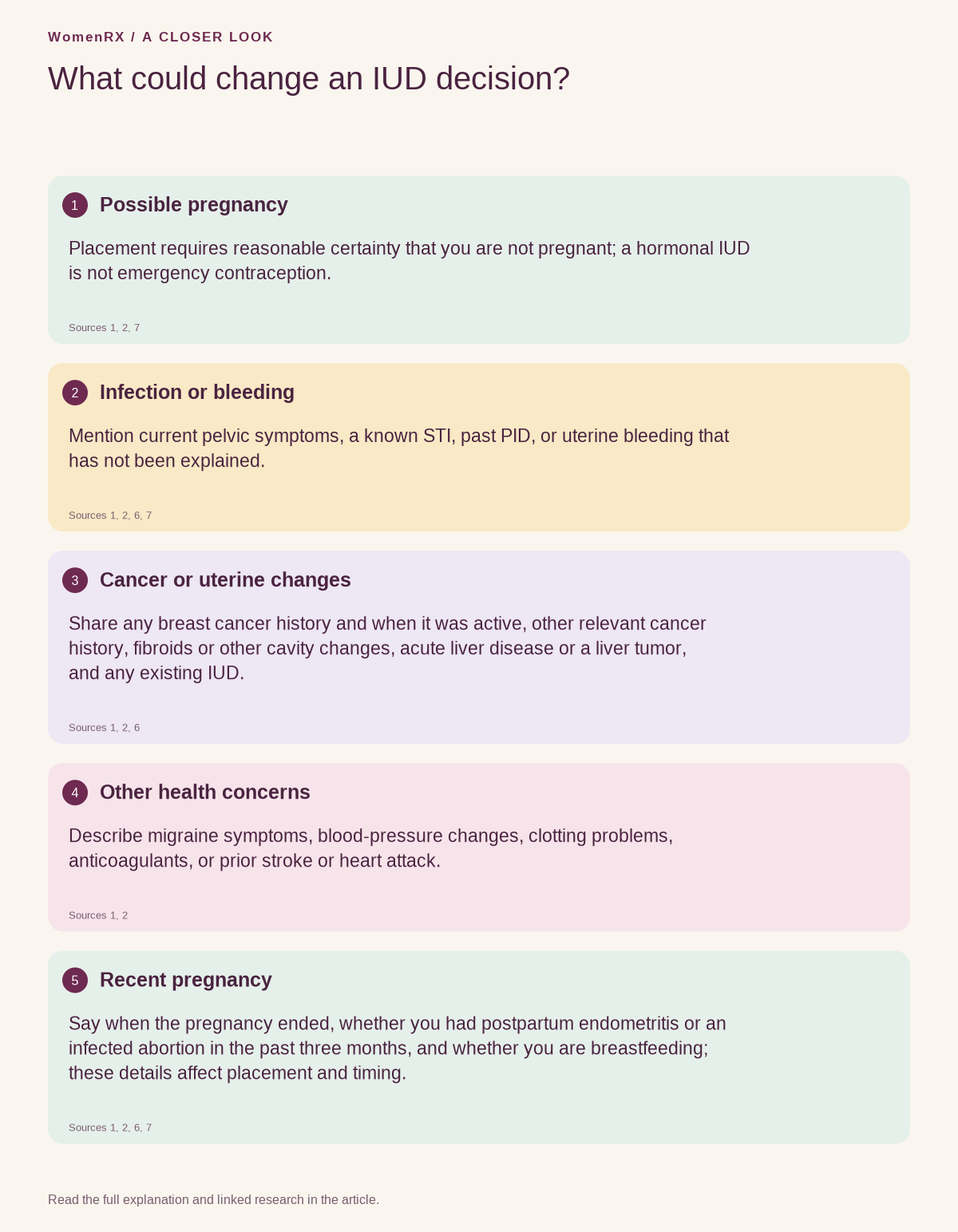
What could change an IUD decision?
Possible pregnancy: Placement requires reasonable certainty that you are not pregnant; a hormonal IUD is not emergency contraception.127
Infection or bleeding: Mention current pelvic symptoms, a known STI, past PID, or uterine bleeding that has not been explained.1267
Cancer or uterine changes: Share any breast cancer history and when it was active, other relevant cancer history, fibroids or other cavity changes, acute liver disease or a liver tumor, and any existing IUD.126
Other health concerns: Describe migraine symptoms, blood-pressure changes, clotting problems, anticoagulants, or prior stroke or heart attack.12
Recent pregnancy: Say when the pregnancy ended, whether you had postpartum endometritis or an infected abortion in the past three months, and whether you are breastfeeding; these details affect placement and timing.1267
Read the figure as text
These five topics help distinguish a placement barrier, a reason to wait, and a precaution to weigh.- Possible pregnancy: Placement requires reasonable certainty that you are not pregnant; a hormonal IUD is not emergency contraception.127
- Infection or bleeding: Mention current pelvic symptoms, a known STI, past PID, or uterine bleeding that has not been explained.1267
- Cancer or uterine changes: Share any breast cancer history and when it was active, other relevant cancer history, fibroids or other cavity changes, acute liver disease or a liver tumor, and any existing IUD.126
- Other health concerns: Describe migraine symptoms, blood-pressure changes, clotting problems, anticoagulants, or prior stroke or heart attack.12
- Recent pregnancy: Say when the pregnancy ended, whether you had postpartum endometritis or an infected abortion in the past three months, and whether you are breastfeeding; these details affect placement and timing.1267
More questions, answered
Does having fibroids rule out a hormonal IUD?
Not necessarily. The key distinction is whether a fibroid distorts the uterine cavity in a way that interferes with IUD placement. The CDC classifies fibroids separately from a cavity distortion that is incompatible with placement. 126
Do I need STI test results before my IUD appointment?
Not always. If screening is due, CDC guidance says it can usually be done at the placement visit without a delay. Known current purulent cervicitis, chlamydia, or gonorrhea is different: an IUD should not be placed while that infection is present. 7
Sources you can check
- MIRENA (LEVONORGESTREL) INTRAUTERINE DEVICE [BAYER HEALTHCARE PHARMACEUTICALS INC.] | US prescribing information and patient instructionsAccessed 2026-09-25Return to first citation
- KYLEENA (LEVONORGESTREL) INTRAUTERINE DEVICE [BAYER HEALTHCARE PHARMACEUTICALS INC.] | US prescribing information and patient instructionsAccessed 2026-09-25Return to first citation
- Vaginal Bleeding | Uterine Fibroids | MedlinePlusAccessed 2026-09-25Return to first citation
- Pelvic Inflammatory Disease | PID | MedlinePlusAccessed 2026-09-25Return to first citation
- Immediate postpartum levonorgestrel intrauterine device insertion and breast-feeding outcomes: a noninferiority randomized controlled trial.Turok DK, Leeman L, Sanders JN, Thaxton L, Eggebroten JL, Yonke N, Bullock H, Singh R, Gawron LM, Espey E. · American journal of obstetrics and gynecology · 2017Return to first citation
- Appendix A: Summary of Classifications for U.S. Medical Eligibility Criteria for Contraceptive Use, 2024 | Contraception | CDCAccessed 2026-09-25Return to first citation
- CDC: Intrauterine contraception and copper IUD bleedingAccessed 2026-09-25Return to first citation